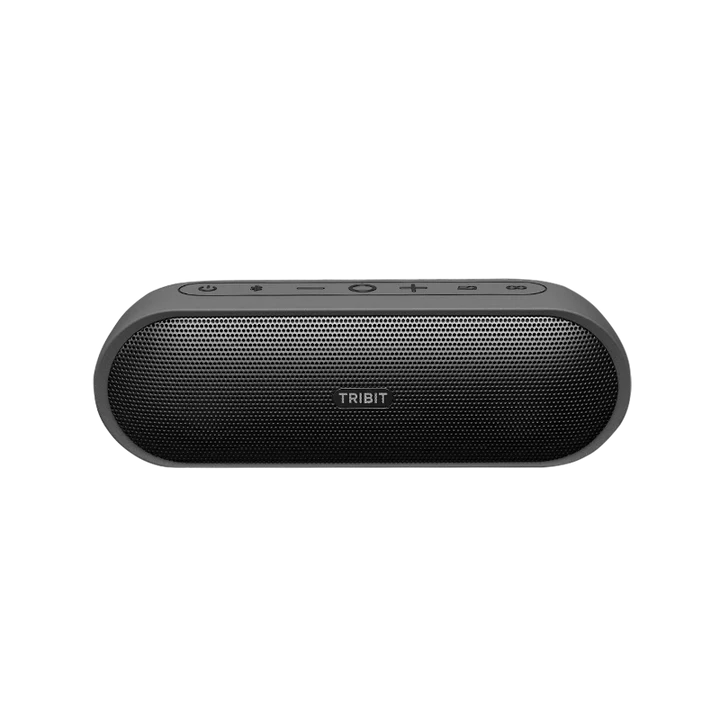
Tribit XSound Plus 2 is an affordable Bluetooth speaker whose strongest appeal is the amount of sound and adjustment offered for the money. It combines two full-range drivers with XBass, app EQ and supported two-speaker playback. The original review finds an energetic and capable result, but also hears clear tonal compromises that change with the music. It is therefore a particularly interesting budget choice for someone willing to make sound adjustments, rather than a guaranteed fit for every listener straight from one default setting.
Research-based review. This assessment draws on manufacturer documentation and the original published evaluations linked below. Audio Review has not performed a hands-on test of this model.
An energetic presentation with a practical qualification
TechRadar’s original test praises punch and musical scale with suitable material, while finding some upper frequencies brittle and certain recordings less balanced. Its reviewer improves the result by changing EQ but does not identify one preset that flatters every track. That is a meaningful daily-use qualification, not a minor detail to hide behind the low price.
Try several types of familiar music before choosing. A speaker that sounds full with bass-rich electronic material may expose a thinner balance with a lean guitar recording. Decide whether changing a preset is an acceptable part of the routine. Some listeners enjoy that control, while others want one predictable setting. The right value judgment depends on that preference. More available adjustment is useful when it makes the desired sound achievable without becoming a distraction from the music.
Use EQ to solve an identified preference
The official page describes app customisation and a Traditional EQ option aimed at owners familiar with MaxSound Plus, dependent on current app and firmware. A preset associated with an older model is a sound-setting option, not proof that the new and old speakers have identical hardware or performance.
Begin with the actual listening location and moderate volume. Make a small change that addresses a clear issue, then compare with the unmodified state. Avoid adding bass to compensate for placing the speaker unnecessarily far from the listener, or reducing every treble band after one unusually bright recording. A useful default should work reasonably well across the library. If constant changes remain necessary and irritating, compare a speaker with a more suitable basic balance before investing in a second unit.
The linking limit matters when planning a group
Tribit’s current FAQ limits the documented arrangement to two speakers and names StormBox Flow and StormBox 2 as cross-model partners. It explicitly excludes the original MaxSound Plus. Party playback and a separated stereo pair also serve different listening purposes.
Do not buy several units expecting an unlimited chain based on the broad phrase party mode. Demonstrate the exact two-speaker setup and current software before committing to an expansion. Two matching units are a sensible starting point for a stereo comparison. For a group spread across a space, reproducing the same programme from two locations may be more useful than assigning left and right. The connection feature should be chosen for the layout of the listeners, not simply because it appears to double the number of speakers for a relatively small extra cost.
A battery estimate is not a completed full-discharge test
The twenty-four-hour manufacturer claim uses sixty per cent volume with XBass off. TechRadar follows a partial battery drop over eight hours and forty-five minutes and estimates nearly twenty-two hours from that observation. Its method should not be rewritten as a fully measured twenty-two-hour run.
This still gives useful evidence that moderate playback can last a long time, but real use depends on volume, processing and material. Charge before travel and allow a margin if uninterrupted playback is important. The loudest outdoor setting is a different requirement from background music at a desk. Also consider when the phone will need charging and whether a suitable power source is available. Long speaker endurance is welcome, but it is only one part of the complete portable listening arrangement.
Carrying, placement and water resistance
The IPX7 rating provides a documented water-ingress classification without a dust rating. TechRadar also questions the carrying loop relative to the size of the speaker. Those details favour a little practical care rather than treating the unit as an indestructible outdoor accessory.
Try how it sits in the bag and on the surface where it will be used. Do not rely on a loop that feels insecure for the planned activity. Keep connectors dry before charging and avoid leaving the speaker exposed to sand or repeated impacts. Indoors, experiment with distance from a wall and the listener before reaching for another EQ preset. The physical installation can change how full or clear a small speaker seems. A good portable design is one that can be positioned and carried comfortably through the real routine.
Current value beside smaller and more refined options
The XSound Plus 2 should be compared at its current offered price, including any required carrying protection and the real cost of a second speaker if pairing is essential. Two budget units are not automatically the better purchase than one more suitable speaker.
If the main need is personal listening on a walk, a smaller design may be worth more than extra volume. If the priority is consistently balanced sound across varied music, listen carefully to rivals even if they cost more. If app adjustment is welcome and the chosen balance works well, the Tribit can deliver an appealing amount of capability for the money. Its strongest recommendation is conditional on that successful everyday match, rather than a claim that nominal power or a low price defeats every alternative.
Alternatives to consider
JBL Flip 7: Flip 7 is a relevant compact comparison at a different current price. Compare the preferred balance, carrying arrangement and supported speaker-linking system rather than assuming any two Bluetooth units can form a pair.
Tribit StormBox Micro 2: Micro 2 is the more compact alternative to consider when attachment and easy carrying matter most. The XSound Plus 2 extra scale is worthwhile only if the larger object suits the actual outing or room.
Tribit XSound Plus 2 key specifications
- Type
- Portable Bluetooth speaker
- Bluetooth
- 5.3
- Drivers
- Two full-range units
- Manufacturer power listing
- 2 × 15 W
- Sound controls
- XBass, presets and app EQ
- Resistance
- IPX7
- Battery claim
- Up to 24 h at 60% volume, XBass off
- Charge time claim
- Approximately 4 h
- Speaker linking
- Up to two connected speakers in documented FAQ
- Compatible cross-model partners
- StormBox Flow and StormBox 2 listed
- Original MaxSound Plus linking
- Not supported
- Dimensions
- 198.5 × 66.5 × 70 mm
- Weight
- 1.31 lb (approximately 594 g)
Verdict
XSound Plus 2 is a capable budget portable with meaningful EQ flexibility, energetic playback and a promising endurance proposition. The original test also gives clear reasons to evaluate the balance with varied music rather than a single demonstration track.
Confirm the two-speaker limits, accept the absence of a dust rating and judge the carrying arrangement in person. It can be strong value for someone happy to tailor the sound. A listener who wants a more consistent set-and-leave presentation should compare alternatives before treating the feature list as the complete buying decision.
Documentation and original reviews
Tribit official XSound Plus 2 specifications and two-speaker FAQ · TechRadar original XSound Plus 2 sound and battery evaluation
Editorial record
Sources and updates
Product specifications and factual claims were checked against Official Tribit XSound Plus 2 product page ↗. Scores and buying advice follow our category-specific editorial methodology.
- Published
- November 17, 2026
- Last updated
- November 17, 2026