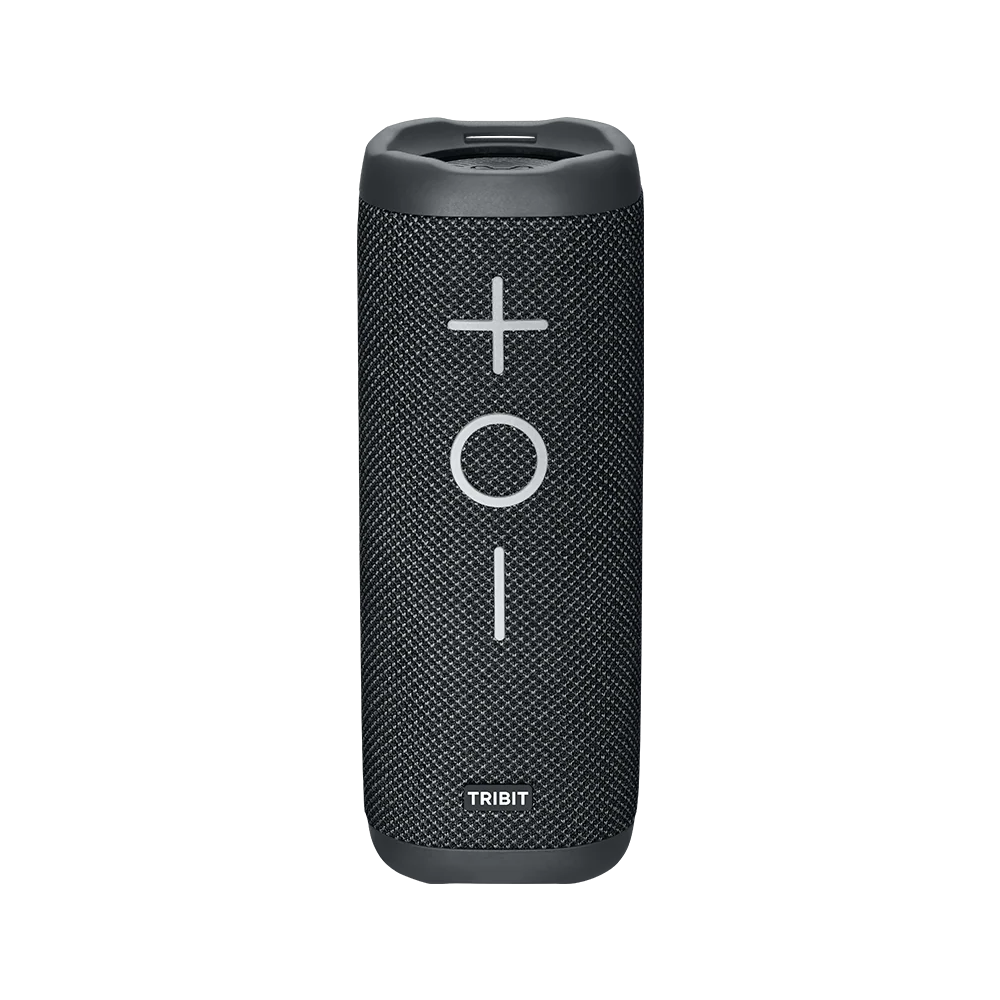
Tribit StormBox 2 is an affordable portable Bluetooth speaker built around broad sound coverage, physical controls and configurable EQ. It offers a useful alternative to very small budget speakers when carrying a somewhat larger unit is acceptable. The original review is enthusiastic about its price-relative sound and endurance, while noting limitations in upper-frequency refinement. Its battery claim and speaker-linking modes also need to be read with their conditions intact rather than reduced to a few headline numbers.
Research-based review. This assessment draws on manufacturer documentation and the original published evaluations linked below. Audio Review has not performed a hands-on test of this model.
Shared coverage is different from a room-wide stereo image
Tribit promotes all-around sound from the compact enclosure. That can be useful when people sit in different directions around a table, but it is not the same physical arrangement as placing separate left and right speakers across a room.
Think about where the listeners will be. For a picnic or kitchen, broad coverage may be more useful than a carefully fixed listening position. For music at a desk, a speaker aimed towards one listener can also work well. Try placement before increasing volume: putting the speaker nearer the group may give clearer playback without filling a larger surrounding area. The benefit is a practical portable sound source, not a promise that a single small cabinet creates the same separation and scale as a full stereo system.
Sound quality and the role of XBass
TechRadar’s original test finds appealing mids and useful bass with XBass active, while identifying occasional sharpness in the upper range. It regards the overall result as particularly good value rather than equal to more expensive rivals in precision. Those qualifications help explain what to listen for.
Try familiar voices, guitar and percussion at the normal level, then compare XBass on and off. A fuller balance can work well outdoors while sounding excessive beside a wall indoors. Use app EQ for a modest correction if needed, and keep an unchanged setting for comparison. The aim is a comfortable balance across the material you actually play. A bass button should not become a reason to ignore roughness elsewhere, and a larger power number does not by itself establish deeper bass or better musical clarity.
Two-speaker functions have distinct purposes
The official FAQ distinguishes stereo mode, with separate left and right roles, from party mode, where the speakers reproduce the same channel. It also names particular compatible models for cross-model connection. This is a supported linking arrangement, not universal compatibility with every product carrying the Tribit name.
For a stereo purchase, two matching StormBox 2 units are the clearest starting point to demonstrate. Place them with useful separation and listen to whether the added space serves the room. For listeners spread through an area, same-signal playback may be the more practical mode. Confirm current compatibility before buying another model specifically as a partner. A pairing button and common Bluetooth version do not establish that different brands or every older model can join the same system.
Read the endurance claim and review method carefully
Tribit states the twenty-four-hour claim at sixty per cent volume with XBass disabled. TechRadar observes a relatively small battery drop during a shorter run and extrapolates a longer possible duration. That is encouraging evidence, but it is not a completed thirty-hour playback test.
For planning a day out, use the stated conditions as a reference and allow a margin for louder playback and bass enhancement. A phone’s percentage indication or app estimate can also behave imperfectly across a discharge cycle. Charge before an important outing rather than depending on the last few displayed points. Long moderate-level endurance is useful for background listening over several sessions. It should not be turned into a guarantee that the speaker can play at its loudest setting throughout a full day.
Water protection is one part of outdoor use
The documented IPX7 rating addresses water ingress under the specified test classification. The X does not provide a dust rating. It also does not establish that every cable connection or charging activity is suitable while the speaker is wet.
Keep the port area dry before charging and follow the product’s care instructions. Avoid placing the speaker where sand or grit can work into controls and connectors, or where it can fall onto a hard surface. Water resistance is helpful for an accidental splash, but a deliberate rough-use test is not necessary to enjoy the feature. Consider carrying comfort and how the speaker sits on the intended surface. A portable product should be easy to position securely, not simply able to survive one kind of laboratory exposure.
App convenience and a realistic value comparison
The app offers sound adjustment beyond the physical XBass control. That can make a low-cost speaker more adaptable to a room, while adding a configuration step some owners may prefer to avoid. Set a useful default and learn the normal physical controls before relying on the app for every small change.
Compare the current complete price with a smaller speaker and a more expensive compact rival. If one StormBox 2 already meets the requirement, two should not be bought merely because linking is available. If better refinement or dust protection is important, a higher budget may be justified. The value case is strongest when the intended use is shared everyday music at sensible levels. It is weaker when the requirement is deep party bass, Wi-Fi services or a precisely positioned full stereo image from a single cabinet.
Alternatives to consider
JBL Flip 7: Flip 7 is worth comparing when budget allows a newer compact platform. Compare the specific speaker-linking system, resistance rating and actual sound rather than assuming all Bluetooth speakers join the same group.
Tribit StormBox Micro 2: StormBox Micro 2 prioritises a smaller carrying arrangement. Decide whether the reduced footprint is more useful than the StormBox 2 scale and handling, then compare at the moderate levels expected in normal use.
Tribit StormBox 2 key specifications
- Type
- Portable Bluetooth speaker
- Bluetooth
- 5.3
- Drivers
- Two 48 mm full-range units
- Power listing
- 2 × 17 W manufacturer specification
- Sound controls
- XBass and app EQ
- Water resistance
- IPX7
- Battery claim
- Up to 24 h at 60% volume, XBass off
- Charge time claim
- Approximately 4 h
- Two-speaker modes
- Stereo and same-signal party playback
- Cross-model provision
- Official FAQ lists StormBox Flow and XSound Plus 2
- Wi-Fi
- No
- Dimensions
- 180 × 69 × 69 mm
- Weight
- 1.28 lb (approximately 580 g)
Verdict
StormBox 2 offers a persuasive amount of everyday listening capability for a modest price. Original testing supports its useful sound, EQ flexibility and promising moderate-level endurance, while keeping refinement in perspective.
Check the preferred XBass setting, distinguish stereo from party playback and verify the exact partner model before expanding the system. Read the battery figure with its conditions and remember the absence of a dust rating. For an affordable speaker shared around a table or carried between rooms, those limits can be entirely reasonable.
Documentation and original reviews
Tribit official StormBox 2 specifications and pairing FAQ · TechRadar original StormBox 2 sound, battery and usability evaluation
Editorial record
Sources and updates
Product specifications and factual claims were checked against Official Tribit StormBox 2 product page ↗. Scores and buying advice follow our category-specific editorial methodology.
- Published
- November 17, 2026
- Last updated
- November 17, 2026