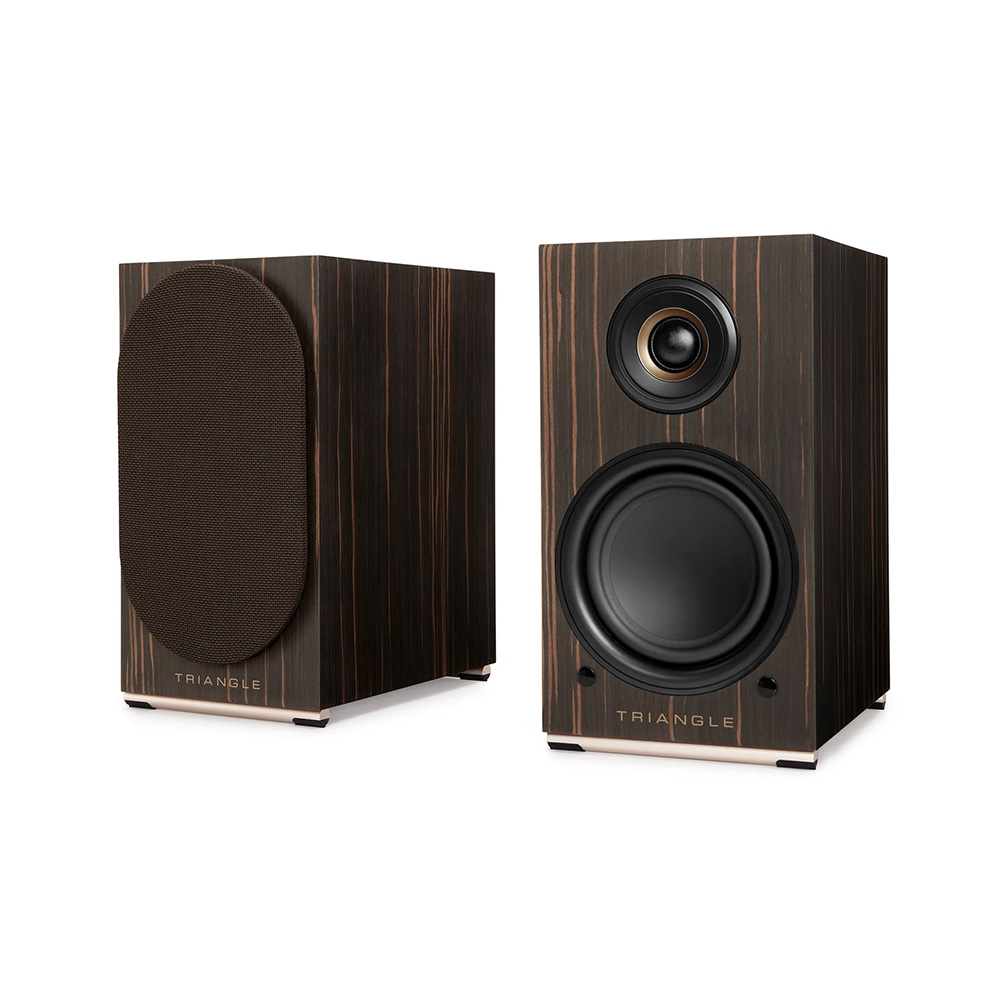
Triangle AIO Twin combines a compact stereo pair with network streaming, Bluetooth and useful wired inputs. It is a powered main speaker feeding a passive partner through an ordinary speaker cable, not two battery speakers communicating wirelessly with each other. That distinction matters less than whether its practical package fits the room. The appeal is a music system that can handle daily streaming, a television’s optical output and an MM turntable without requiring a conventional amplifier. Original listening evidence is strongly encouraging, with a qualification for the built-in phono stage.
Research-based review. This assessment draws on manufacturer documentation and the original published evaluations linked below. Audio Review has not performed a hands-on test of this model.
A lively music-first system with useful control
What Hi-Fi’s original evaluation describes an enthusiastic yet composed presentation, clear voices and rhythmically confident bass. Its main sound reservation concerns the internal phono route, which the reviewer found less precise and expressive than the other inputs. That distinction is more useful than treating every source as identical.
For a buying audition, use the input that will carry most listening. Someone streaming throughout the week should hear the network route, while a vinyl-focused buyer should insist on a record demonstration. Keep the playback level similar when comparing another system, and include a dense arrangement as well as a simple vocal track. Listen for intelligibility and comfortable balance rather than just the immediate impression of bass quantity. Compact speakers can be a sensible match for an ordinary living space without being expected to reproduce the scale of a much larger installation. Their success depends on whether music remains engaging at the actual seat and volume. A favourable original review supports a shortlist, not an automatic answer for every room.
The small pair still needs a stereo installation
AIO Twin puts amplification and source connections in the powered cabinet. A supplied speaker cable connects the other cabinet. This reduces the number of electronic boxes but still requires two suitable locations and a route between them.
Measure the furniture before choosing a finish. Check that both cabinets can sit securely and that the powered one is near the intended sources and mains supply. Leave room for plugs and avoid pulling a cable taut across a doorway or moving shelf. A desk can be convenient, but a crowded desktop may prevent sensible spacing or put a reflective screen directly between the speakers. Dedicated supports may be worthwhile where they improve height and symmetry, although they also change the total cost. Begin with ordinary stereo spacing and assess bass before pushing the cabinets against a wall. The important advantage is a compact complete system, not freedom from all placement decisions. A carefully arranged small pair can be more useful than a larger model squeezed into an unsuitable space.
Network convenience should be demonstrated with the actual service
Triangle documents Wi-Fi, Ethernet and its AIO control app. Bluetooth provides another source route, with codec availability depending on the sending device. The advertised high-resolution ceiling does not mean every service, wireless protocol and input operates at the same format.
Use the intended phone or tablet during setup and confirm access to the actual music account. Check the ordinary actions: finding an album, adjusting volume, returning after standby and changing to another source. Ethernet is worth considering if a convenient cable route exists and wireless reception is unreliable at the speaker position. Do not assume that a service name in an old review establishes every current account feature or regional integration. For multiroom plans, establish the documented compatible devices and control arrangement before buying additional speakers. A single-room purchase should first succeed on its own. The practical value of network audio is reliable access and easy control; the maximum sample-rate number is a secondary consideration if the daily interface is awkward for the household.
MM phono is convenient, but check the cartridge and comparison
The RCA input can be selected for line-level use or MM phono. This makes a straightforward moving-magnet turntable system possible without a separate phono box. It does not establish compatibility with an arbitrary low-output moving-coil cartridge.
Identify the record player’s actual output. If it already contains a phono stage, select the appropriate line-level arrangement rather than applying two stages in succession. If the record player provides an unamplified MM signal, follow the documented phono connection and grounding instructions. Give the turntable stable support that does not share obvious vibration problems with the speakers. The original review’s reservation makes a direct audition especially worthwhile for someone with a substantial record collection. A separate phono stage is a possible alternative through the line input, but it should solve an audible or compatibility need rather than be purchased automatically. Include its price before comparing the system with separates. For occasional records, the internal facility may be exactly the useful reduction in boxes that makes the Twin attractive.
Optical television sound is different from HDMI ARC
The documented television route is optical. AIO Twin does not provide HDMI ARC, so it should not be bought on the assumption that it behaves exactly like an HDMI soundbar. It is a stereo speaker system rather than a multichannel cinema decoder.
Check that the television offers an appropriate optical output and can send a compatible stereo signal. Demonstrate ordinary programmes and an external source, not just a music app. Establish how volume will be controlled and whether the included remote is convenient from the sofa. Do not assume the television remote’s volume button will control every optical arrangement. Check dialogue intelligibility at the actual seat and whether source switching is straightforward for everyone who will use it. A stereo pair can be a satisfying music-first television solution when this routine works well. A viewer who wants automatic HDMI control or a dedicated centre-channel arrangement should compare a different system. The right choice depends on the everyday television workflow as much as the quality of a music demonstration.
Complete-system value is the reason to consider it
AIO Twin’s appeal comes from combining useful facilities within a compact pair. There is no need to add a separate ordinary stereo amplifier. There may still be a case for stands, different cable routing or a source-specific accessory, depending on the room.
Compare complete working packages at current local prices rather than repeating a launch-era bargain claim. Include the sources required now, realistic placement and the current support arrangement. Think about how the system will be operated without relying on one technically confident household member. A single-enclosure alternative may be more convenient where two cabinets cannot be spaced sensibly. A conventional amplifier and passive speakers may be more appealing to someone who changes components frequently. The Twin is strongest for a buyer who wants the existing combination of streaming and wired sources in a tidy form. Its specification is broad enough to deserve attention, but the best value comes from using those connections well rather than simply owning the largest number of them.
Alternatives to consider
KEF LSX II: Compare this compact active system if its connection set and streaming platform better suit the sources. Judge the complete package at current local prices, including any necessary stands.
Audio Pro C20 W: This offers a different one-enclosure approach to a connected room system. It may suit a location that cannot accommodate two spaced cabinets, while a properly placed pair remains a different stereo proposition.
Triangle AIO Twin key specifications
- System
- Powered main speaker and passive partner
- Amplifier rating
- 2 × 50 W RMS Class D, manufacturer specification
- Drivers
- 25 mm tweeter and 13 cm bass/mid per cabinet
- Network
- Wi-Fi and Ethernet; Triangle AIO app
- Wireless input
- Bluetooth with supported aptX variants, AAC and SBC
- Analogue
- RCA switchable line / MM phono; 3.5 mm
- Digital TV input
- Optical; no HDMI ARC
- Subwoofer
- Dedicated output
- USB-A
- Not a USB-B computer audio interface
- Speaker connection
- Supplied 3 m speaker cable between cabinets
- Power
- Mains at the powered speaker
- Dimensions (W × H × D)
- 165 × 304 × 235 mm per speaker
- Speaker weight
- 5 kg each
Verdict
AIO Twin is an appealing compact music system with encouraging original listening evidence and a useful mixture of network, analogue and optical sources. Its main caveats are the wired partner cabinet, optical rather than HDMI television operation and a phono stage worth auditioning carefully. Choose it when that complete arrangement fits the room and routine, at a competitive current price.
Documentation and original reviews
Triangle official AIO Twin connections and specifications · What Hi-Fi original AIO Twin listening and usability review
Editorial record
Sources and updates
Product specifications and factual claims were checked against Official Triangle AIO Twin product page ↗. Scores and buying advice follow our category-specific editorial methodology.
- Published
- November 17, 2026
- Last updated
- November 17, 2026