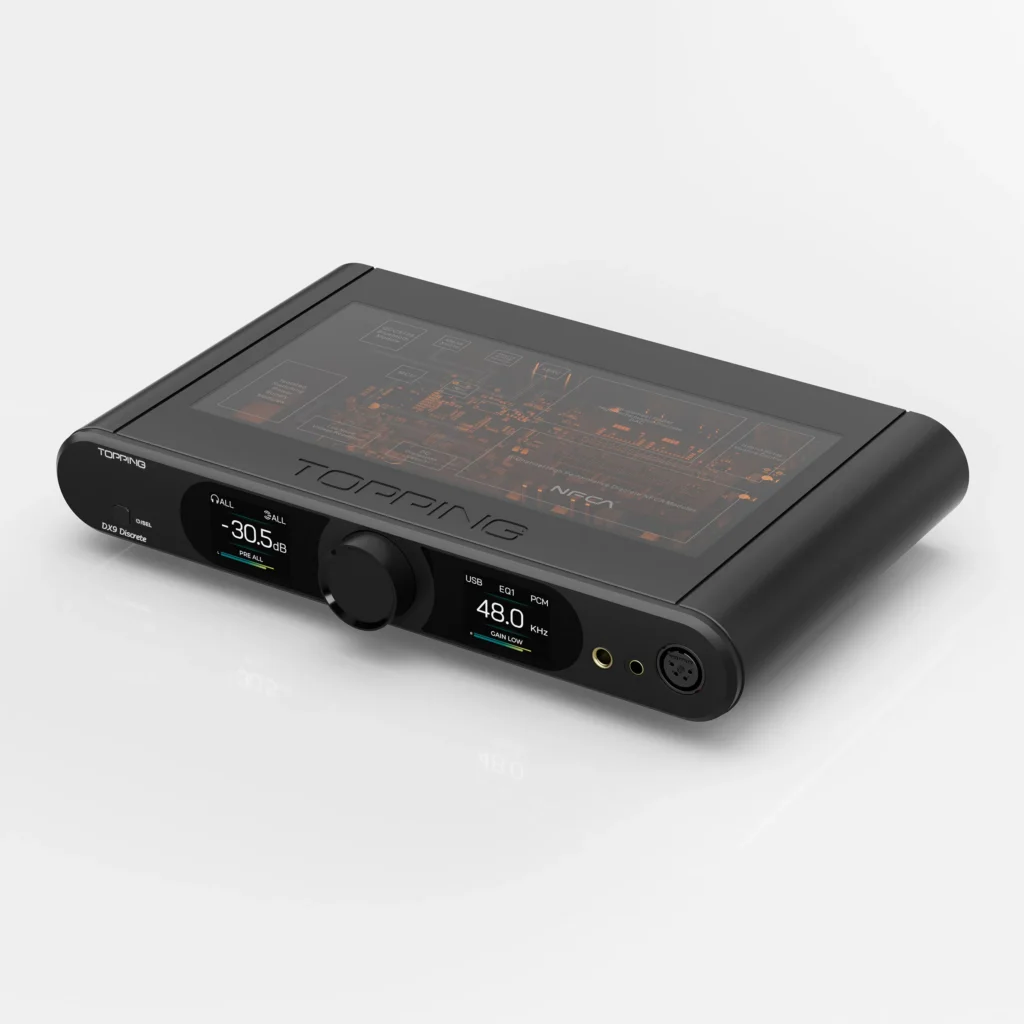
The original Topping DX9 combines digital conversion, a substantial headphone amplifier and preamplifier operation in one desktop component. It uses the AK4499EQ conversion platform and should be distinguished from the later DX9 Discrete. Its appeal is a complete digital listening centre with flexible outputs, while the lack of analogue inputs limits how it can serve an existing mixed-source system.
Topping DX9 — Design and desktop presence
The DX9 is more visually elaborate than a small utilitarian DAC-and-amplifier box. Its twin displays, central control and glass-panel treatment make it a component likely to remain visible rather than disappear behind a monitor. That can be appealing for a dedicated listening desk, but check the width and cable clearance before replacing a smaller unit. A single-box system still needs room for the rear connections and headphone plugs.
The display facilities can make input, format and level information easier to follow. Meter-style graphics are an optional visual convenience rather than a reason to expect better sound. The useful test is whether the owner can understand the active input and output quickly. A visually impressive interface should still support an obvious mute, volume and speaker-to-headphone routine.
Headfonics’ original review noted that the glass area became warmer than the metal housing. That is an observation from its sample, not an Audio Review temperature measurement. Provide the space and ventilation required by the manufacturer and avoid covering the component with other equipment. A desk installation should be comfortable for long sessions, including cable handling and access to the main control.
The original model and its conversion stage
This review concerns the original AK4499EQ-based DX9. The later DX9 Discrete uses a different conversion architecture and has its own feature set. Shared naming and similar appearance do not make their reviews interchangeable. Confirm the designation on the invoice and use firmware and documentation for the actual unit. An offer described only as a flagship DX9 is not a sufficiently precise basis for choosing between them.
The original combines the DAC with Topping’s NFCA headphone amplification. That removes the need for separate converter-to-amplifier interconnects and can simplify a new digital desk. It also ties the functions together. There is no analogue input allowing the headphone amplifier to be used independently with an external analogue source. An owner who wants to compare several separate DACs through one amplifier should understand that boundary before purchase.
The conversion chip is one part of the implementation. Its historical reputation or limited availability should not replace a comparison of the complete device. The more useful questions are whether the required inputs are present, the amplifier suits the headphones and the controls fit daily use. A specialist chip does not make unsuitable connectivity or an awkward desk layout less relevant.
Digital sources and connection limits
USB, two optical inputs, two coaxial inputs, AES, IIS and Bluetooth provide broad digital-source provision. The highest PCM and DSD decoding capabilities apply to particular inputs, while optical, coaxial and AES have lower ceilings. Check the manual’s format table for the route being used. A maximum USB rate cannot be assumed available over every connection merely because the same DAC eventually converts the signal.
The IIS connector resembles HDMI but does not function as television HDMI ARC or eARC. A matching transport needs compatible digital-audio wiring and settings. For a television, a suitable optical stereo PCM output is a more straightforward route. The DX9 does not replace an AV receiver’s multichannel decoding, so the television should not send a surround bitstream to a DAC expecting compatible stereo input.
Bluetooth reception is convenient for a phone, with supported codecs dependent on both devices. It does not make the DX9 an independent network streamer or music-library browser. A computer, phone or dedicated transport remains the source of the programme. Choose the most reliable everyday route first, then test unusual sample rates or formats only where they serve material that will actually be played.
Headphone power in useful context
The manual lists 7.08 watts per channel into thirty-two ohms from the balanced outputs at less than one percent THD+N, with ten watts into sixteen ohms under the same stated distortion ceiling. Those conditions matter when comparing another amplifier rated at a lower distortion threshold. The largest number should not be detached from its load and test limit or treated as a direct measure of sound quality.
The single-ended and balanced paths have different available power, and headphone sensitivity matters alongside impedance. A sensitive model can need very little of the available capacity, while a less efficient planar may benefit from more reserve. Start with the lowest useful gain and a manageable volume setting. Extra wattage is headroom for a relevant load, not a reason to listen louder or assume every headphone becomes more detailed.
The front provides 6.35 mm single-ended, 4.4 mm balanced and four-pin XLR balanced connections. Use appropriately wired cables, especially with the balanced outputs. A casual adapter that joins separate output returns is not the correct way to accommodate a single-ended cable. Test low-level noise and channel balance with sensitive earphones as well as the desired level with demanding headphones. One maximum-power demonstration does not cover both use cases.
Fixed outputs, pre-outs and speaker use
The rear panel includes separate RCA and XLR line-output and preamplifier-output banks. That is a useful distinction for a system feeding more than one downstream component. The owner must identify which sockets and modes provide the intended fixed or controlled signal. A fixed output is appropriate for an integrated amplifier with its own volume control, while direct active-speaker or power-amplifier use needs an understood level-control arrangement.
The manual’s DAC mode fixes volume at zero dB, so mode selection should be checked before playback. Begin with a controlled level and confirm muting, standby and output selection in the completed system. A mixed headphone-and-speaker desk should have a simple routine that prevents unexpected simultaneous playback. The number of output sockets is helpful only when their purpose is clear.
The DX9 does not directly power passive loudspeakers and has no turntable phono input. An analogue record system therefore needs another route or another control component. If several analogue sources are already owned, a separate DAC and analogue amplifier may create a more flexible solution than this digital all-in-one. The best configuration follows the source list rather than the attraction of reducing the visible box count.
Published sound assessment
Headfonics’ original DX9 review praised its detailed, punchy presentation and broad suitability for headphones and IEMs. It also identified the inability to use the amplifier independently of the internal DAC as a limitation. Those are findings from that publication’s listening systems, not tests conducted by Audio Review. They support a serious audition of the original model while keeping the architectural trade-offs visible.
A useful audition includes the owner’s actual headphones and a consistent source signal. Match levels against any alternative and keep processing comparable. A stronger output or different gain setting can make a quick demonstration seem more dynamic through loudness alone. The combined unit should also be assessed at normal quiet listening levels, where noise and usable control range may matter more than maximum output.
If an existing DAC-and-amplifier combination already supplies a clean signal and sufficient level, the DX9 may offer a larger convenience and interface improvement than a dramatic tonal transformation. That can still be worthwhile. The purchase should be justified by the complete experience rather than an expectation that a premium integrated component changes every recording or compensates for a headphone balance the listener does not enjoy.
Value and ownership decision
The original DX9 is strongest for a digital-focused desk where its source switching, headphone connections and speaker-control facilities all have a job. It can simplify wiring compared with separate components, while offering more scope than a basic USB headphone dongle. Its premium is harder to justify where one easy-to-drive headphone and one computer are the entire system.
Compare current European availability and support with integrated alternatives and a separate DAC-and-amplifier arrangement. Distinguish original stock from the newer Discrete version and compare actual required features. A historical flagship label or limited-edition story should not decide the result. Choose the DX9 when the verified original model fits the source list, headphones and daily routine, with its analogue-input limitation accepted from the start.
Alternatives to consider
FiiO K17: Compare the complete digital and headphone feature set against the requirements of the intended desk.
RME ADI-2 DAC FS: A relevant comparison when detailed adjustment and a different headphone-control workflow are priorities.
Topping DX9 key specifications
- Model scope
- Original DX9 with AK4499EQ; not DX9 Discrete
- Inputs
- USB, Bluetooth, 2 optical, 2 coaxial, AES, IIS
- Headphone outputs
- 6.35 mm; 4.4 mm balanced; 4-pin XLR balanced
- Published balanced power
- 7.08 W/ch into 32 ohms, THD+N <1%; 10 W/ch into 16 ohms under same ceiling
- Analogue source inputs
- None
- Line facilities
- Separate RCA/XLR line and preamplifier outputs
- USB decoding
- Up to PCM 32-bit/768 kHz and native DSD512
- Mains
- 100–240 V AC, 50/60 Hz
Verdict
The original Topping DX9 is a capable premium digital listening centre with substantial headphone headroom and useful line-output flexibility. Its appeal depends on using those facilities regularly. Confirm the original AK4499EQ model, understand fixed-output modes and choose another architecture if analogue inputs or an independent amplifier path are essential.
Primary documentation and independent reviews
Topping official original DX9 information · Topping official DX9 manual · Headfonics original DX9 review · Headfonics DX9 comparisons and verdict
Editorial record
Sources and updates
Product specifications and factual claims were checked against Official Topping DX9 product page ↗. Scores and buying advice follow our category-specific editorial methodology.
- Published
- November 8, 2026
- Last updated
- November 8, 2026