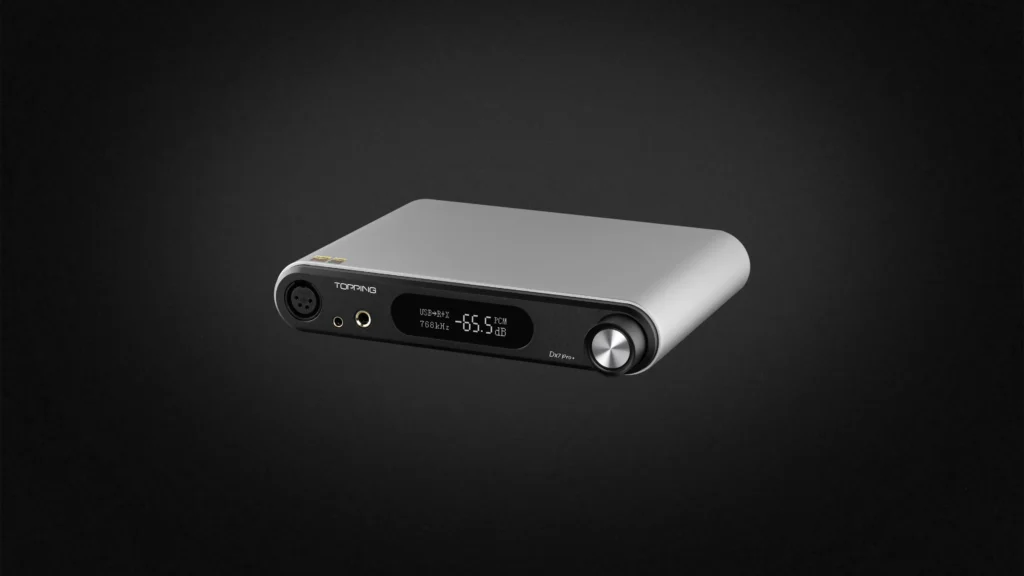
The Topping DX7 Pro+ is a desktop digital hub with headphone and line-output roles. Its many sockets can simplify a system using several sources, but they also make output mode and volume behaviour important. This assessment is based on the manufacturer’s DX7 Pro+ manual, rather than borrowing specifications from the earlier DX7 Pro or another DX-series product.
Topping DX7 Pro+ — Several digital inputs serve different systems
The manual identifies USB, optical, coaxial SPDIF, AES, I2S and Bluetooth inputs. These are digital-source routes; the DX7 Pro+ is not an analogue-input amplifier for a turntable or ordinary line-output source. Check the signal type rather than just the connector shape.
I2S uses an HDMI-shaped connector but is not a television HDMI ARC input. Compatibility depends on the documented pin and format configuration of both devices. Do not connect it expecting TV audio or assume that every I2S source shares one universal wiring arrangement. USB or SPDIF may be a simpler route where their capabilities are sufficient.
Headphone socket count is not a power hierarchy
The front panel provides four-pin XLR, 4.4 mm and 6.35 mm headphone sockets. The manual’s specified output conditions are more informative than assuming that a balanced-looking connector must always deliver more power than the ordinary jack.
Topping lists the same 1900 mW per-channel figure at 32 ohms for the compared 6.35 mm and four-pin XLR paths under its stated sub-one-percent distortion test condition. This is a manufacturer result, not our measurement. Match the actual headphone load and sensitivity, choose appropriate gain and start at a low level rather than buying a new cable merely to obtain a presumed power increase.
Fixed DAC output and variable preamp mode
The manual distinguishes a variable preamplifier mode from a fixed DAC line-output mode. In a system feeding a power amplifier or active monitors, there must be an appropriate volume-control arrangement. Selecting fixed output without planning the downstream level can produce an unexpectedly loud signal.
RCA and XLR line outputs provide different connection options, with output selection available in settings. They do not drive passive speakers directly. Establish a known output and volume state before connecting or switching equipment, particularly when headphones and loudspeakers share the same source.
Formats and configuration should serve the music
USB and I2S have different maximum PCM and DSD capabilities from optical, coaxial and AES. Bluetooth also uses negotiated codecs. Do not move the largest format number in the manual onto every input description. The source and receiving mode must agree on a supported path.
The remote, display and automatic-standby options can be useful in a desk or living-room arrangement. Configure them once for a predictable routine rather than repeatedly changing filters without a clear comparison method. A filter name or high sample-rate display does not establish that a familiar recording contains more audible information.
The manufacturer includes measurement graphs, but this review has not replicated them or conducted listening tests. Compare the DX7 Pro+ with simpler devices at the required connections and complete-system price. Its concrete attraction is routing flexibility and output control, not a blanket claim that additional sockets improve sound.
What to expect in a real setup
Can the HDMI-shaped I2S socket receive TV ARC audio? No. It is an I2S digital-audio connection with model-specific configuration, not a television HDMI ARC input.
Does four-pin XLR automatically mean more power than 6.35 mm? No. Read the actual output specifications. Topping’s manual lists the same stated 32-ohm power figure for the compared outputs under its test conditions.
Separate the connector shape from the signal it carries
The DX7 Pro+ provides a broad digital connection set, but each socket has a particular job. Its HDMI-shaped I2S connection is not a television ARC input. A television installation therefore needs a genuinely compatible audio route instead of an ordinary HDMI cable connected by appearance alone. With an I2S transport, check the documented pin arrangement and configuration at both ends. With conventional digital connections, verify the source’s output format and the corresponding input limits rather than assuming that the largest USB figure applies everywhere.
This distinction also helps avoid unnecessary equipment. If the main task is computer playback and the existing source already works reliably over USB, an exotic additional connection may provide no practical benefit. If several transports need to share the DAC, the input selector and remembered settings become more important. Try each actual source during setup, then return to the one used most often to make sure that routine operation remains simple.
Decide which control sets the room’s listening level
The line outputs can serve a downstream amplifier or a compatible powered-speaker arrangement, but fixed DAC and variable preamp operation are different configurations. Choose deliberately, begin at low level and verify the controller before normal listening. If the downstream amplifier already offers convenient volume adjustment, keeping that familiar control in charge may be simplest. If the Topping becomes the preamplifier, make the remote and local knob accessible to everyone who will use the system.
Headphone socket choice should follow the documented wiring and the headphone’s cable. The presence of several socket types does not establish a simple hierarchy in which each larger connector gives more power or better sound. Read the model’s actual output conditions and avoid improvised balanced adapters. Lower volume before swapping headphones, because a setting appropriate for one sensitivity can be excessive for another. Comfortable control at the intended listening level is the useful outcome.
For a used purchase, include the correct remote, mains accessories and access to the manual in the value calculation. Check the exact Pro+ designation rather than treating every DX7-family listing as equivalent. The product is most attractive when its switching and output flexibility fit a system with several real destinations. For a single computer and efficient headphone, a simpler combination may leave more budget for the headphone itself while requiring fewer settings and cables.
Alternatives to consider
Topping DX5 II: Compare the newer desktop control and connection arrangement if the complete input set of the DX7 Pro+ is unnecessary.
RME ADI-2 DAC FS: A different desktop workflow to investigate when adjustment and system-control priorities outweigh the particular DX7 Pro+ socket selection.
Topping DX7 Pro+ key specifications
- Digital inputs
- USB, optical, coaxial, AES, I2S, Bluetooth
- Headphone sockets
- 4-pin XLR, 4.4 mm, 6.35 mm
- Line outputs
- RCA and XLR
- Line-output modes
- Fixed DAC or variable preamp
- 32-ohm headphone claim
- 1900 mW/channel, THD+N <1%, documented test conditions
- Display
- OLED
- Control
- Local multifunction knob and remote
- Dimensions
- 220 × 180 × 44 mm
- Weight
- 1.07 kg
- TV ARC
- Not supported by the I2S connector
Verdict
The DX7 Pro+ is best chosen for a defined digital-source and output-control plan. Confirm I2S compatibility, gain and line-output mode before use. Its manual supports a flexible system role, while audible transparency and measured performance require testing beyond a connection inventory.
Primary documentation
Specifications and feature descriptions were checked against the following official documents on 6 November 2026. Compatibility advice is our interpretation of those documented capabilities; it does not establish measured sound quality. Regional bundles, software features and service availability can change, so verify the exact European model and current support information before purchase.
Editorial record
Sources and updates
Product specifications and factual claims were checked against Official Topping DX7 Pro+ product page ↗. Scores and buying advice follow our category-specific editorial methodology.
- Published
- November 7, 2026
- Last updated
- November 8, 2026