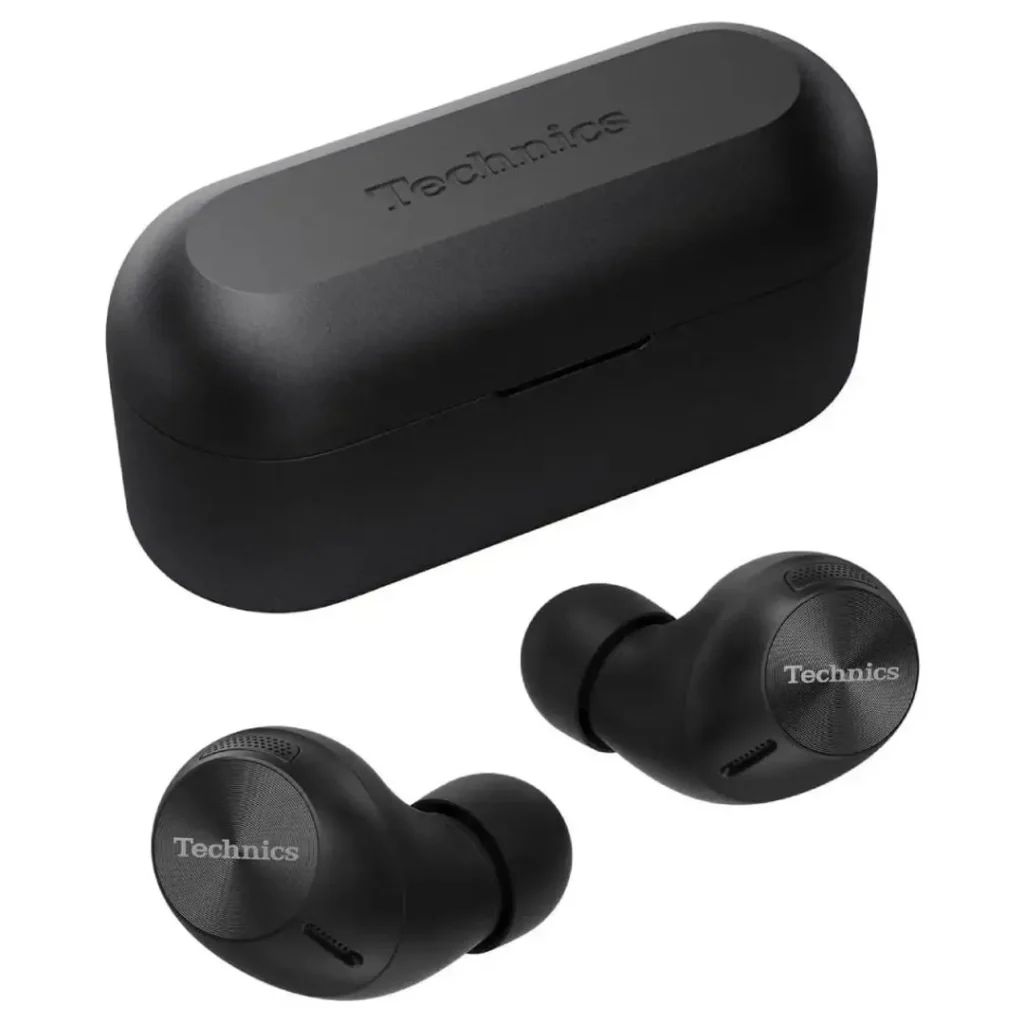
Technics EAH-AZ40M2 puts a compact, lightweight design around an unusually flexible connection package for an established mid-range earbud. Its appeal is clear for someone who uses several sources and prefers an unobtrusive fit. Original reviews welcome its clarity and spaciousness but are less convinced by bass impact and overall musical energy. The practical recommendation therefore depends on priorities: small size and switching convenience can matter more than maximum isolation, but they should be chosen consciously.
Research-based review. This assessment draws on manufacturer documentation and the original published evaluations linked below. Audio Review has not performed a hands-on test of this model.
Compact construction is the most immediate advantage
The official specification gives approximately five grams per earbud, with a similarly modest case. Both original evaluations respond positively to comfort and the small form. That makes the model worth trying for someone who finds larger premium earbuds cumbersome.
Start with the supplied tip selection and check the two ears independently. The preferred tip should give consistent contact without requiring a forceful insertion. Try a familiar voice and a bass line after changing sizes so that comfort is not being gained simply by losing the seal. Wear the pair for the normal session length, including glasses or a hat if used. A small body can be easier to accommodate, but the nozzle and tip still need to suit the ear. Also check whether the small earbuds can be removed and returned to the case conveniently. The design is most useful when its physical neatness improves the routine every day, rather than merely looking compact beside larger products.
Three-device multipoint needs a defined workflow
The ability to maintain connections with up to three devices is a distinctive part of the AZ40M2 package. LDAC introduces restrictions, so the maximum connection arrangement should not be promised simultaneously with every quality setting. Read the current app options and instructions for the chosen mode.
Test the actual phone, computer and third source if all three are important. Try an incoming call while music is playing elsewhere, then check how playback returns. Being paired in a device list is not the same as proving the desired switching behaviour. A person working from one laptop and occasionally checking another device may gain more from connection flexibility than from a higher-bitrate listening mode. Someone using one source almost exclusively may make the opposite choice. Choose according to the routine instead of enabling every impressive-sounding option and assuming it carries no trade-off. A successful setup is one that works predictably without repeatedly opening Bluetooth settings during an ordinary day.
The clear presentation is not a bass-heavy one
What Hi-Fi finds an open, orderly sound but wants greater rhythmic drive and lower-frequency authority. Headphonecheck also welcomes clarity while finding bass pressure limited. The common evidence points towards a restrained presentation that will suit some listeners more than others.
Try an acoustic recording and something rhythmically dense before deciding whether the character feels balanced or underpowered. Listen for the weight of a bass instrument as well as the intelligibility of a voice. Compare at similar loudness and resist using a louder demonstration as proof of better dynamics. A listener who dislikes overwhelming low frequencies may welcome the approach; someone seeking a substantial workout beat may prefer another model. The important decision is whether the preferred music remains engaging across several tracks. The advanced connection features do not determine the final tonal balance, and a high-resolution label cannot make the pair reproduce the same subjective impact as a differently tuned alternative.
App adjustment helps within the design’s limits
Headphonecheck describes a useful app with presets, a five-band equaliser and control configuration. It also confirms the absence of automatic playback pause. These details influence convenience without turning the product into a fully personalised hearing or sound system.
Try modest EQ changes with the seal already settled. Check whether a little extra bass produces the preferred result or merely distracts from another compromise. Keep a reference setting so that comparisons remain meaningful. Configure the controls around the actions needed most often, then try them with the phone out of sight. Learn to pause before removing an earbud if automatic pause is part of the previous routine. A deliberate manual action can be acceptable, but it should not arrive as a surprise after purchase. The app is most valuable when it makes the small pair more convenient and enjoyable in daily use. It should not be expected to remove every physical or acoustic limitation identified in the original listening evidence.
Noise reduction and calls are less distinctive
Headphonecheck finds the ANC and difficult-call performance fairly ordinary compared with more capable alternatives. Its awareness-mode account is more positive about naturalness. These findings support a careful everyday trial rather than selecting AZ40M2 specifically for the strongest cancellation.
Try the pair in the main location and check which surrounding sounds remain distracting at a normal listening level. Compare awareness controls when a conversation or announcement is needed. For calls, use the intended application and ask the other person about clarity through complete sentences. A compact earbud and stable connection do not guarantee clean outgoing speech when the environment becomes noisy. The pair may still be useful for a quiet office or casual communication, but a frequent traveller or busy-call user should compare more directly. Decide whether the small fit and source-switching convenience provide more daily value than a stronger noise-control package would. That is a more useful question than whether the product simply includes ANC on its specification list.
Battery life changes substantially with the codec
The official manual claims 5.5 hours with ANC and AAC, falling to 3.5 hours with ANC and LDAC. The corresponding case-inclusive figures are 18 and 12 hours. These are different operating conditions, not numbers to combine into one best-case promise.
Plan around the longest uninterrupted session and the exact mode likely to be used. The cumulative total requires charging breaks. USB-C charging is provided without a wireless option, so check whether the case fits the existing charging routine. An established discounted model can be attractive, but condition and battery age deserve attention when comparing remaining stock or used offers. Confirm the included fitting parts and return terms as well as the current price. AZ40M2 makes its strongest case when compact comfort and connection flexibility are the main requirements. If the day requires long continuous LDAC listening or a more forceful sound, the compromises may matter more than the appealing size and feature list.
Alternatives to consider
Soundcore Liberty 4 NC: Compare this existing review if noise reduction and value are central. Use the current local price and the intended phone, then judge fit and the complete controls rather than choosing from a single battery or codec headline.
Technics EAH-AZ60M2: A useful existing Technics comparison when considering a different fit and overall package. Compare the exact model specifications, everyday connections and preferred music before assuming that moving within the same brand will automatically solve every compromise.
Technics EAH-AZ40M2 key specifications
- Driver
- 6 mm dynamic
- Earbud weight
- Approximately 5 g each
- Case weight
- Approximately 35 g
- Bluetooth
- 5.3
- Codecs
- SBC, AAC, LDAC
- Multipoint
- Up to three devices; codec restrictions apply
- AAC battery claim
- 5.5 h ANC on; 18 h including case
- LDAC battery claim
- 3.5 h ANC on; 12 h including case
- Charging
- USB-C; no wireless charging
- App
- Technics Audio Connect with EQ
- Automatic pause
- Not provided
- Resistance
- IPX4 earbuds
Verdict
EAH-AZ40M2 is a focused compact choice with useful connection flexibility and a clear, spacious presentation. It is less convincing for strong bass impact, maximum cancellation or long high-bitrate sessions. Try it for fit and the real switching routine, then choose the operating mode with its battery consequences understood.
Documentation and original reviews
Technics official UK EAH-AZ40M2 product information · Technics official English AZ40M2 specification manual · What Hi-Fi original AZ40M2 listening evaluation · Headphonecheck original AZ40M2 use and listening evaluation
Editorial record
Sources and updates
Product specifications and factual claims were checked against Official Technics EAH-AZ40M2 product page ↗. Scores and buying advice follow our category-specific editorial methodology.
- Published
- November 17, 2026
- Last updated
- November 17, 2026