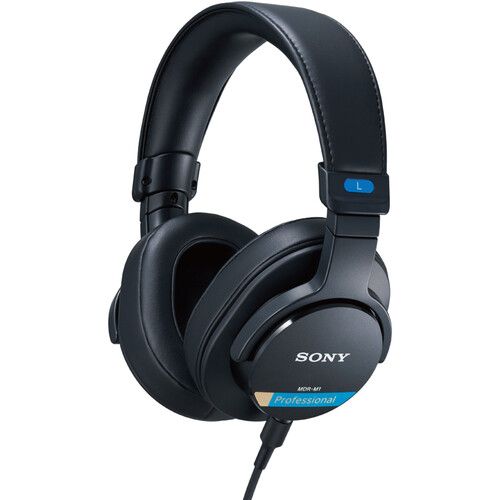
Sony MDR-M1 takes the familiar idea of a wired studio headphone and concentrates on the details that determine whether it stays on your head during a long session. Its low weight and replaceable cable arrangement are persuasive on paper. The more important question is what kind of monitoring presentation you want. Despite the resemblance and family history, this is a separate model from the MDR-7506, not simply the same sound in a refreshed shell.
Research-based review. This assessment draws on manufacturer documentation and the original independent evaluations linked below. Audio Review has not performed a hands-on test of this model.
What the MDR-M1 is designed to do
Sony specifies a closed dynamic design with a 40 mm driver, 50-ohm impedance and an approximate weight of 216 g without the cable. The package includes 1.2-metre and 2.5-metre straight detachable leads plus a larger jack adapter. There is no battery-powered listening mode to configure, and no wireless connection to pair before a session.
That format suits an instrument station, editing desk or project studio where monitoring should be available immediately. A direct wired path also avoids the variable transport delay associated with ordinary Bluetooth playback. It does not remove latency introduced elsewhere by recording software, buffers or an interface. Before buying headphones to fix a delayed instrument sound, establish which part of the signal path is actually responsible.
Low weight and the working session
WIRED’s original review is particularly positive about comfort and the improved fit relative to the MDR-7506. MusicRadar also praises the lightweight wearing experience during extended tracking. These are encouraging reports from actual users of review samples, rather than a guarantee that the pads and headband will fit every head equally well.
For a useful personal check, wear the headphone while turning toward your keyboard or instrument. A pair that feels fine when sitting perfectly still may move or pull when the working position changes. Try your normal glasses and allow enough time for pad warmth to become apparent. Low mass helps, but pressure distribution and the size of the opening around the ear still decide whether a headphone remains comfortable for your routine.
Cable choices and practical connections
The short supplied lead is a sensible match for a laptop or nearby interface. The longer lead gives more freedom around an instrument or a separate equipment rack. MusicRadar notes the convenient detachable connection. That means a damaged lead need not automatically retire the headphone, provided the correct replacement is available.
Choose the cable length deliberately rather than leaving unused wire hanging across a chair. Keep the plug accessible enough that standing up does not pull the source off a desk. If the source is a phone with only USB-C, an appropriate audio adapter is required; a passive change of connector shape is not always sufficient. For meetings, use a separate microphone input. The listening cable does not turn this studio product into a complete communications headset.
Sound quality: a new balance to learn
MusicRadar describes a presentation distinct from the MDR-7506, with a less insistent high end and a balance it found comfortable for long monitoring sessions. Its reviewer is more reserved about relying on the very lowest and highest regions for mixing decisions. WIRED is more enthusiastic overall about the refinement and isolation. The difference in emphasis is a reason to audition, not to average two opinions into a supposedly measured truth.
Our judgment is that the MDR-M1 deserves attention when sustained usability matters more than an immediately forensic character. A relaxed presentation can be welcome during repeated takes, while critical equalisation still benefits from a second reference. Someone deeply accustomed to another headphone should expect a learning period. The important test is whether the Sony helps you work reliably, rather than whether its sound conforms to an expectation created by an older model name.
Tracking and mixing are different decisions
A performer often needs a clear cue mix that remains comfortable while concentrating on timing and expression. A mix engineer may instead need to notice small changes in balance without overcorrecting. One headphone can serve both roles, but a comfortable tracking experience does not establish perfect tonal accuracy for every production decision.
For home recording, start with a simple cue mix that makes the performer and backing track easy to follow. Avoid solving every problem by increasing the level. For mixing, use a small set of familiar references and check important bass and vocal decisions elsewhere when possible. This is particularly useful after changing headphones. Consistent results come from learning a monitoring system in context, rather than expecting a product category or professional label to do that learning for you.
Isolation and the room around you
The closed cups make the MDR-M1 a different proposition from an open reference headphone. Nevertheless, passive isolation varies with fit and the sound outside. Do not assume that all fan noise, traffic or low-frequency rumble will disappear simply because the cup is closed. If noise is causing you to turn monitoring up repeatedly, address the room or the noisy equipment as well.
When recording close to a microphone, check the actual amount of cue sound reaching it at your normal level. A quiet acoustic part is more vulnerable to leakage than a loud amplified instrument. A short test recording is more informative than a universal claim about all closed headphones. Positioning the microphone and choosing an appropriate cue level can matter as much as the enclosure choice.
Value and long-term ownership
The MDR-M1 sits among capable established wired options. Its value is strongest when the low weight, detachable straight cables and particular tonal presentation improve your daily routine. It is less persuasive as an automatic purchase for someone whose existing monitoring pair remains comfortable and dependable. A replacement should solve a recognisable limitation, not merely update a model number.
Pads are wear items, and changes in their condition can change both fit and acoustic behaviour. Check replacement availability before purchase and avoid assuming that every visually similar third-party pad is equivalent. Store the lead without sharp strain at the connectors and keep the cups away from moisture. These ordinary ownership details matter because the appeal of a passive studio headphone is partly the ability to keep using it without dependence on an app or an ageing battery.
Alternatives to consider
Beyerdynamic DT 770 Pro: The DT 770 Pro is a useful established closed monitoring comparison. Check the exact impedance version and compare fit during a realistic session; a different cable arrangement and tonal balance can matter more than the studio branding shared by both.
Audio-Technica ATH-M50x: The ATH-M50x is another detachable-cable closed headphone worth assessing for tracking and general use. Try both with glasses and your normal working posture, then decide whether the Sony comfort and presentation justify any local price difference.
Sony MDR-M1 key specifications
- Design
- Closed dynamic, over-ear
- Driver
- 40 mm
- Nominal impedance
- 50 ohms at 1 kHz
- Sensitivity
- 102 dB/mW, manufacturer specification
- Weight
- Approximately 216 g without cable
- Supplied cables
- 1.2 m and 2.5 m detachable straight leads
- Source connection
- 3.5 mm; 6.35 mm adapter
- Wireless
- None
- ANC
- None
- Microphone
- None
- Frequency response
- 5 Hz–80 kHz (JEITA)
Verdict
The Sony MDR-M1 is a strong candidate for a lightweight wired studio setup. Independent reports support its comfort credentials, and the cable package makes sense for both a desk and a recording position. Its appeal is practical as well as musical: equipment that remains easy to wear and connect is more likely to be used consistently.
Choose it after comparing the tonal balance with familiar references, especially if you are replacing an MDR-7506 or another established monitoring tool. The DT 770 Pro and ATH-M50x remain useful alternatives to audition. The Sony recommendation is strongest when comfort and workflow clearly improve and the presentation suits your decisions, rather than when family resemblance is taken as proof of an identical sound.
Primary documentation and independent reviews
Sony official MDR-M1 specifications · MusicRadar original Sony MDR-M1 evaluation · WIRED original Sony MDR-M1 evaluation
Editorial record
Sources and updates
Product specifications and factual claims were checked against Official Sony MDR-M1 product page ↗. Scores and buying advice follow our category-specific editorial methodology.
- Published
- November 17, 2026
- Last updated
- November 17, 2026