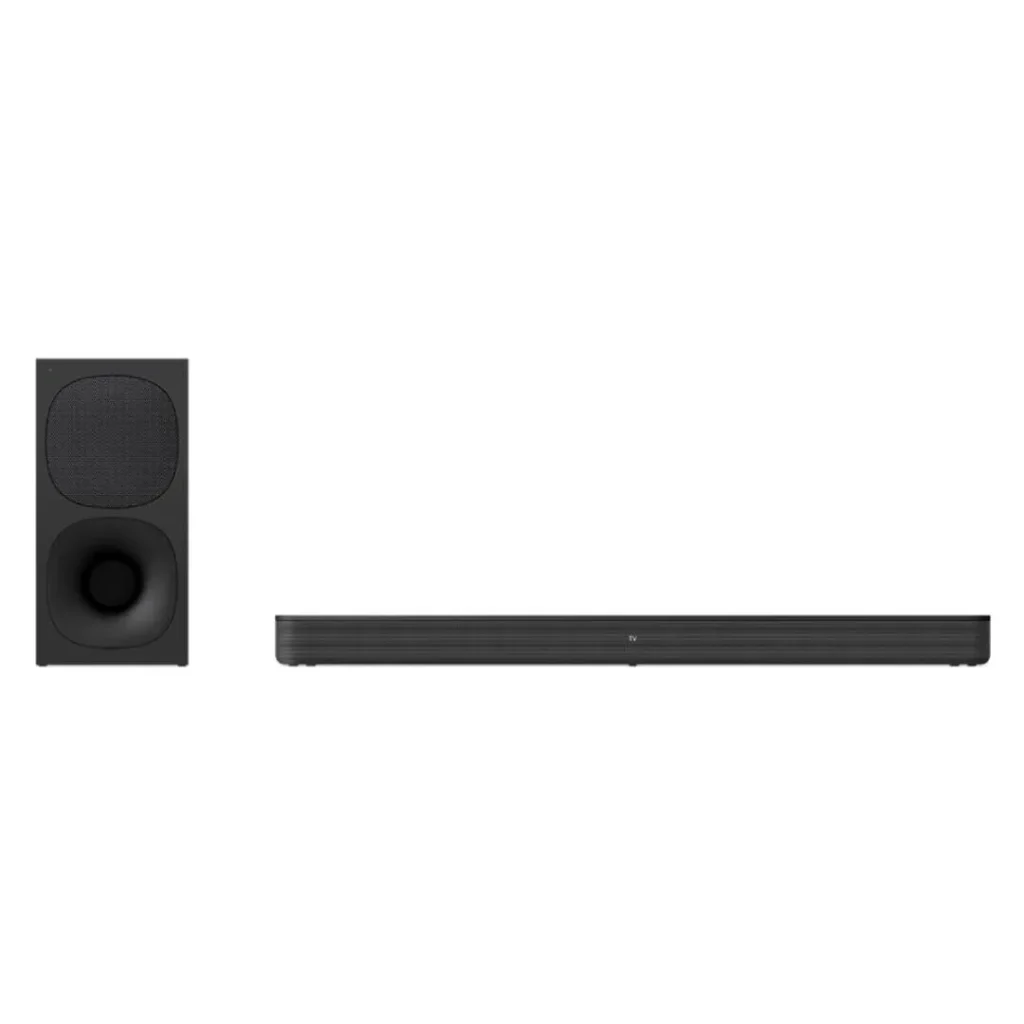
Sony HT-S400 is an established 2.1 soundbar package that combines a relatively slim television bar with a separate wireless subwoofer. Its appeal is a straightforward upgrade from TV speakers without a full receiver installation. The important limitations are equally clear: it has no dedicated centre channel, no rear-speaker system and no Dolby Atmos decoding. It should be evaluated as a simple front-of-room solution rather than an inexpensive substitute for every home cinema requirement.
Research-based review. This assessment draws on manufacturer documentation and the original published evaluations linked below. Audio Review has not performed a hands-on test of this model.
A simple TV route, with no source passthrough
The official specification lists an HDMI ARC connection and an optical input, but no HDMI source input. A console, disc player or streaming box therefore connects to the TV rather than passing through the soundbar. The television must deliver an audio format the Sony supports.
Check all of the sources you normally use during the return period. A soundbar can work with a built-in TV application yet remain silent with an external device using a different output setting. Keep the first setup simple, verify a supported signal and then restore any more complex arrangements deliberately. An HDMI socket on the bar is not evidence of video passthrough or eARC. Confirm the labels and documented functions before planning a cable route around capabilities that this model does not provide.
Sound evidence is positive but not unanimous
TechRadar’s original review is enthusiastic about the package’s impact and ease of use. RTINGS offers a more qualified view: it finds clear vocals and useful loudness, but notes upper-bass emphasis, limited deepest-bass rumble and a weak surround impression. Together these accounts support a practical television upgrade while arguing against inflated cinema expectations.
For an audition, use both ordinary speech and a scene with substantial effects. Listen for whether the subwoofer contributes useful weight or simply becomes the most noticeable part of the system. Compare at normal home level, not only at a dramatic shop demonstration setting. A fuller presentation than TV speakers can be satisfying without being balanced enough for every musical preference. The best judgement is whether the complete package improves the content you actually watch and remains easy to live with over a whole evening.
Virtual surround is not a rear-speaker system
Sony provides S-Force PRO Front Surround processing, but the physical system remains 2.1. The supported format list includes Dolby Digital and stereo LPCM, while Atmos and DTS:X are outside its decoding role.
Do not equate a surround-related marketing phrase with separately reproduced sound behind the listener. A processing mode can change the presentation from the front of the room without providing the placement of real rear speakers. If the main aim is tracking effects around a seating area, include systems designed for that task in the comparison. If the aim is clearer, fuller television sound with minimal equipment, a simpler layout may be preferable. The distinction should be made before buying, because extra enthusiasm about wattage cannot add physical channels that the system does not have.
Subwoofer placement and the meaning of wireless
The included bass unit receives its audio wirelessly from the bar, but it still needs electrical power. Its enclosure is large enough that placement deserves planning before delivery rather than being left to the final gap beside the furniture.
Start with an accessible position and assess bass from the main seat using both music and speech. Adjust the subwoofer level so it supports the bar without becoming a separate attraction on every soundtrack. If one seat has excessive boom while another has very little bass, try another practical location before deciding that maximum bass is the right setting. Keep access to the power connection and avoid placing the enclosure where it can obstruct movement. A two-box system is worthwhile only if both pieces can occupy sensible places in the room.
Everyday controls and useful restraint
The supplied remote offers Voice, Night and Sound Field functions, and the bar has a small display. Voice and Night modes can be useful for different circumstances, but the range of sound-adjustment tools is modest compared with more elaborate systems.
Try the modes with familiar content and leave the system in the configuration that helps most at your normal volume. A late-night setting need not be ideal for daytime music, so make sure other household members can change it without confusion. Check ordinary TV remote behaviour through the chosen connection rather than relying solely on the soundbar remote during setup. The strongest convenience feature is a system that starts correctly, produces understandable dialogue and adjusts predictably each day, without requiring repeated troubleshooting whenever the source changes.
Music, expansion and current value
Bluetooth receiving provides a straightforward music option, while the USB socket is for updates rather than playback from a memory stick. There is no analogue music input or network streaming platform built into this simple arrangement.
Consider whether that meets the intended routine. Occasional phone playback may be enough, whereas an established multiroom household may want a different system from the outset. This is also not a route to adding a full set of matching rear channels later. Compare current local pricing against alternatives with the channels, formats and controls you genuinely need. An older model can be good value at a sensible price, but a discount is less persuasive if the missing capability is precisely the one motivating the upgrade.
Alternatives to consider
Sony HT-S2000: HT-S2000 offers a different Sony starting point in an all-in-one enclosure. Compare whether the included HT-S400 subwoofer is useful in your room or whether a smaller initial arrangement better suits the space.
Sonos Beam Gen 2: Beam Gen 2 addresses a different feature and expansion brief. It is worth comparing when network music and Atmos support matter, with the complete system cost kept visible rather than only the entry price.
Sony HT-S400 key specifications
- Layout
- 2.1 with included wireless subwoofer
- HDMI
- One ARC TV connection; no source input
- Other audio input
- Optical digital
- Bluetooth
- 5.0 receiving; SBC
- Formats
- Dolby Digital and two-channel LPCM
- Sound controls
- Voice, Night and Sound Field
- USB
- Firmware updates only
- Atmos / DTS:X
- Neither
- Bar size W x H x D
- 900 x 64 x 88 mm
- Subwoofer size W x H x D
- 192 x 387 x 400 mm
Verdict
HT-S400 makes sense as a straightforward front-of-room sound upgrade with a separate bass unit, familiar TV connections and simple controls. Published tests support clearer, more substantial playback than basic television sound, while also identifying meaningful limits in surround and deep-bass performance.
Choose it for that focused role at an appropriate current price. If a dedicated centre, realistic rear effects, Atmos or network music is central to the plan, compare a system designed around those requirements before committing to this simpler package. Correct expectations and sensible placement matter more than the largest headline power figure.
Documentation and original reviews
Sony UK official HT-S400 specifications · Sony Europe official HT-S400 features and controls · RTINGS original HT-S400 sound and format assessment · TechRadar original HT-S400 listening and usability review
Editorial record
Sources and updates
Product specifications and factual claims were checked against Official Sony HT-S400 product page ↗. Scores and buying advice follow our category-specific editorial methodology.
- Published
- November 17, 2026
- Last updated
- November 17, 2026