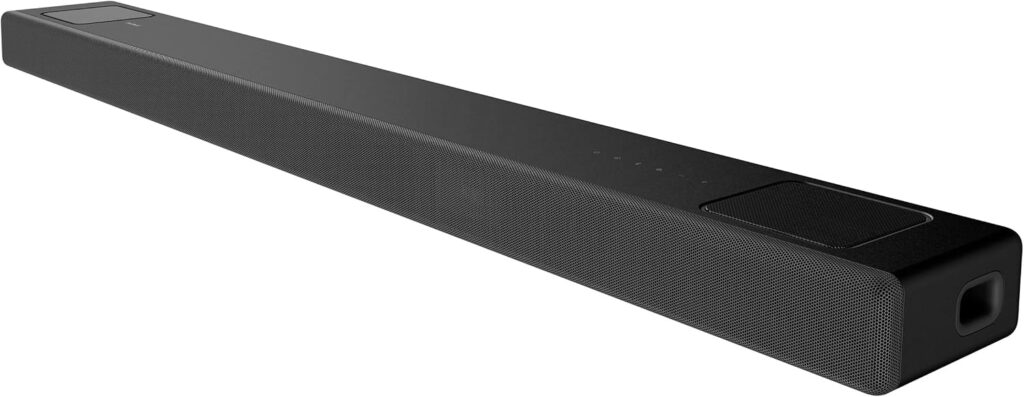
Sony HT-A5000 is a substantial 5.1.2 soundbar with physical up-firing drivers, built-in bass and a useful HDMI source input. Network music and optional rear speakers give it a broader role than basic television amplification. Its software history is important: current official support includes VRR and ALLM, so early reviews describing these as future additions no longer tell the whole connection story. This research-based review separates those documented updates from original listening impressions, and considers the bar alone before judging the more expensive expanded system.
Research-based review. This assessment draws on manufacturer documentation and the original published evaluations linked below. Audio Review has not performed a hands-on test of this model.
A broad film presentation, with bass caveats
AVForums’ original evaluation praises detail, staging and height precision, while finding the built-in bass comparatively basic and sometimes over-insistent on deeper voices. It also notes the absence of convincing physical rear effects from the standalone bar. That is a more useful buying distinction than treating the channel label as a complete account of the experience.
Use a familiar film passage with speech, quieter atmosphere and a demanding effect sequence. Check whether the tonal character remains consistent as the soundtrack changes rather than judging only the loudest moment. Then return to a normal television programme at the ordinary household level. A bar that sounds impressive during a demonstration should also make everyday speech comfortable. The Sony’s generous enclosure and physical height speakers support an ambitious front presentation, but they do not remove the need to hear bass integration and vocal balance. A buyer especially interested in tightly controlled music bass should compare that aspect directly with alternatives before deciding that more scale is the same as greater refinement.
Physical height does not mean physical surround behind you
The HT-A5000’s up-firing drivers distinguish it from smaller bars that rely entirely on virtual height. It remains a single enclosure at the front of the room unless compatible optional rear speakers are added. Sony’s 360 Spatial Sound Mapping expansion also depends on the appropriate rear hardware and software.
Keep the upward and side paths clear and follow the installation guidance rather than placing the bar inside a cabinet. Assess the actual ceiling, listening distance and seating width. A suitable soundtrack can reveal whether the room produces a useful sense of height, but no format label guarantees the same effect in every building. If clearly placed rear effects are the main objective, plan supported physical rears from the start. Check their mains power and mounting positions before counting them as an easy later addition. A simple front-only installation can still be the right compromise for a shared living room. The important point is to choose that compromise knowingly, without comparing a single bar at home with an expanded system demonstrated elsewhere.
HDMI support has improved since the early reviews
Sony’s official software history records VRR and ALLM support, alongside earlier spatial-mapping and accessory updates. These changes matter when reading launch-period descriptions. The bar provides one source HDMI input and an eARC/ARC output, with 4K/120 support documented for this model. Current firmware should be part of the installation check.
Map the console or player route and test the exact video and audio settings used in the household. Check the television’s relevant HDMI socket, cable suitability and source configuration rather than assuming that an HDMI connection automatically enables every advanced mode. Decide whether the source belongs at the bar or at the display, depending on which route preserves the required features most reliably. Use a known soundtrack to verify the audio output independently from the picture settings. Do not infer support for every HDR or gaming feature from one successful mode. The source input is a useful practical advantage, especially where the television cannot pass a required audio signal, but one input is still a finite resource when several demanding sources are involved.
Music flexibility is stronger than a Bluetooth-only design
AirPlay 2, Chromecast built-in and Spotify Connect provide network playback options. Optical and USB music broaden source choice, while Bluetooth reception supports SBC, AAC and LDAC according to Sony’s specification. Bluetooth transmission is a separate facility and should be checked against the intended headphones and listening requirement.
Try the same familiar music through the normal daily route, with sound-field processing both enabled and disabled where appropriate. AVForums preferred a less processed presentation for some music and found that bass weight could obscure clarity in other settings. Treat that as guidance for an audition, not a universal preset. A soundbar used for albums as well as films should make the transition between those roles straightforward. Check account switching, standby recovery and volume operation with the actual phones. Avoid assuming that every casting route carries the same format or that a service named in an old review still offers the same special catalogue. Convenient access and a coherent balance are more useful than a list of rarely used playback logos.
Optional components change the price and the performance
A separate Sony subwoofer and compatible rear speakers can add capabilities unavailable from the bar alone. The current official software history also expands accessory support, making exact model and firmware checks more reliable than repeating a list from an older test. The basic HT-A5000 package should not be described as including those components.
Calculate the final system price with all planned speakers, stands and practical installation costs. Compare that complete amount with a rival bundle that already includes bass and rear units. Wireless links simplify signal cabling but do not eliminate power requirements or the need for sensible placement. Audition the chosen subwoofer with the bar if possible, listening for integration rather than just stronger rumble. A useful upgrade should improve coherence and involvement at normal levels as well as increase impact. Starting with the bar can make sense when the standalone result is already satisfying. It is less convincing when the purchase depends on an undefined future accessory solving a sound balance that is not currently enjoyable.
A large enclosure needs a measured installation
At approximately 1210 mm wide, 67 mm high and 140 mm deep, this is a substantial piece of equipment. Its roughly 6.1 kg weight and rear connection clearance belong in a furniture or mounting check. The control arrangement includes the supplied remote, television interface and Sony Music Center; newer BRAVIA Connect instructions should not be applied automatically to this generation.
Measure the screen clearance and make sure the remote receiver is not obstructed. Confirm the exact compatible television before relying on Sony-specific centre-channel integration. Test ordinary tasks from the sofa, including volume, source changes, standby and returning to a preferred sound mode. Keep an accessible record of the working source settings so another user can recover normal sound after experimentation. A premium bar should reduce friction rather than require constant adjustment. The HT-A5000 earns attention where its source input, network facilities and expansion route are all relevant. Its value is more conditional when the room cannot accommodate the enclosure or when a simpler complete bundle better matches the actual listening priorities.
Alternatives to consider
Sonos Arc Ultra: Compare musical expression, room presentation and the app platform, noting the different source-connection arrangement and the cost of any optional speakers.
Samsung HW-Q800F: Assess this supplied-subwoofer package against the Sony configuration actually being purchased. Included components and final local price matter more than comparing bar-only headline figures.
Sony HT-A5000 key specifications
- Base configuration
- 5.1.2 single soundbar; built-in bass
- Height speakers
- Physical up-firing drivers
- HDMI
- One source input; one eARC/ARC output
- Video path
- 4K/120 support; VRR / ALLM with appropriate current software
- Other inputs
- Optical; USB music playback
- Network music
- AirPlay 2; Chromecast built-in; Spotify Connect
- Bluetooth
- Reception SBC / AAC / LDAC; transmission SBC / LDAC
- Dimensions
- 1210 × 67 × 140 mm
- Weight
- Approximately 6.1 kg
- Separate subwoofer / rears
- Optional; not included in basic bar package
- 360 Spatial Sound Mapping
- Compatible optional rears and appropriate software required
- Control
- Remote; Sony Music Center; television interface
- HDMI audio formats
- Includes Dolby Atmos, Dolby TrueHD, DTS:X, DTS-HD Master Audio and LPCM
Verdict
The HT-A5000 offers a well-equipped premium platform with physical height drivers and a useful updated HDMI path. Original listening evidence supports detail and staging while qualifying built-in bass and standalone surround reach. Confirm current firmware, audition music and dialogue, and compare the exact expanded-system cost. Its strongest case is a considered fit with the room and sources, rather than a purchase based on channel count alone.
Documentation and original reviews
Sony official HT-A5000 specifications · Sony official HT-A5000 features and video support · Sony official software history including VRR, ALLM and accessory support · AVForums original HT-A5000 listening and installation evaluation
Editorial record
Sources and updates
Product specifications and factual claims were checked against Official Sony HT-A5000 product page ↗. Scores and buying advice follow our category-specific editorial methodology.
- Published
- November 17, 2026
- Last updated
- November 17, 2026