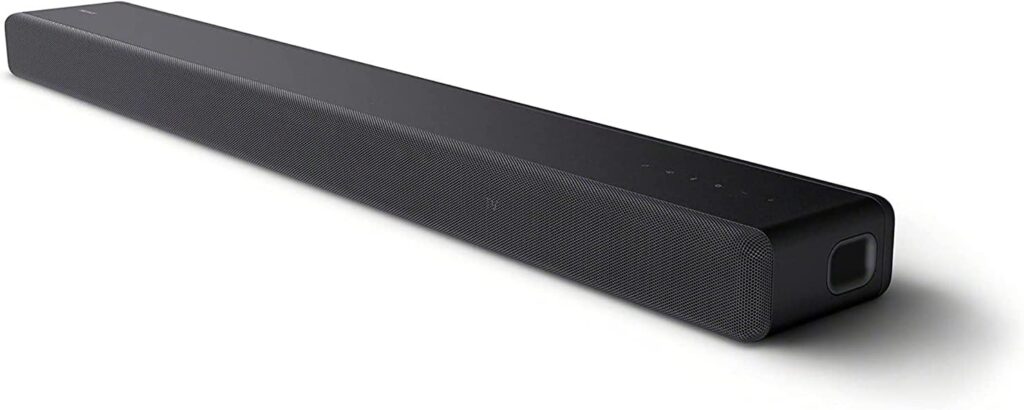
Sony HT-A3000 combines a compact 3.1 layout with useful network music facilities and optional wireless expansion. Its built-in bass drivers allow a tidy bar-only installation, while eARC carries television audio without a separate source input. Atmos and DTS:X compatibility rely on virtual processing in this configuration: there are no physical up-firing speakers. This research-based review considers the exact standalone product first, then the cost and setup implications of optional speakers. The distinction matters because an expanded demonstration can sound substantially different from the single bar supplied in the box.
Research-based review. This assessment draws on manufacturer documentation and the original published evaluations linked below. Audio Review has not performed a hands-on test of this model.
A compact bar with a qualified sound case
AVForums’ original evaluation favours the HT-A3000’s detail and staging, while recognising limited standalone bass and the expense of expansion. What Hi-Fi hears useful detail and dynamics but is less positive about vocal balance, energy and the projection of height effects. Those differences make a short comparative audition more useful than treating either judgement as a universal result.
Start with ordinary dialogue and a familiar piece of music at the level used in the household. Check whether voices remain natural through busy passages and whether bass supports the presentation without making male speech sound over-emphasised. Then compare a film scene with the sound-field processing enabled and disabled. Prefer the setting that improves the actual programme rather than assuming that more processing always reveals more information. This is a practical all-purpose bar, but a buyer particularly sensitive to sibilance or musical timing should hear those aspects before committing. Its modest physical footprint is helpful only if the everyday sound remains enjoyable.
Virtual height and optional spatial mapping are different
Sony documents three front channels with built-in dual bass drivers. Vertical Surround Engine and S-Force PRO Front Surround create spatial effects from that arrangement. The separate 360 Spatial Sound Mapping setting requires compatible optional rear speakers; it is not a hidden bar-only mode that recreates the complete expanded installation.
Judge the single bar from the main seats with appropriate material. Do not infer rear localisation from a diagram showing phantom speakers around a room. A listener who needs clearly placed effects behind the sofa should include physical rears in the initial plan, with power and mounting positions checked in advance. Conversely, a smaller household may prefer an unobtrusive front-only system to an ambitious layout that cannot be installed properly. Keep the bar exposed rather than enclosed behind furniture. Even virtual processing benefits from sensible placement, and the television screen should remain unobstructed. Choose the practical speaker layout first, then decide whether the available processing adds useful involvement to that layout.
The television supplies every external source
There is one HDMI output with eARC/ARC and no separate HDMI input. A console, disc player or streaming box therefore normally connects to the television, which passes audio onward. The official specification also provides optical input, but that path should not be assumed to carry every format available through eARC.
Write down the actual sources and verify the television’s handling of each required audio format. Test internal apps separately from external equipment, because success with one source does not prove that all settings are correct. Check synchronisation, standby recovery and volume control with the normal remote. The absence of a source input can be perfectly acceptable in a modern installation, but it is a relevant boundary where the display blocks a desired format. Avoid buying a converter before understanding what the television already supports. A more expensive bar is not automatically a simpler system if its connections differ from the intended route. The HT-A3000 makes most sense when a reliable television-return path already exists.
Network music is a genuine part of its appeal
The official product page confirms AirPlay 2, Chromecast built-in and Spotify Connect. These are independent network playback routes, rather than merely a phone-control app attached to a Bluetooth-only speaker. Sony also documents USB music playback and Bluetooth reception with SBC, AAC and LDAC, subject to the capabilities of the source.
Use the family’s normal phones and music accounts when assessing convenience. Check how playback starts, how volume is adjusted and what happens when another person takes over. Do not assume that a particular service or casting route delivers the same format through every app and handset. Network playback can be more convenient than leaving a phone occupied as a Bluetooth source, while USB may suit a small local collection. A buyer who already uses a particular multiroom platform should examine that ecosystem’s actual grouping options rather than expecting all wireless speakers to work together. The best connection is the one that remains understandable to ordinary users after the initial setup is finished.
Expansion needs a complete price and firmware check
The optional Sony subwoofer and rear-speaker route can change both impact and spatial presentation. Sony’s help guide ties Sound Field Optimization to optional speaker hardware, and provides separate distance, level and sound-field settings. Those instructions should not be described as unconditional automatic room correction for the standalone bar.
Check the exact accessory models against current official compatibility information and install the appropriate software before expecting a new combination to work. A shared Sony badge is not sufficient evidence of compatibility. Add the cost of every planned component, plus suitable stands or mounting arrangements, before comparing competing packages. Remember that a wireless signal link still leaves each powered component needing mains electricity. It can be sensible to start with a bar and expand later, but only when the bar-alone performance is already acceptable and the supported route is clear. Do not justify a weak initial fit by assuming that an unspecified future purchase will solve every tonal or spatial concern.
Control, dimensions and everyday living
At approximately 950 mm wide and 64 mm high, the HT-A3000 fits furniture that cannot accommodate some larger premium bars. Its depth and cable clearance still need measuring. The supplied remote, television interface and Sony Music Center belong to this generation’s control arrangement; instructions for newer BRAVIA Connect models should not be substituted automatically.
Test the activities repeated most often: changing input, returning from standby, adjusting volume and selecting an ordinary listening mode. Confirm any Acoustic Center Sync feature against the exact compatible television rather than assuming it works with every display. Keep the setup simple enough that another household member can restore normal sound after using a different source. The compact enclosure and built-in bass minimise equipment clutter, but they do not remove the need for an accessible power socket and a sensible position beneath the screen. Value is strongest when the documented connections and unexpanded sound already suit the room, with optional speakers treated as a deliberate upgrade rather than an essential surprise.
Alternatives to consider
Sonos Beam Gen 2: Compare dialogue, musical expression and the network platform in a similarly compact installation. Price any optional bass and rear additions as part of the final system.
Sennheiser AMBEO Soundbar Mini: Another compact virtual-surround approach worth hearing in the intended room. Check its physical connections and expansion route against the Sony rather than choosing from the format logo alone.
Sony HT-A3000 key specifications
- Basic layout
- 3.1; built-in dual bass drivers
- Physical up-firing drivers
- None
- Television audio
- HDMI eARC/ARC; optical
- HDMI source input
- None
- Network playback
- AirPlay 2; Chromecast built-in; Spotify Connect
- USB
- Music playback; check supported file formats
- Bluetooth reception
- SBC, AAC, LDAC
- Bluetooth transmission
- SBC, LDAC
- Dimensions
- 950 × 64 × 128 mm
- Weight
- Approximately 4.6 kg
- Expansion
- Compatible optional Sony subwoofer / rear speakers
- 360 Spatial Sound Mapping
- Requires compatible optional rear speakers
- Control
- Supplied remote; Sony Music Center; TV interface
Verdict
The HT-A3000 is a versatile compact bar with stronger network facilities than many simpler television packages. Its virtual-height approach and built-in bass have practical limits, while original listening assessments give good reasons to audition dialogue and music carefully. Confirm the eARC route, compare the complete expansion price and choose it for the exact configuration the room can support.
Documentation and original reviews
Sony official HT-A3000 features and network playback · Sony official HT-A3000 specifications · Sony official speaker setup and optional-hardware optimisation · Sony official 360 Spatial Sound Mapping requirements · AVForums original HT-A3000 evaluation · What Hi-Fi original HT-A3000 listening review
Editorial record
Sources and updates
Product specifications and factual claims were checked against Official Sony HT-A3000 product page ↗. Scores and buying advice follow our category-specific editorial methodology.
- Published
- November 17, 2026
- Last updated
- November 17, 2026