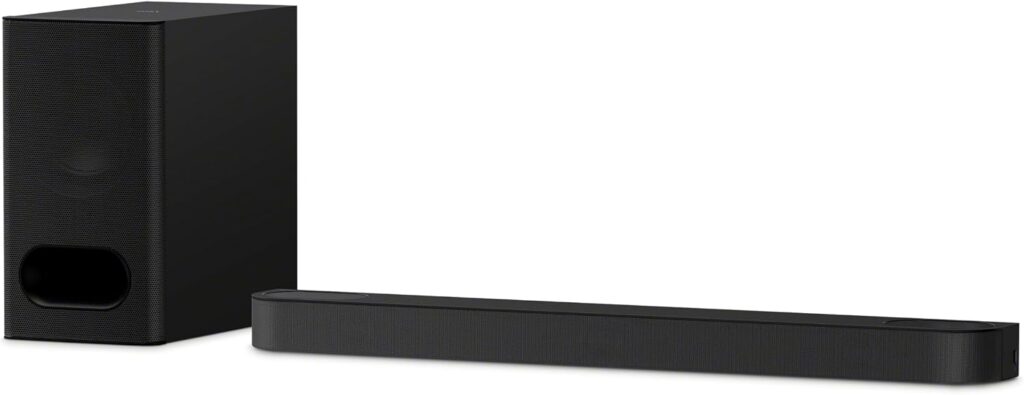
Sony BRAVIA Theatre Bar 6 combines a 3.1.2 soundbar with a substantial supplied subwoofer. Physical up-firing drivers make height reproduction part of the hardware plan, while HDMI eARC and optical handle television sources. The BRAVIA Connect app supports setup and control, but this is not a Wi-Fi music-streaming system. Original listening assessments favour its film scale and bass impact more consistently than its refinement. It is also a different product from BRAVIA Theatre System 6, so the shared number should not be used to infer the same speakers or expansion facilities.
Research-based review. This assessment draws on manufacturer documentation and the original published evaluations linked below. Audio Review has not performed a hands-on test of this model.
Film scale is the attraction, with bass qualifications
What Hi-Fi’s original review finds impressive scale and height effects for the category, but criticises dominant bass, limited bass agility and integration with the main bar. TechRadar is more positive about the overall balance, while noting a narrower soundstage than desired. Both provide reasons to audition the complete package rather than judge it from the subwoofer size.
Use a dialogue scene, a busy action passage and a familiar music track. Listen at the normal household level and then a quieter evening level. Check whether bass supports the soundtrack without masking speech or appearing as an unrelated lump of energy. Make a moderate level adjustment if needed, keeping the same test passage for comparison. The setting used in another review is not a universal prescription for a different room. The evidence supports a buyer who prioritises impact and scale, while leaving refinement and tonal balance as important personal checks. A soundbar should remain satisfying between dramatic effects as well as during them.
Physical height drivers still depend on the installation
Sony documents up-firing speakers in a 3.1.2 layout. Their presence distinguishes Bar 6 from a purely virtual-height compact bar, but it does not guarantee a convincing result in every room. The supplied arrangement has no physical rear speakers behind the seats.
Keep the upward path clear and follow the documented placement rather than putting the bar inside a shelf. Consider the actual ceiling and listening distance during setup. An unusual room or very open layout should be assessed on its own merits rather than assumed to behave like the review environment. Listen to an appropriate known soundtrack and decide whether the sense of height adds useful involvement. Do not treat an Atmos label as proof that an effect appears in a particular location. A two-piece system may be the most practical answer where rear placement is impossible. A buyer specifically seeking sound from behind should compare a supported complete surround system before committing. The best choice follows the room and desired effect, not the largest number of logos available at the price.
BRAVIA Connect is a setup tool, not a network streamer
Sony’s official help guide directs the user to install BRAVIA Connect and follow its setup instructions, with current software recommended for the available functions. That app connection is separate from independent Wi-Fi music playback, which this model does not provide.
Use the intended smartphone during the return period and check the ordinary tasks: changing volume, adjusting bass, returning from standby and selecting the desired mode. TechRadar’s original evaluation records delayed responses through its app setup. That is a specific tested experience rather than proof that every current handset and firmware combination behaves identically, or that a later version has necessarily fixed it. Check the actual routine. The supplied remote remains relevant for quick everyday operation, while the app provides a clearer view of settings than the bar’s indicator lights. A successful setup should be repeatable without guessing which sound mode or input is active. Do not buy on the assumption that an associated app automatically includes casting, multiroom or direct access to a music service.
The TV return path carries the source system
The official specification lists HDMI OUT with eARC/ARC and an optical input, with no separate source HDMI input. External players and consoles therefore normally connect to the television, which must send an appropriate audio signal onward to the soundbar.
Map each source before choosing cables. Check the actual television’s format handling and output settings, including internal apps and any demanding console or player mode. Sound from one programme does not establish that every source is configured correctly. Optical can be useful for an older display, but it should not be assumed to carry all formats available through a suitable eARC connection. Test synchronisation and ordinary remote control from the sofa. Avoid adding converters unless the required path and their limitations are clear. A bar with a source input may suit a different installation better. Bar 6 is easiest to recommend when the existing television already supplies a reliable audio-return route for everything the household watches. That keeps the two-piece package simple instead of surrounding it with unplanned accessories.
The included subwoofer needs room, power and a useful position
The official dimensions show a bass enclosure approximately 210 mm wide and 388 mm in both height and depth, weighing around 7.7 kg. Its signal link is wireless, but it still requires mains power. The supplied feet also change the height of the bar, so they belong in a clearance check.
Measure the furniture and floor position with connectors attached. Keep the bass enclosure secure and its documented operating space unobstructed. Try practical positions before hiding it permanently, judging both ordinary music and film speech through transitions. A corner may reinforce bass more than desired; a less convenient-looking location may produce a more coherent result. Keep changes controlled and avoid treating a stronger rumble as an automatic improvement. The two components were designed as a package, so simply removing the subwoofer is not a reasoned way to judge the intended system. The appeal is substantial bass from a relatively simple installation. That works best when the room can accommodate the bass unit sensibly and its level can be set for the actual seats.
Model identity and complete-system value deserve attention
Bar 6 should be distinguished from Theatre System 6 and from higher Sony soundbars with different source and optional-speaker facilities. Bluetooth SBC and AAC provide phone playback, while the USB connection is for updating rather than music or a computer DAC role. Those boundaries are useful before a purchase expands beyond ordinary television sound.
Confirm the exact retail model, included accessories and local warranty. Do not assume compatibility with an arbitrary Sony rear speaker or replacement subwoofer based on the brand name. If physical rear channels or network music are essential, choose a documented system that supports them rather than relying on an unspecified later addition. Compare current complete offers, including all components required for the listening plan. A bar-only competitor may need an extra bass purchase, while a larger bundle may already include surrounds. The Sony is strongest when the supplied two-piece format, actual TV path and film character already meet the requirement. Its value becomes less compelling when several missing functions need workarounds or the buyer prefers a more restrained and integrated presentation.
Alternatives to consider
Sonos Beam Gen 2: Compare this more compact networked bar when source platform and refinement matter more than supplied bass weight. Include optional subwoofer or rear equipment in the full price if those are part of the plan.
Samsung HW-Q800F: This is another package to assess for a television room when network facilities and its expansion route are useful. Compare the actual source arrangement, included components and current local price.
Sony BRAVIA Theatre Bar 6 key specifications
- Product
- BRAVIA Theatre Bar 6 / HT-B600 family
- Not the same as
- BRAVIA Theatre System 6
- Basic layout
- 3.1.2; physical up-firing drivers
- Included
- Main bar and wireless-signal subwoofer
- TV connections
- HDMI eARC/ARC; optical
- Separate HDMI source input
- None
- USB
- Software update only
- Phone music
- Bluetooth SBC / AAC; no built-in Wi-Fi streamer
- Setup app
- Sony BRAVIA Connect
- Bar dimensions
- 950 × 64 × 110 mm; height 77 mm with supplied feet
- Subwoofer dimensions
- 210 × 388 × 388 mm
- Bar / subwoofer weight
- Approximately 3.1 / 7.7 kg
- Power
- Mains required for both components
- HDMI eARC audio formats
- Includes Dolby Atmos, Dolby TrueHD, DTS:X and up to 7.1-channel LPCM
Verdict
BRAVIA Theatre Bar 6 is a substantial two-piece film system with physical height drivers and useful app-led control. Original reviews support scale and bass impact while qualifying refinement and spatial performance. Audition the bass balance, confirm the TV return path and test the current app routine. Choose it as the exact supplied package, with realistic expectations about music streaming and future expansion.
Documentation and original reviews
Sony official UK BRAVIA Theatre Bar 6 product features · Sony official Bar 6 specifications, codecs and update-only USB · Sony official Bar 6 app-led setup guidance · What Hi-Fi original Bar 6 comparative listening review · TechRadar original Bar 6 sound and usability evaluation
Editorial record
Sources and updates
Product specifications and factual claims were checked against Official Sony BRAVIA Theatre Bar 6 product page ↗. Scores and buying advice follow our category-specific editorial methodology.
- Published
- November 17, 2026
- Last updated
- November 17, 2026