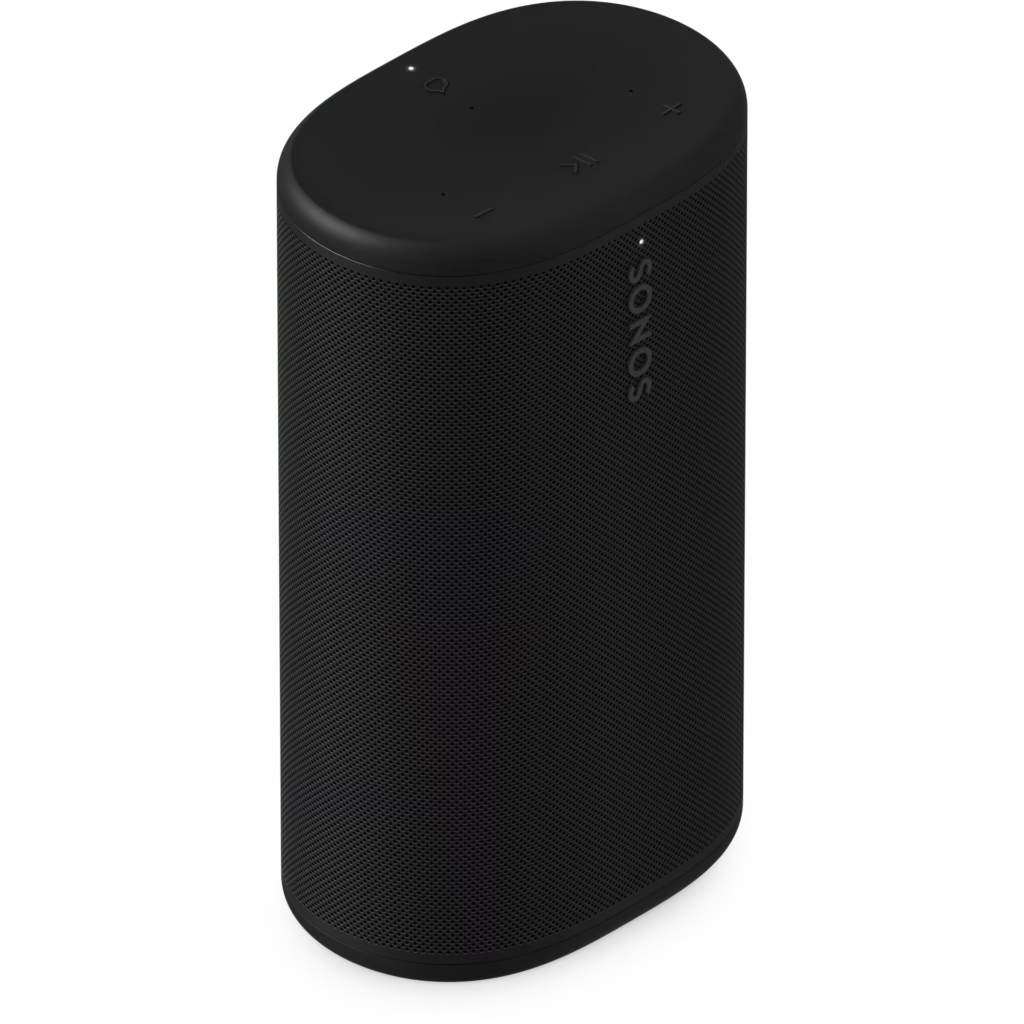
The Sonos Play combines a home-network speaker with a portable battery design. That places it between a permanently installed smart speaker and a simple Bluetooth travel speaker. Its appeal is the ability to use one product in both roles, but the app, charging accessories and optional wired connections remain part of the ownership decision.
A home speaker that can leave the shelf
Sonos documents two angled tweeters, one mid-woofer and three Class-H amplifiers. That architecture provides the basis for its compact stereo presentation, but we have not measured dispersion, bass extension or maximum clean output. A single enclosure should not be assumed to create the same separation as two deliberately spaced speakers.
The specified weight is 1.3 kg, with dimensions of approximately 192.3 by 112.5 by 76.7 mm. It is portable rather than pocket-sized. Decide whether the main use is moving between rooms, occasional outdoor listening or regular luggage travel; those are different carrying requirements.
Wi-Fi and Bluetooth serve different situations
Wi-Fi 6, Bluetooth 5.3 and AirPlay 2 are listed. Wi-Fi supports the home-system role, while Bluetooth is useful away from the local network. Feature availability still depends on the selected connection, app and source, so the full home-system experience should not be assumed in every portable situation.
Automatic Trueplay is documented, with Sonos noting app and Wi-Fi requirements to enable it. The microphone switch disconnects power to microphone hardware. These are useful ownership details for users who want to control voice and room-adjustment functions deliberately rather than leave every option enabled by default.
Battery serviceability and charging costs
Sonos advertises up to 24 hours of playback and describes battery replacement as a serviceable ownership route. Neither establishes real endurance at a particular outdoor volume or the availability and cost of a replacement years later. Check the current regional support and instructions before treating serviceability as guaranteed lifetime support.
A charging base is included, but the official package requires a USB-PD adapter rated at 18 W or more, sold separately. That distinction matters when comparing prices. The base is for indoor use and should not inherit the speaker’s weather-resistance rating.
Optional wired connections need optional accessories
USB-C can provide analogue line input through the Sonos Line-In Adapter, or Ethernet through the Combo Adapter. Both are separately sold. This is not a promise of direct USB digital audio from every laptop or phone simply because the connector is USB-C.
For a turntable, an appropriate phono stage is still needed before a line-level connection. A USB-C adapter does not perform cartridge equalisation or supply speaker amplification to another passive product. Map the complete signal path before buying several adapters.
IP67 protection is useful for portable use, but charging care remains necessary. Dry the relevant areas and keep the indoor base protected. Compare the total setup with a simpler Bluetooth speaker if Sonos grouping will rarely be used. We have not tested wireless reliability, automatic tuning or sound quality, so those remain practical checks during an audition or return period.
What to expect in a real setup
Is everything needed for charging included? The base is included, but Sonos specifies a separately sold USB-PD power adapter of 18 W or greater. Check what you already own.
Can I plug a turntable straight into USB-C? A compatible Sonos line-in adapter and an appropriate line-level signal are required. A turntable without phono amplification needs that function separately.
Sonos Play’s home and away roles
A speaker that moves between the shelf and a trip needs both routines checked. Test the normal home network service and the actual phone’s Bluetooth playback separately, then rehearse the transition. A feature available on home Wi-Fi should not be assumed identical away from that network. The useful portability is a dependable change of setting, not simply a battery figure beside a home-speaker name.
At 1.3 kg, Play is a carried speaker rather than a tiny pocket accessory. Try the route and bag normally used. A larger format may be worth taking for a gathering, while a lighter alternative may be used more often on a long walk. Compare the actual listening distance and handling rather than assuming more enclosure always means more value.
Charger and input adapters belong in the price
The documented USB-PD charging requirement and separately sold adapter should be included in the purchase plan. A USB-C plug alone does not prove a supply provides the intended charging behaviour. Test the actual cable and power source before travel and leave margin for volume, settings and battery age. A maximum runtime claim does not establish personal endurance under every condition.
Wired expansion also requires the appropriate Sonos accessories and source signal. Do not treat the speaker’s USB-C socket as a universal computer-audio input or assume a generic lead substitutes for every adapter. A record player may need a phono stage before a line-input route. Check the complete path and cost instead of assigning value to a socket without its operating role.
A practical supported system
Choose sensible stable placement and keep the driver paths clear. Compare familiar material at similar levels when changing location or sound settings. For linked or paired use, verify exact model compatibility and intended mode rather than assuming every Sonos product is interchangeable in every role.
Follow the care and drying guidance after wet use before charging; the speaker’s IP67 rating should not be expanded to every accessory. For used stock, check reset/setup, controls, charging and applicable support within the return period. Play is strongest when its actual home-network and portable routines are both useful regularly, with the complete charging and adapter package counted honestly in the final price.
Alternatives to consider
Sonos Era 100: A more stationary Sonos option when battery operation and outdoor use are unnecessary.
Sonos Move 2: Compare the larger portable Sonos format when carrying size and budget permit a different system scale.
Sonos Play key specifications
- Driver arrangement
- 2 angled tweeters; 1 mid-woofer
- Amplifiers
- 3 Class-H
- Wi-Fi
- Wi-Fi 6
- Bluetooth
- 5.3
- Apple integration
- AirPlay 2
- Protection
- IP67 speaker
- Weight
- 1.3 kg
- Claimed playback
- Up to 24 hours
- Charging requirement
- USB-PD 18 W or greater adapter, sold separately
- Wired expansion
- Optional Sonos line-in / Combo adapters
Verdict
The Sonos Play is most attractive when both home integration and portability will be used regularly. Its serviceable battery concept and connection options are practical benefits, but adapters and charging costs belong in the comparison. Choose it for system fit rather than untested assumptions about sound quality.
Primary documentation
Specifications and feature descriptions were checked against the following official documents on 6 November 2026. Compatibility advice is our interpretation of those documented capabilities; it does not establish measured sound quality. Regional bundles, software features and service availability can change, so verify the exact European model and current support information before purchase.
Editorial record
Sources and updates
Product specifications and factual claims were checked against Official Sonos Play product page ↗. Scores and buying advice follow our category-specific editorial methodology.
- Published
- November 7, 2026
- Last updated
- November 8, 2026