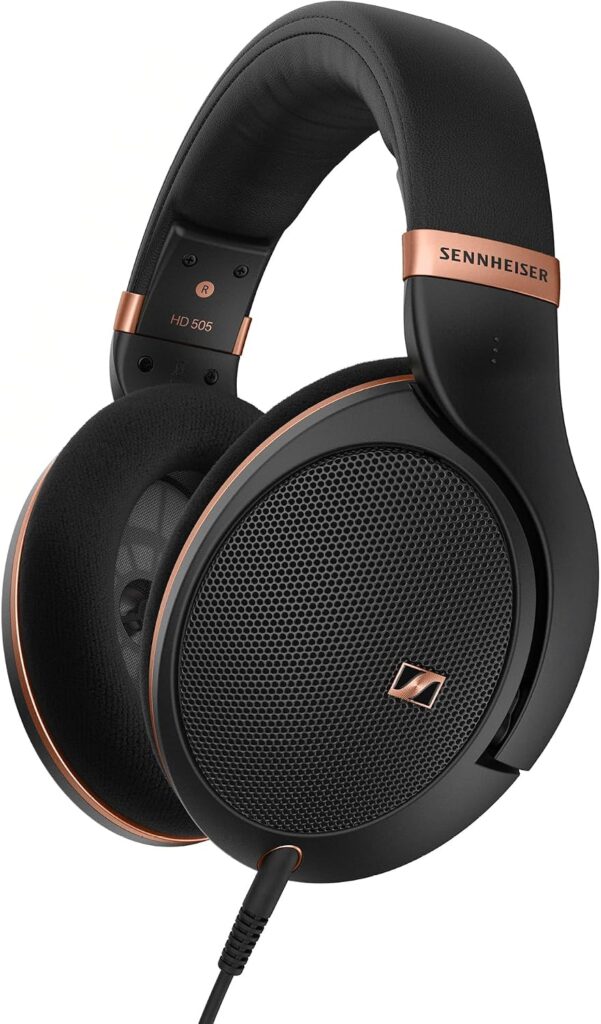
The Sennheiser HD 505 is an inviting home-listening headphone with an awkward commercial challenge: it competes with several established models from its own manufacturer. The light construction and conventional cable arrangement make it approachable, while published listening tests suggest an appealing but not universally preferred balance. Choosing it well means considering the complete package rather than treating it as the automatic replacement for every older HD 500 model.
Sennheiser HD 505 — A light design with a deliberately narrow job
Sennheiser documents a weight of 237 g without the cable, synthetic velour pads and a dynamic open-back arrangement. Those are sensible foundations for a headphone that will spend most of its life at a desk or in a listening room. The low weight is an attraction, but it is the distribution of pressure around your particular head that decides whether a long session remains comfortable.
The HD 505 does not try to hide what sort of product it is. The open grilles are part of an unsealed acoustic system, so room noise remains audible and music can reach the people nearby. For a person listening alone, that may be an acceptable compromise. For a shared workspace, it can make the headphone unsuitable regardless of the quality of its drivers or the enthusiasm of its reviews.
The official UK product information concerns the Copper Edition. A finish designation should not be treated as a separate level of acoustic performance without supporting evidence. Confirm the precise package and accessories on the retailer’s listing, particularly when comparing offers from different territories. Cosmetic preference is a legitimate reason to choose one finish, but it should not substitute for a listening comparison.
The published sound picture is positive, with reservations
SoundGuys praises the HD 505’s sound, comfort and accessibility, while its measurement discussion identifies elevated upper-midrange energy relative to its preferred studio target. The same review also notes that the deepest bass does not follow its consumer target completely. This is useful evidence of a distinct tonal choice, rather than proof that the headphone will sound wrong to everyone outside a single listener profile.
What Hi-Fi describes the HD 505 as a smooth, detailed and comfortable listen. The different emphasis between those reviews is a reason to audition familiar material, not a reason to average their adjectives into a new certainty. A listener may find the presentation clear and articulate while another notices an edge on voices or cymbals. Both responses can coexist with the same physical product.
Our assessment therefore favours the HD 505 as a considered starting point for open-back listening. It is less persuasive as an unquestioned upgrade from an existing headphone you already enjoy. Compare the way it handles vocal presence, low-frequency weight and the texture of busy recordings, with volume matched closely enough that a louder presentation does not win by default.
How to judge brightness without chasing detail
A headphone that makes the upper range more obvious can initially seem especially revealing. That first impression needs a longer check. Listen to a recording with natural vocal sibilants, a bright cymbal part and a dense arrangement in which you know the balance. The question is whether the HD 505 makes them easier to follow without making their relationship to the rest of the music feel exaggerated.
This is not a recommendation to turn the level up until every small production detail becomes obvious. Hearing more at a higher level is not a fair comparison, and fatigue can make an exciting first impression less appealing after an hour. Use the level you would normally choose at home and assess whether you still want to continue listening.
Equalisation is an option, but a supplied headphone should still be acceptable for the situation in which you will use it. A correction that works in a desktop application may not follow you to another source. If a substantial adjustment is essential to make the HD 505 enjoyable, include the practicality of applying that adjustment in the purchase decision instead of assuming that software makes every competing headphone equivalent.
Connections are straightforward, with one compatibility check
The supplied 1.8 m cable uses a 3.5 mm plug, accompanied by a screw-on 6.35 mm adapter. That is a useful everyday arrangement for moving between suitable small headphone sockets and larger hi-fi outputs. The adapter changes the connector size; it does not add conversion, extra output power or a different listening mode.
The earcup end of the cable uses a locking connector. SoundGuys identifies that arrangement as a practical annoyance in its review, although a replaceable cable is still preferable to one that cannot readily be changed. When ordering a spare, verify the actual plug and locking fit for the HD 505. Buying a lead simply because it has the correct source-end connector can leave you with an unusable accessory.
For a phone or computer with only USB connections, a suitable USB audio adapter or DAC with a headphone output is required. An optical socket on a television is another different signal path again. The HD 505 is an analogue listening device, so the source must ultimately provide the correct analogue output rather than just a socket that can be connected with an inexpensive shape-changing lead.
Amplification should solve an identified need
The official specification lists 120 ohms and sensitivity of 107.9 dB at 1 kHz for 1 V RMS. That combination calls for a source with adequate clean voltage, not an assumption that an exotic amplifier is part of the headphone’s purchase price. Try the output already available and establish whether the available level, volume adjustment and noise performance are satisfactory.
A dedicated desktop unit can be useful when a computer output is noisy or when greater adjustment range is needed. Extra headroom can also help if the chosen equalisation requires a lower digital preamplifier setting. These are functional reasons to consider another device. They are more useful than attributing a specific musical character to an amplifier you have not compared.
The same caution applies to advertised maximum sample rates. A larger format number on an accompanying DAC does not establish a better match for this headphone. Check the source’s real output facilities and operating requirements, then concentrate on the recordings, fit and listening level. The HD 505 should be part of a manageable system rather than an excuse to accumulate extra equipment.
Long-term ownership and value
The replaceable cable and conventional pad arrangement are worth considering for a product intended for regular use. Before purchase, check the current replacement-parts route in your country. Pads are wear items as well as acoustic components: a different material or a heavily compressed original set can change the experience. Treat changes to the pad assembly as something to evaluate, not as a purely cosmetic refresh.
SoundGuys also notes that the headband can require adjustment to get used to. That is a reminder to assess comfort with glasses and during ordinary movements, rather than relying only on the quoted weight. If the headphone is intended for a shared household, test the practical implications of leakage as carefully as the physical fit.
Value is unusually dependent on neighbouring Sennheiser prices. The HD 560S, HD 550 and HD 600 can move around relative to each other during local promotions. Compare final European prices and warranty terms at the time of purchase. The HD 505 is attractive when its fit, package and preferred tonal balance align; its model number alone does not make the alternatives obsolete.
Alternatives to consider
Sennheiser HD 600: A natural audition partner when vocal balance and an established home-listening design are central to the choice.
Sennheiser HD 490 PRO: Investigate the studio-oriented package if production work and pad options are more important than a straightforward consumer bundle.
HiFiMAN Sundara: A different planar-magnetic approach to compare on fit, tonal preference and the complete source requirements.
Sennheiser HD 505 key specifications
- Design
- Dynamic open-back over-ear
- Weight without cable
- 237 g
- Impedance
- 120 ohms
- Sensitivity
- 107.9 dB at 1 kHz / 1 V RMS
- Cable
- 1.8 m; 3.5 mm plug and 6.35 mm adapter
- Pads
- Synthetic velour
- Frequency response
- 12 Hz–38.5 kHz (manufacturer specification)
- Total harmonic distortion
- <0.2% at 1 kHz and 90 dB SPL
- Included storage
- Drawstring bag
Verdict
The HD 505 is an appealing, light open-back headphone with a sensible analogue connection package and encouraging independent evaluations. Its brighter aspects deserve an audition, and its price needs to be judged against strong internal and external competition. Shortlist it for quiet home use, check the clamp and cable arrangement, and buy it because the complete listening experience suits you rather than because it is a newer name in a familiar series.
Primary documentation and independent reviews
Sennheiser official UK HD 505 information · Sennheiser HD 505 specification index · SoundGuys original HD 505 review · What Hi-Fi original HD 505 review
Editorial record
Sources and updates
Product specifications and factual claims were checked against Official Sennheiser HD 505 product page ↗. Scores and buying advice follow our category-specific editorial methodology.
- Published
- November 7, 2026
- Last updated
- November 17, 2026