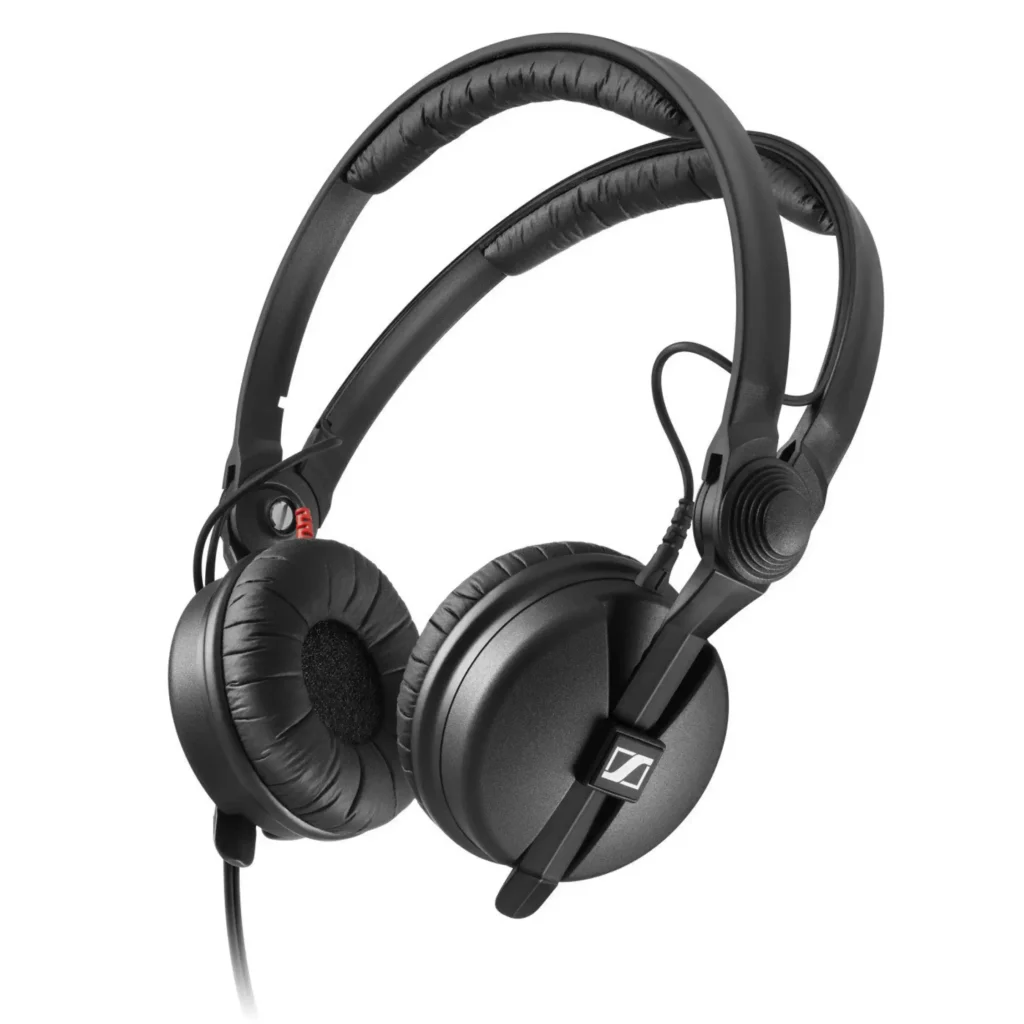
Sennheiser HD 25 is a compact closed on-ear headphone whose appeal is practical rather than decorative. The standard model combines a split headband, a rotatable cup for one-ear listening and replaceable parts in a very light structure. It is widely associated with DJ and location-monitoring work, but that does not mean every listener will enjoy its pressure or choose it as a main mixing reference. The right purchase starts with the job and the fit, then considers the sound.
Research-based review. This assessment draws on manufacturer documentation and the original independent evaluations linked below. Audio Review has not performed a hands-on test of this model.
The standard model and the bundle question
This review concerns the standard HD 25, not HD 25 Light or a claim that every accessory is included in every package. The official standard specification lists a detachable lead and a jack adapter. Check the exact seller bundle if a coiled cable, spare pads or a pouch is part of the attraction.
Similar model names can create an unfair price comparison. A cheaper package may suit the buyer perfectly if its mechanical arrangement and accessories are sufficient. A more expensive bundle is not automatically a sound upgrade. Make a short list of the required parts and compare the total cost of obtaining them. That is particularly useful for professional work, where a spare cable may be more valuable than a presentation box.
Compact monitoring and one-ear cueing
The light structure and rotatable capsule are practical for checking a cue while retaining awareness of the surrounding sound. For a DJ or location recordist, easy positioning can matter as much as a comfortable seated fit. Try the actual motion rather than assuming an on-ear design will behave like an over-ear pair.
Cable routing also deserves attention. Confirm that the lead falls away from the working hand and does not snag controls or a recorder bag. In a busy setup, a simple wired headphone can be dependable because there is no battery or wireless pairing step. That simplicity still relies on a clean source connection and sensible handling. It is a working arrangement to evaluate as a whole, not merely a list of mechanical features.
Sound: useful punch without a flatness guarantee
MusicRadar’s original review finds clear, punchy sound and good separation, while identifying a bass-region emphasis rather than a perfectly flat response. It recommends the HD 25 strongly as an all-round workhorse, with more qualification for mixing. That distinction is central to this assessment.
For cueing and performance monitoring, an intelligible and familiar presentation is useful. For balancing a finished recording, learn how reference tracks sound on the headphone before compensating for every perceived difference. A headphone can remain a valuable tool even when it is not the only reference used for final decisions. The sensible response to a distinctive balance is familiarity and cross-checking, not assuming that a professional reputation guarantees universal neutrality.
On-ear comfort is personal
The official weight is approximately one hundred and forty grams without the cable. Low weight helps with carrying and movement, but the cups rest on the ears rather than surrounding them. Pressure, ear shape, glasses and session length can therefore matter more than the weight figure alone.
MusicRadar specifically notes that some listeners may find the fit fatiguing. Try a longer session if possible, including looking down at equipment and moving as you normally would. Avoid deciding from the first minute of a shop audition. If the pressure is wrong for you, an over-ear alternative may be the better tool even if it is heavier. Comfort is an operational requirement when concentration and reliable cueing depend on wearing the headphone consistently.
Passive isolation and listening level
The closed design provides passive isolation. It is not an active cancellation system or certified hearing protection. In a noisy environment, do not interpret the ability to produce a high level as a reason to use it. Establish a comfortable cue feed and reduce unnecessary background exposure where practical.
Seal and position affect how much surrounding sound is reduced. Worn pads or a partially displaced cup can change that result, particularly during movement. For a recording job, test the actual monitoring arrangement before the important take begins. If dialogue or a cue is difficult to hear, improving the feed can be more effective than simply raising the entire signal. The headphone should make the task clearer without encouraging an unnecessarily loud working habit.
Serviceability is part of the value
The official product information lists replacement parts and instructions for components such as the cable and pads. That can make a long ownership period more practical than with a design whose ordinary wear items are difficult to obtain. Confirm current local parts availability rather than assuming every accessory will always be stocked nearby.
Use the correct replacement and follow the manufacturer procedure. A removable cable is not permission to pull on the conductors or force a connector in the wrong orientation. If buying used, inspect the cup connections, adjustment, headband and cable along its full length. A repairable design is valuable when the remaining structure is sound, but a low price on a heavily worn pair should include the cost and effort of restoring it.
Source matching and the purchase decision
The official nominal impedance is seventy ohms. Check the intended mixer, recorder, interface or portable source rather than judging compatibility from impedance alone. Start with the level low when moving between unfamiliar equipment. A dedicated headphone amplifier is useful only when the existing output presents a real limitation.
The strongest HD 25 buyer needs its compact handling, cueing flexibility and serviceable structure. Someone primarily listening at a quiet desk may prefer a larger over-ear shape, while a mixer should compare an open reference where the room allows it. The current price matters, but so does whether the exact working routine benefits from the design. A famous tool earns its place through usefulness for its owner, not through familiarity alone.
Alternatives to consider
Audio-Technica ATH-M50x: ATH-M50x offers an over-ear alternative with a different fit and removable cable package. Compare the actual cueing movement and bag space rather than assuming one studio headphone will handle every mobile and desk task equally well.
Beyerdynamic DT 770 Pro: DT 770 Pro is worth considering for a more desk-centred closed-headphone role. Try the appropriate impedance version and longer-session fit; a larger cup can suit one listener better without replacing the HD 25 practical advantages for another.
Sennheiser HD 25 key specifications
- Model
- Standard HD 25, article 506909
- Design
- Closed-back, on-ear, dynamic
- Nominal impedance
- 70 ohms
- Weight
- Approximately 140 g without cable
- Cable
- Detachable, single-sided, approximately 1.5 m
- Connector
- 3.5 mm with screw-on 6.3 mm adapter
- Headband
- Split design
- Cup movement
- Rotatable capsule for one-ear listening
- Wireless / ANC / microphone
- None
- Transducer type
- Dynamic
Verdict
HD 25 remains a compelling compact working headphone for cueing, location recording and mobile monitoring. Its light construction and replaceable parts are meaningful advantages, with an original review that supports its clear and energetic presentation.
Try the on-ear fit for long enough and treat mixing as a task that benefits from familiar references and cross-checks. Verify the exact package rather than confusing Light, standard and Plus offerings. When its particular handling suits the job, the standard HD 25 provides a coherent and durable route to straightforward wired monitoring.
Primary documentation and independent reviews
Sennheiser official HD 25 product information · Sennheiser HD 25 official specification sheet · MusicRadar original HD 25 evaluation
Editorial record
Sources and updates
Product specifications and factual claims were checked against Official Sennheiser HD 25 product page ↗. Scores and buying advice follow our category-specific editorial methodology.
- Published
- November 17, 2026
- Last updated
- November 17, 2026