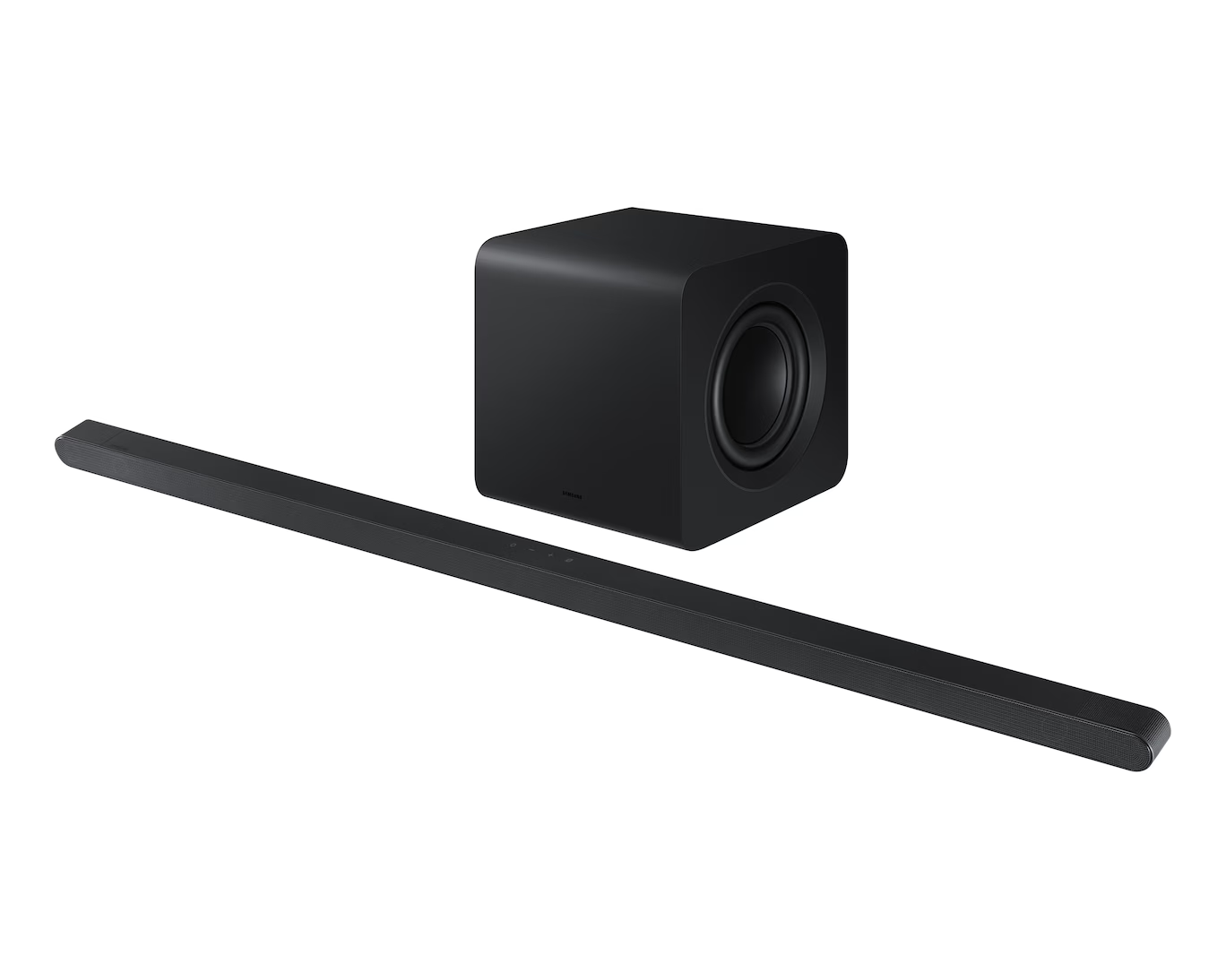
Samsung HW-S800D is built around an unusually slim main bar, supported by a separate compact subwoofer. The 3.1.2 package aims to provide a substantial television upgrade without the visual presence of a conventional thick soundbar. Network playback and SmartThings give it more flexibility than its physical connection panel suggests, but there is no optical input or source HDMI pass-through. Original review evidence is encouraging about dialogue and the integration of bass, with realistic output and spatial limits. It is a deliberate design trade-off that makes most sense where the thin format is genuinely useful.
Research-based review. This assessment draws on manufacturer documentation and the original published evaluations linked below. Audio Review has not performed a hands-on test of this model.
The physical design can solve a real television problem
The official dimensions put the main bar at only 38 mm high and 39.9 mm deep, while retaining a substantial width. This can help where a larger soundbar would dominate the furniture or obscure the bottom of a display. It still requires a careful placement and connection plan.
Measure the screen clearance, stand and cable space before ordering. A slim bar should not be squeezed behind an obstructing trim or installed where its active surfaces are covered. If wall mounting is intended, use the documented arrangement and suitable hardware. Check that the control and connection routine remains practical once the bar is in position. Its width also matters beside a smaller television, even when its height is unobtrusive. The design advantage is strongest when it permits an otherwise difficult installation without awkward compromises. Where ordinary furniture already accommodates a conventional bar comfortably, compare whether the slim profile is worth its price and source limitations. Good appearance is a legitimate priority, but it should work with the listening arrangement rather than substitute for it.
Original sound evidence is positive within clear limits
AVForums’ original evaluation finds clear dialogue, a well-rounded balance and effective integration with the supplied subwoofer after setup. It also reports limited full three-dimensional projection, occasional brightness and rare bass crackle during very demanding high-level passages. Those are specific observations from the tested system, not a universal fault diagnosis.
Audition ordinary speech as well as an action scene. Check the balance at a comfortable evening volume and whether the bass remains connected to voices and effects. A slim design need not be dismissed before listening, but neither should it be expected to duplicate a larger system in every respect. Compare familiar music too if the bar will serve as the main room speaker. Keep levels similar between alternatives and use the basic package actually being offered. The original evidence supports a serious shortlist for someone whose room benefits from the format. A buyer seeking the most convincing rear and height placement at any cost should also hear a more complete surround arrangement before deciding.
The included subwoofer is an important part of the package
The compact bass enclosure is supplied with the bar, rather than an optional extra required to obtain the reviewed basic system. Its audio signal is wireless, but it still needs mains power. Its location affects the blend and bass level at the listening seats.
Plan a few practical positions before hiding it behind furniture. Keep the documented active surfaces unobstructed and route power safely. Listen to speech and music as well as low-frequency effects, then adjust position or level gradually. A strong rumble does not by itself show good integration. The bar and subwoofer should sound like one system through ordinary soundtrack transitions. Avoid assuming the smallest available corner is automatically ideal simply because the bass enclosure fits there. If several seats matter, assess more than one position on the sofa. The supplied package is attractive partly because the separate unit allows the main bar to stay so slender. That advantage works best when the room can accommodate the bass component sensibly as well, rather than treating it as a box that can be placed anywhere without consequence.
One audio-return connection defines the wired source plan
S800D offers HDMI eARC for television audio, with no separate HDMI source input and no optical input. It therefore does not provide video pass-through or a direct wired digital route for every independent source. The television becomes a particularly important part of the connection chain.
List the devices and formats actually used. Connect sources through a suitable display arrangement and confirm that the television sends the intended audio to the bar. Check internal apps, broadcast and external players during the return period. An eARC label does not establish that every TV passes every format from every input unchanged. For an older optical-only display, do not assume a simple cable can replace the missing interface. If additional converters are proposed, include their cost, format restrictions and control routine in the comparison. A more directly equipped soundbar may be the simpler choice. The slim design is easiest to justify when the existing television already provides the required return path. That avoids paying for an elegant bar only to surround it with accessories needed for basic source compatibility.
Network features and Samsung integration are separate benefits
Wi-Fi, Bluetooth and SmartThings support a range of music and control options. Samsung-specific features such as Q-Symphony and wireless Atmos television transmission require a documented compatible display. Their presence should not be assumed from the television brand alone.
Demonstrate the actual TV model and desired service. Check source switching, volume, standby and the format information available through the app. The lack of a full text display makes a clear app routine especially useful. For music, verify the intended account and playback route rather than assuming all service integrations operate identically. Bluetooth may be convenient for a guest while a network route suits daily household listening. A compatible Samsung combination can add useful integration, but the basic wired audio-return arrangement deserves its own assessment. Do not pay for a feature that cannot be activated with the existing display. Equally, do not reject an otherwise suitable system solely because one brand-specific extra is unavailable. Judge the complete routine and sound that will actually be used.
Expansion and current value need a complete comparison
Rear speakers are not included in the basic two-piece package. Compatible optional additions can change its surround role, but they also change the price, power requirements and placement plan. A launch-era package comparison may therefore be misleading today.
Confirm the exact supported accessories and local warranty before buying extra speakers. Compare a complete expanded offer with a larger bundle already containing the required components. If the aim is a discreet two-piece system, assess whether expansion is necessary at all rather than purchasing it simply because it exists. Check the current price against conventional bars that fit the furniture, with the same sources and realistic listening demands. The S800D is most persuasive when its unusually thin form solves a practical problem while its musical and dialogue performance remain satisfying. It becomes less attractive when missing inputs require workarounds or a larger surround ambition overwhelms the original simplicity. A clear room and source plan lets the design earn its place without overstating what a slim package can do.
Alternatives to consider
Sennheiser AMBEO Soundbar Mini: Compare this compact single-bar approach if eliminating a separate bass enclosure matters more than the thinnest possible bar. Include any desired bass expansion in the complete price.
Samsung HW-Q800F: A conventional Samsung package is worth comparing when furniture can accommodate a larger bar. Judge source facilities and the complete channel arrangement alongside the value of the slimmer design.
Samsung HW-S800D key specifications
- Generation
- 2024 HW-S800D UK specification
- Basic layout
- 3.1.2 with included wireless-signal subwoofer
- Main bar
- 1160 × 38 × 39.9 mm (W × H × D)
- Subwoofer
- Approximately 238 × 240.8 × 238 mm
- TV connection
- HDMI eARC
- Source HDMI input
- None; no video pass-through
- Optical input
- None
- Network
- Wi-Fi; SmartThings app
- Wireless source
- Bluetooth 5.2
- Network music
- Documented AirPlay, Chromecast and Spotify Connect routes
- USB music
- No
- Rear speakers
- Optional compatible additions, not included
- TV integration
- Q-Symphony / wireless Atmos require exact compatible Samsung TV
- Main soundbar weight
- 1.4 kg
- Subwoofer weight
- 6.4 kg
Verdict
S800D is an appealing ultra-slim package with encouraging original sound evidence and a useful included subwoofer. Its physical source limits are significant, so confirm the TV return path before purchase. Choose it when discretion is a real installation priority and the supplied system meets the listening need at a sensible current price.
Documentation and original reviews
Samsung official UK S800D specifications and compatibility · AVForums original S800D sound and installation evaluation
Editorial record
Sources and updates
Product specifications and factual claims were checked against Official Samsung HW-S800D product page ↗. Scores and buying advice follow our category-specific editorial methodology.
- Published
- November 17, 2026
- Last updated
- November 17, 2026