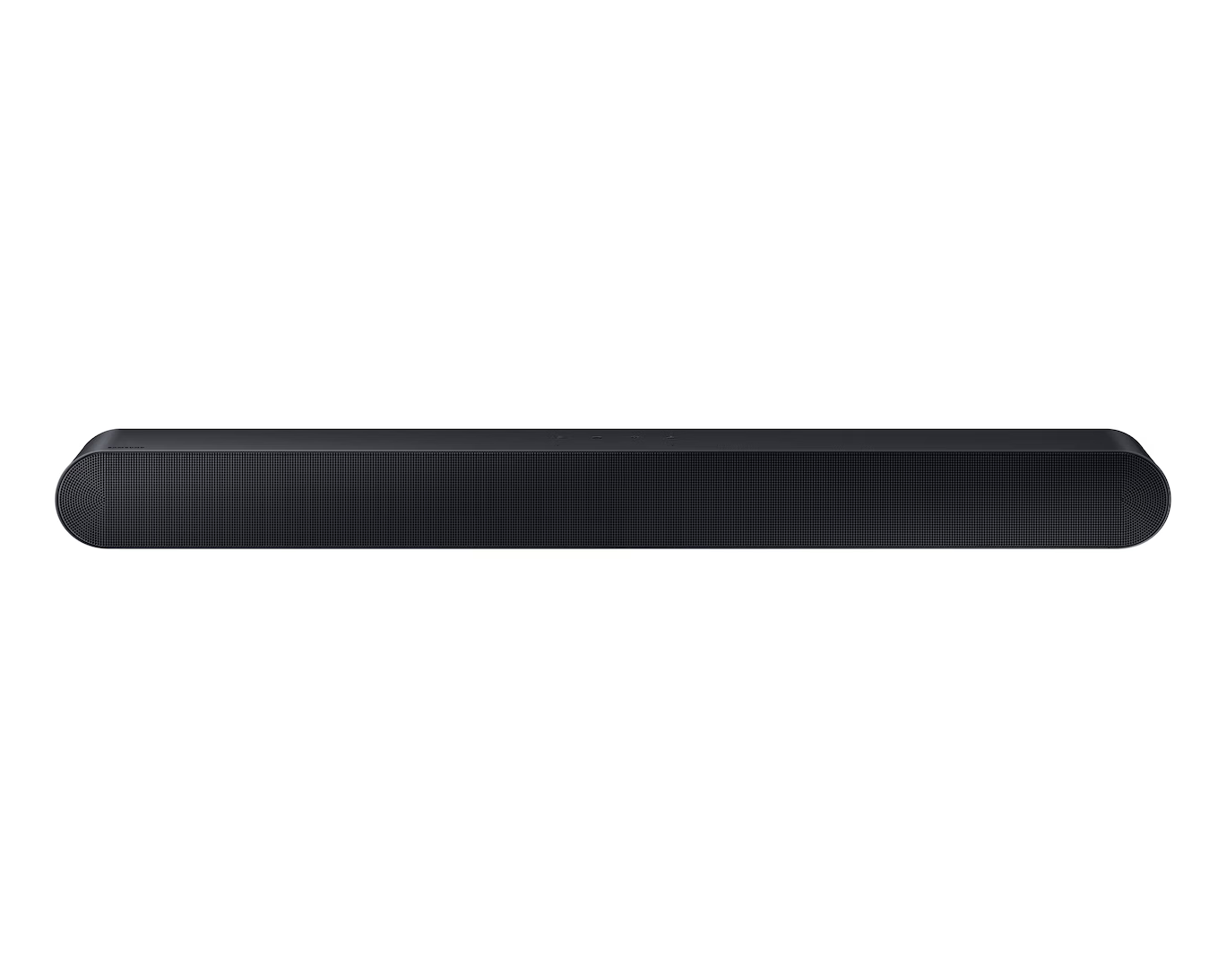
Samsung HW-S60D is a compact 5.0 soundbar designed to improve ordinary television and music playback without adding a separate subwoofer to the floor. Network facilities and HDMI eARC make it more versatile than a basic Bluetooth bar, while a dedicated centre channel supports its dialogue role. Dolby Atmos format support should not obscure the physical limits: there are no up-firing drivers or supplied rear speakers. Original evaluations differ on some aspects of speech and refinement, but agree that this is a compact upgrade rather than a full cinema system.
Research-based review. This assessment draws on manufacturer documentation and the original published evaluations linked below. Audio Review has not performed a hands-on test of this model.
Dialogue is a main attraction, with a useful audition caveat
RTINGS’ public original assessment finds clear, detailed speech and a reasonably balanced midrange, while noting limited deep bass and surround performance. Tom’s Guide finds a worthwhile improvement over its television but reports some muffled dialogue and a less remarkable overall presentation. Those differences should encourage a direct check with ordinary programmes rather than a universal promise of perfect speech.
Use a familiar programme with quiet voices as well as a busy action scene. Listen at the volume normally used in the household, including a restrained evening setting. Check whether dialogue remains natural when enhancement modes are changed. Louder or more forward is not automatically clearer over a long session. A compact bar can be especially useful when the television has limited speaker space, but the benefit should be audible with the actual content and room. The original evidence supports the S60D as a sensible shortlist option for that role, with enough disagreement to make a return-period check worthwhile. Do not choose purely from a channel count or a favourable demonstration excerpt.
Atmos support is not a physical height-speaker system
The official specification lists a 5.0 arrangement with side-firing speakers and no up-firing drivers. There is no supplied separate subwoofer or rear pair. Atmos processing and format compatibility therefore operate within a very different installation from a bar with dedicated height channels and speakers around the room.
Set expectations around the actual listening goal. If a compact improvement in front of the television is sufficient, the simple layout can be an advantage. If distinct overhead and rear effects are the main reason for upgrading, compare a more complete package before buying optional additions. A supported soundtrack label does not establish where an effect will appear in a particular room. Listen from the actual seats and decide whether the result is convincing enough for the price. It is equally unhelpful to dismiss every virtual system without hearing it or to describe it as physically equivalent to a larger installation. The strongest recommendation follows what the supplied bar accomplishes in the intended room, with its limits clearly understood.
The one-bar format makes placement simpler
At approximately 670 mm wide, the S60D can suit furniture that cannot comfortably accommodate a long conventional bar. It still needs mains power, a sensible position beneath the screen and clearance around the active surfaces. Compact dimensions do not make an obstructed recess a good acoustic location.
Measure the screen clearance and leave room for plugs. Keep the bar centred where practical and avoid placing decorative objects directly in front of its sides or front. Check that the television’s remote sensor remains accessible. If wall mounting is intended, use the appropriate documented hardware and confirm the position before installation. A soundbar that stays visually discreet can make the living room easier to use, but its convenience should extend to everyday control as well. Test whether the included remote or app provides comfortable access from the sofa. The best compact installation is one where dialogue relates naturally to the screen and the bar can be left in a stable, unobstructed position. That matters more than fitting it into the smallest possible gap.
eARC and optical are different source arrangements
The bar offers HDMI eARC and an optical input, but no separate source HDMI input or video pass-through. External video devices therefore normally connect to the television, with the display providing the selected audio path to the bar.
List the actual sources and test each one. An internal app, broadcast and external console can behave differently depending on television settings and format support. Confirm the desired audio output and ordinary volume control rather than assuming that sound from one source proves the entire system is configured. Optical may be useful with an older display, but it should not be expected to carry every format available through a suitable eARC connection. Do not add an arbitrary converter before checking the native outputs already present. A clear connection map avoids repeated cable or mode changes. It also makes the comparison with another bar fairer: a product with an additional source input solves a different requirement from one relying entirely on the TV’s return path.
Network convenience is distinct from Samsung-only extras
Wi-Fi, SmartThings and documented service or casting routes give S60D a useful music role. Features such as Q-Symphony and wireless Atmos transmission from a TV have specific compatible Samsung display requirements. That restriction should not be misread as a statement that ordinary wired audio or Atmos format support always requires a Samsung television.
Check the full television model against the current compatibility information. Demonstrate the desired integration if it contributes to the purchase decision, while assessing ordinary HDMI operation separately. For music, use the actual account and phone or tablet to check album access, level control and return from standby. An app can make settings easier to understand, but it is not proof that every streaming service appears in the same way. A buyer using another television brand may still find the basic soundbar useful at the right price. The important point is to value the facilities that will really operate, rather than paying for a branded feature or rejecting the entire product because one optional integration is unavailable.
Bass expectations and expansion decide the long-term cost
The all-in-one arrangement avoids a separate bass enclosure, with a corresponding limit in low-frequency reach. Compatible optional bass and rear equipment can change the system, but also changes the price and placement needs. That should be planned before treating the initial bar as a budget route to a larger cinema setup.
Listen to music and film at ordinary volume before deciding whether more bass is required. A buyer focused on speech may appreciate the compact arrangement exactly as supplied. Someone seeking physical impact may be better served by a package already containing a suitable subwoofer. Confirm the exact supported accessories, local warranty and complete price before expanding. Compare the finished system with a larger bundle rather than only its starting price. Current discounts can make an established compact model attractive, but they do not create facilities absent from the hardware. S60D is strongest when its existing combination of dialogue, streaming and minimum component count already meets the routine. It becomes less economical if several extra purchases are needed to fulfil the original listening ambition.
Alternatives to consider
Sonos Beam Gen 2: Compare this compact all-in-one if its platform and presentation suit the household better. Include any required source adapter and optional bass or rear expansion in the total.
Samsung HW-Q800F: A larger package with a separate bass enclosure is a different option when film impact matters more than minimum component count. Compare the real installation space and current complete price.
Samsung HW-S60D key specifications
- Generation
- 2024 HW-S60D UK specification
- Physical layout
- 5.0 all-in-one
- Centre channel
- Yes
- Up-firing drivers
- None
- Included separate subwoofer / rears
- None
- TV connection
- HDMI eARC
- Separate HDMI source input
- None
- Other sources
- Optical, Wi-Fi and Bluetooth 5.2
- App
- SmartThings
- Network music
- Documented AirPlay, Chromecast and Spotify Connect routes
- USB music
- No
- Atmos
- Supported format with virtualised height; not physical height channels
- Expansion
- Compatible optional subwoofer / rear equipment must be checked
- Size
- 670 × 62 × 105 mm (W × H × D)
Verdict
S60D is a useful compact all-in-one option for television speech and network music, with clear limits in deep bass and physical height reproduction. Original dialogue assessments differ enough to justify an audition with familiar programmes. Confirm source routing and exact Samsung integrations. Choose the basic bar when its simplicity is a benefit, and compare complete costs before expanding it.
Documentation and original reviews
Samsung official UK HW-S60D specifications and compatibility restrictions · RTINGS original S60D public sound evaluation · Tom’s Guide original S60D listening and usability review
Editorial record
Sources and updates
Product specifications and factual claims were checked against Official Samsung HW-S60D product page ↗. Scores and buying advice follow our category-specific editorial methodology.
- Published
- November 17, 2026
- Last updated
- November 17, 2026