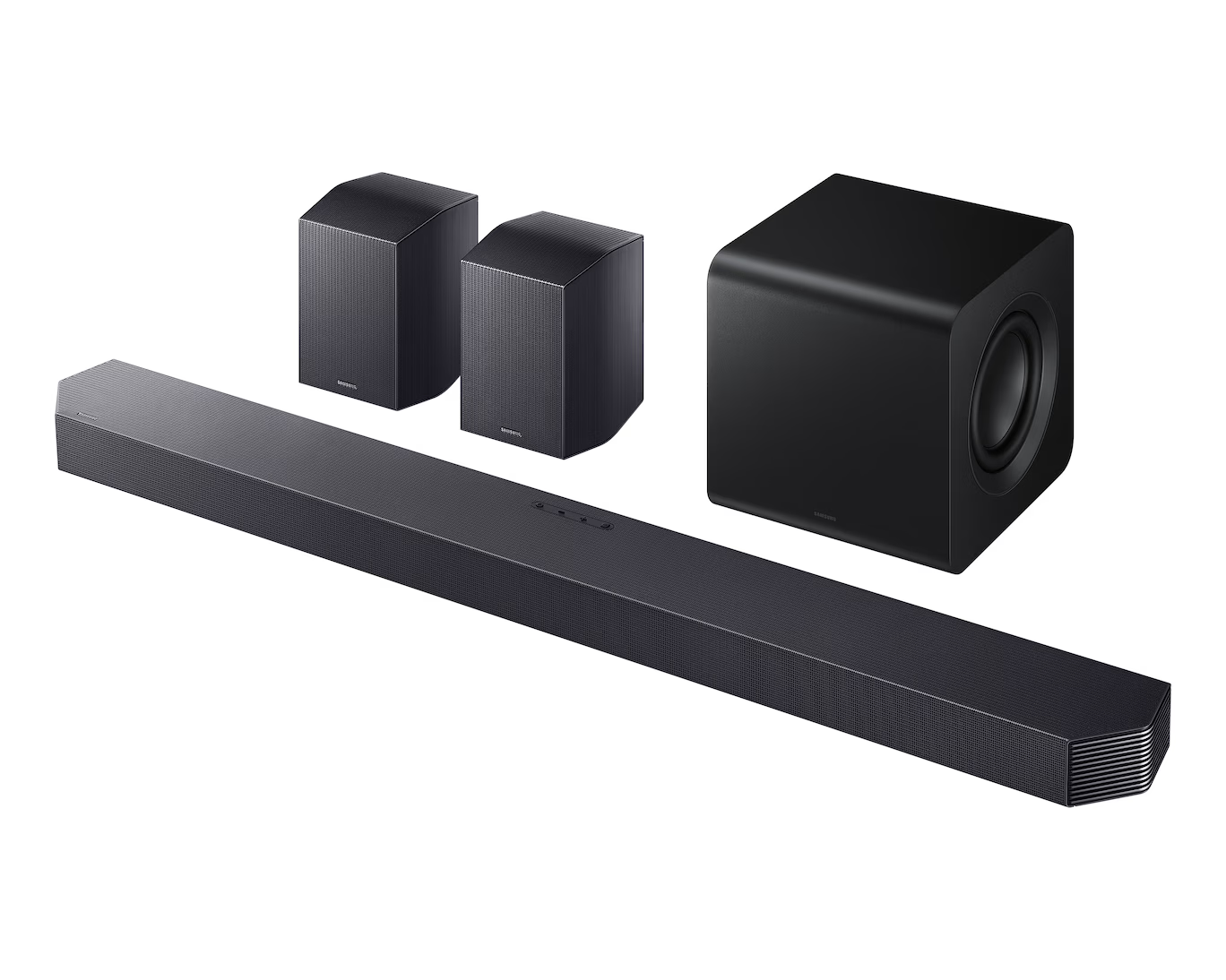
Samsung HW-Q930F is a complete surround package rather than a soundbar that needs several later purchases before rear effects become possible. The included subwoofer and rear speakers are its main practical strengths. The important compromise is connectivity: its HDMI source path stops at 4K/60, so a gaming setup needs careful routing. It is best judged as a whole living-room system, including placement, power and the television’s audio behaviour.
Research-based review. This assessment draws on manufacturer documentation and the original independent evaluations linked below. Audio Review has not performed a hands-on test of this model.
A complete package still needs a room plan
The advertised 9.1.4 layout combines the bar, subwoofer and rear speakers. It is not a count of separate boxes, and the virtual impression of height should not be confused with physical ceiling speakers. The useful advantage over a bar alone is that real rear cabinets can place effects behind the listening position.
Those cabinets still need sensible placement and mains power, as does the subwoofer. Wireless describes the signal link, not a battery-powered installation with no cables. Before buying, identify the rear positions, available sockets and the space in front of the television. A complete package is good value only if all its parts can be used in the intended room rather than left beside the sofa or crowded behind furniture.
Dialogue, surround and the original test
RTINGS’ original evaluation is positive about the clear, natural dialogue from the centre channel and the broadly balanced presentation. It also qualifies the deepest-bass impact and the precision of overhead effects. That supports a strong everyday film-and-TV recommendation without turning every advertised channel into a promise of sharply located sound above the listener.
Our interpretation is that the dedicated rear speakers and centre-channel performance provide the most dependable reasons to choose this format. Test quiet conversation as well as action, at the levels you normally use. A demonstration dominated by explosions can hide whether speech remains comfortable during ordinary programmes. Room acoustics, seating and speaker level settings still influence the result, even with automatic adjustment available.
Gaming: route video and audio deliberately
The official specification lists 4K passthrough at 60 Hz, and the independent test identifies the absence of 4K/120 support. A console or gaming computer that needs a higher-refresh video path may therefore be better connected directly to a suitable television input, with audio returned to the bar over eARC.
That arrangement depends on the television’s own passthrough and format support. Check the actual source, TV input, output setting and soundbar mode as a chain. An eARC label does not guarantee that every TV application and external device sends the same audio format. If several gaming sources need switching, compare the available television sockets and the Q990F’s connection package before assuming a soundbar HDMI input will cover the whole system.
Room adjustment, bass and useful modes
SpaceFit Sound Pro and the available sound controls can help adapt the package to the room, but they cannot make every physical placement equivalent. Keep the bar unobstructed, position the rear speakers sensibly and try more than one practical subwoofer location before relying on a large level change.
Dialogue enhancement and night listening settings are useful tools for particular circumstances. They should be compared deliberately rather than left active simply because they sound more prominent in a quick test. For music, also compare the more restrained modes with surround expansion. A system that is engaging with films can present stereo recordings differently depending on processing, and the right choice is the one that suits the material and your listening preference.
Samsung integration and other televisions
Q-Symphony and wireless Atmos integration have specific Samsung compatibility requirements. They are optional parts of the ecosystem, not prerequisites for using a suitable wired TV audio connection. A buyer with another television brand should assess the HDMI or optical arrangement on its own merits instead of assuming that the entire system becomes unusable.
Check the current service and app facilities for your region and firmware as well. Network music, voice control and TV coordination are separate functions with separate conditions. The SmartThings interface can make setup convenient, but a household should still understand the basic volume, input and listening-mode controls. A good integration experience is the one that works consistently with the equipment actually installed.
Value against the flagship and modular rivals
The Q930F is attractive when its complete package costs meaningfully less than alternatives that require separate rear-speaker and subwoofer purchases. Include all components when comparing prices. Also compare the current Q990F offer, since a small gap can make its extra facilities more appealing than the nominal model hierarchy suggests.
Against modular systems, think about future needs as well as the initial price. A package with included rears may be better value now, while another platform may offer a different music ecosystem or installation approach. Do not pay for extra channels that cannot be placed usefully, and do not dismiss a smaller system if the room cannot accommodate the Q930F’s separate parts. The best choice is a complete installation, not the highest number in a product title.
Alternatives to consider
Samsung HW-Q990F: The Q990F is the important step-up comparison if deeper bass, additional channels or broader gaming connectivity matter. Compare the actual price gap and room requirements rather than assuming the Q930F supplies every flagship facility.
JBL Bar 1000MK2: The JBL offers a different surround-speaker arrangement and daily charging routine. Compare how the rear speakers will be used and stored in your room, not just the advertised channel count or the size of the subwoofer.
Samsung HW-Q930F key specifications
- System
- Soundbar, wireless subwoofer and two rear speakers
- Advertised layout
- 9.1.4 channels
- TV connection
- HDMI eARC
- HDMI source inputs
- One
- HDMI video passthrough
- Up to 4K at 60 Hz; not 4K/120
- Other TV input
- Optical
- Object-based audio
- Dolby Atmos
- Room adjustment
- SpaceFit Sound Pro
- Network
- Wi-Fi and supported regional services
- Bluetooth
- 5.3
- App
- Samsung SmartThings
- Q-Symphony
- Requires a compatible Samsung TV
- USB music playback
- Not supported
- Soundbar dimensions
- 1110.7 × 60.4 × 120 mm
Verdict
HW-Q930F is a persuasive choice for buyers who want real rear speakers and a subwoofer in one well-equipped surround package. The original dialogue and surround assessment supports that role, while the compact subwoofer is useful in a living room where space is limited.
The recommendation depends on installing the separate speakers properly and accepting the HDMI input’s 4K/60 limit. Plan high-refresh gaming through the television where appropriate, check eARC behaviour and compare the current Q990F price. Consider the JBL alternative if its rear-speaker arrangement better suits the room. Choose the Q930F for the complete system it can deliver in your space, with realistic expectations for overhead precision and Samsung-specific extras.
Primary documentation and independent reviews
Samsung Ireland official Q930F specifications · RTINGS original HW-Q930F review · TechRadar Netherlands original HW-Q930F review
Editorial record
Sources and updates
Product specifications and factual claims were checked against Official Samsung HW-Q930F product page ↗. Scores and buying advice follow our category-specific editorial methodology.
- Published
- November 17, 2026
- Last updated
- November 17, 2026