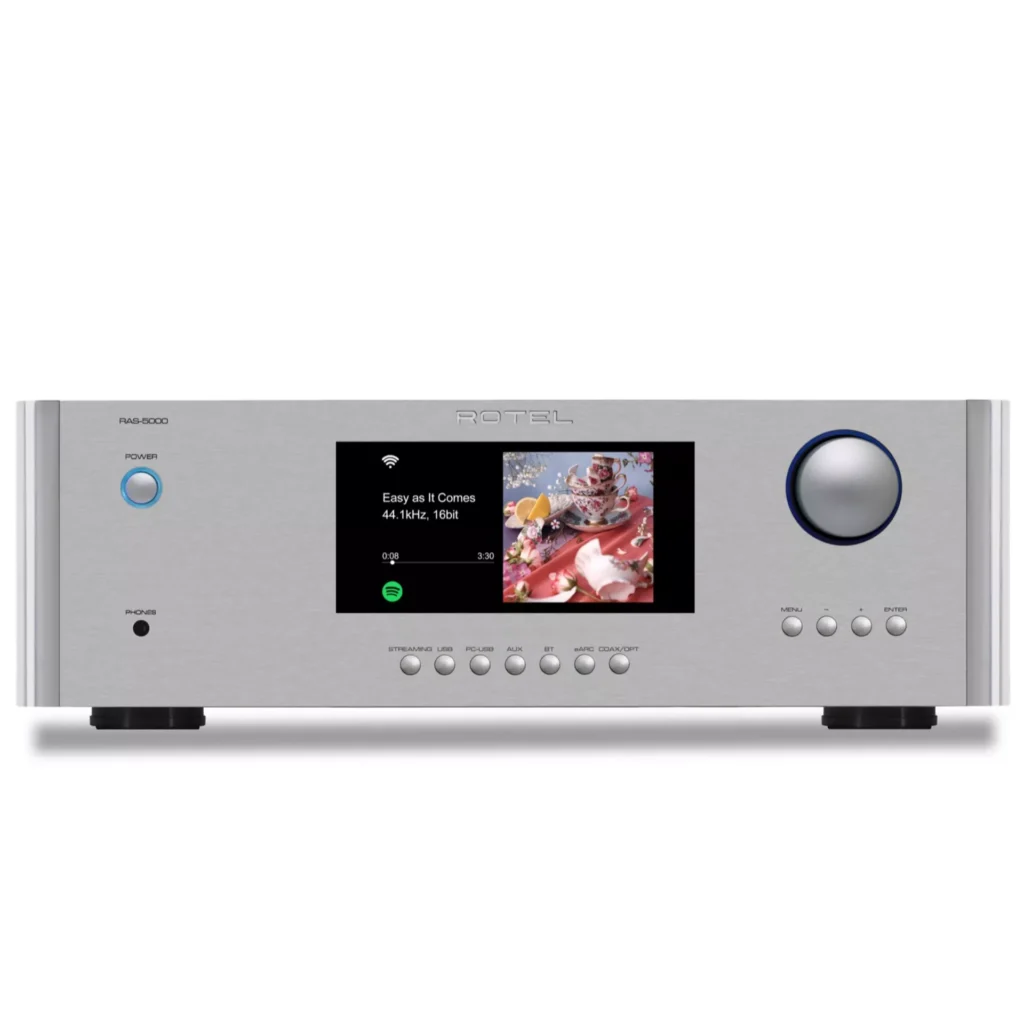
The Rotel RAS-5000 combines a substantial Class AB stereo amplifier with network playback and television audio. It is intended to replace several components without adopting the miniature proportions of many app-led amplifiers. The attraction is a capable music and television hub, while software preference, cabinet space and the limited analogue input provision remain important purchasing questions.
Rotel RAS-5000 — Design and installation
The RAS-5000 is a full-size component with a central colour display and conventional controls. It weighs 15.7 kg and measures 425 mm deep before extra cable clearance is considered. Check shelf support and rear access rather than assuming that an integrated streaming product is necessarily small. Its physical presence is part of the decision, especially in a living room designed around compact electronics.
The screen provides useful playback information, but it is not a touchscreen. A phone, remote and front controls therefore have distinct roles. Try the ordinary routine of finding music, changing a source and adjusting the sound from the listening position. A premium amplifier should be evaluated as an everyday interface as well as a piece of audio hardware, particularly when several people will share it.
Amplification and realistic speaker matching
Rotel lists 140 watts per channel into eight ohms and 220 watts into four ohms. The four-ohm headline should not replace the eight-ohm figure when comparing a different amplifier rated under another load. These are manufacturer specifications rather than power measurements conducted by Audio Review. The practical aim is comfortable headroom with the chosen loudspeakers, not simply the largest printed number.
Room size, speaker sensitivity and listening distance determine how much output is needed. A compact speaker can reach its own mechanical limit before an amplifier runs out of electrical power, while a difficult load can make demands not obvious from nominal impedance. Use the intended loudspeaker and realistic listening level when possible, with clean peaks and sustained comfort as the criteria.
Substantial amplification also needs sensible ventilation. Avoid enclosing the Rotel tightly just because the network section reduces the number of boxes elsewhere. If the room exaggerates bass, begin with speaker and seat placement. More amplifier output does not correct an acoustic resonance, and buying a powerful component should not consume the entire budget before the speakers and room are properly considered.
Network playback and control
The current feature list includes Spotify Connect, Tidal Connect, AirPlay 2, Google Cast and Roon Ready operation. These offer several ways to deliver music without relying exclusively on one proprietary browsing interface. Account requirements, supported services and regional availability still need checking. A long protocol list is useful only if the preferred library and household devices work comfortably with it.
Ethernet is convenient for a permanent installation where a network point is nearby, while Wi-Fi allows more flexible placement. Prioritise reliable playback and control. Bluetooth with supported aptX HD and AAC provides another route, but codec negotiation depends on the sending device. Do not assume that every phone uses the same format simply because the receiver supports it.
WIRED’s original 2024 review praised the amplifier’s sound and available power but found the app and some control behaviour less refined than expected at its price. That is a historical assessment of the tested software, not proof that every current firmware version behaves identically. It makes a current app demonstration particularly worthwhile before committing to a complete system around the Rotel.
Computer, television and other inputs
A proper PC-USB connection lets a compatible computer use the internal DAC, with supported PCM playback up to 24-bit/384 kHz. Optical and coaxial inputs have their own lower format limits. Install any required supported driver and select the amplifier as the computer’s output device. A recognised connector and a working data cable are basic requirements before high-resolution settings become relevant.
HDMI eARC provides the television audio route. The manual specifies two-channel audio, so configure the television’s output appropriately rather than expecting the amplifier to decode and reproduce a multichannel speaker layout. It is not an HDMI video-switching receiver. The television or another device still handles the selection of video sources.
A line-level RCA input accommodates an external analogue source, but there is no built-in phono stage. A bare turntable cartridge therefore requires a suitable external preamp or a turntable with an enabled built-in stage. Count analogue sources before purchase: someone with a separate phono stage, tuner and analogue disc player may need more switching than the Rotel provides. Broad digital connectivity should not hide that practical limitation.
Subwoofer and headphone behaviour
The subwoofer output is useful, but the manual explicitly describes it as a full-range sum of the left and right channels. The subwoofer must provide the filtering. Do not describe the socket as automatic bass management or assume the main speakers are high-passed merely because a sub is connected. Choose crossover, phase and level to suit the speakers and listening room.
A variable preamp output gives another route into a larger system. Its level follows the amplifier’s controls, which matters when connecting another amplifier or a suitable active speaker arrangement. Confirm the receiving device’s requirements before selecting a connection. Output sockets that look alike can have different control behaviour across products.
The front 3.5 mm headphone socket offers private listening. According to the manual, inserting headphones mutes the speakers, preamp output and subwoofer output. That is a useful household detail worth checking during setup. Reduce volume before changing between headphones and speakers, since their sensitivity and comfortable control positions can differ substantially. The speaker power rating does not define the headphone stage’s capability.
Listening priorities and value
For an audition, start with the speakers that will actually be used and a familiar streamed album. Then check television dialogue, standby wake-up and the transition back to music. A product intended to combine both jobs should pass both, rather than being selected from an impressive music demonstration alone. Match levels against alternatives and listen for balance, clear voices and clean peaks.
The distinction between amplification and interface is central to this model. Strong listening evidence can justify keeping the Rotel on a shortlist, while a less comfortable control workflow can still make another product better for a particular home. Current software should be tried directly rather than inferred from the date of an old review.
The RAS-5000 is most persuasive when its substantial amplifier, network routes, computer input and eARC all replace separate equipment. Compare current European offers with a complete alternatives budget, including phono hardware if needed. A smaller network amplifier may be sufficient for easy speakers and moderate levels. Choose the Rotel when its physical and electrical scale serves the actual room, not simply because a streaming amplifier can advertise a large power number.
Alternatives to consider
NAD C 700 V2: A compact network-amplifier alternative when software preference and smaller proportions are more important than substantial output ratings.
Naim Uniti Atom: Compare a premium integrated streaming interface and a smaller enclosure, with the speaker requirements considered separately.
Rotel RAS-5000 key specifications
- Type
- Class AB integrated streaming amplifier
- Manufacturer output
- 140 W/channel at 8 ohms; 220 W/channel at 4 ohms
- Digital sources
- PC-USB, optical, coaxial and HDMI eARC
- PC-USB PCM
- Up to 24-bit/384 kHz with supported setup
- Analogue
- Line-level RCA; no phono stage
- Subwoofer output
- Full-range summed signal; subwoofer supplies filtering
- Network
- Roon Ready, Google Cast, AirPlay 2 and Connect services
- Size / weight
- 431 × 144 × 425 mm / 15.7 kg
Verdict
A substantial and versatile streaming amplifier with useful computer and television access. Its app experience, single analogue source path and lack of phono stage need to fit the system, while the full-range subwoofer output requires proper external filtering.
Primary documentation and independent reviews
Rotel official RAS-5000 product specifications · Rotel official RAS-5000 manual · Rotel official specifications including European power version · WIRED original RAS-5000 review
Editorial record
Sources and updates
Product specifications and factual claims were checked against Official Rotel RAS-5000 product page ↗. Scores and buying advice follow our category-specific editorial methodology.
- Published
- November 8, 2026
- Last updated
- November 8, 2026