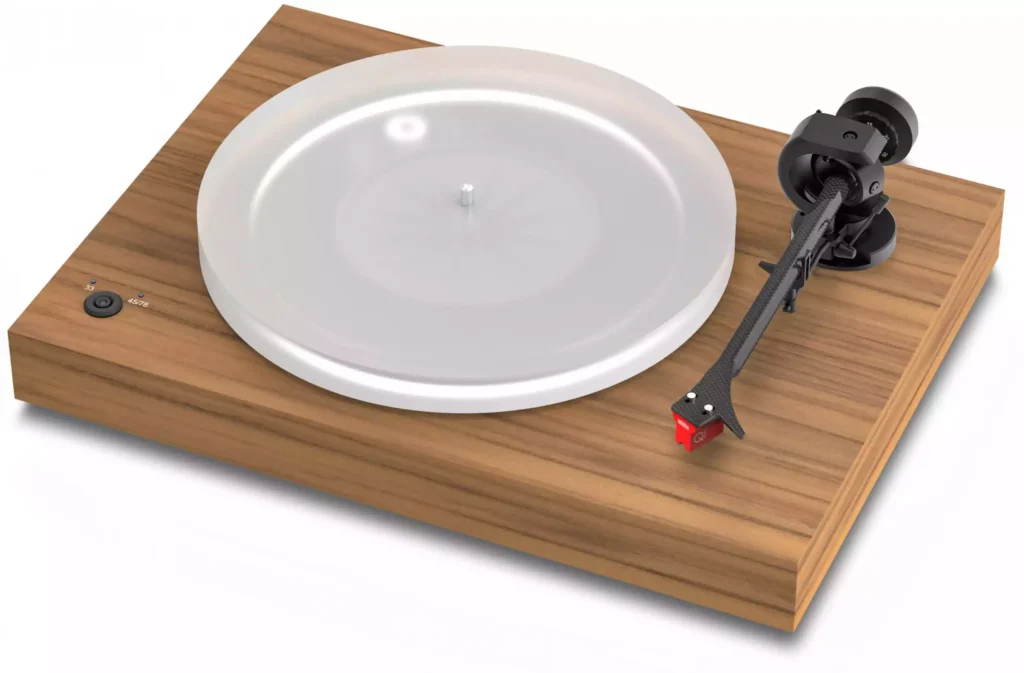
The Pro-Ject X2 B combines a substantial belt-drive platform with an adjustable carbon-aluminium arm and both RCA and mini-XLR phono outputs. The commonly supplied Ortofon Quintet Red moving coil makes it a natural starting point for a more ambitious phono system. Its balanced capability is useful, but the complete connection requires a suitable phono stage and cable as well as the turntable.
Pro-Ject X2 B — Construction and the X2 platform
The X2 B has a conventional rectangular body and cover, with a two-kilogram acrylic platter and a nine-inch arm. At a published ten kilograms it is a substantial component, but the purchase should not be decided by weight alone. Its appeal lies in a coherent mechanical platform with useful adjustment facilities and a choice of connection routes. The familiar shape also makes daily record handling straightforward in a suitable location.
Allow enough space to open the cover and reach the arm without stretching over another component. The deck still needs a rigid, level support, even with damped height-adjustable feet. A resonant cabinet or springy floor can undermine a good source, and placement should be addressed before purchasing accessories. If a wall support is considered, its suitability depends on the building and fixing method as well as the turntable’s weight.
The adjustable arm and MC cartridge
The one-piece carbon-aluminium arm provides both vertical tracking angle and azimuth adjustment. That makes the X2 B more adaptable to future cartridge changes than a deck with almost no adjustment, but it also creates settings that need care. An integrated headshell is not as convenient for rapid cartridge swapping as a detachable design. The flexibility is better understood as support for a considered cartridge installation than an invitation to change everything casually.
The standard documented package uses an Ortofon Quintet Red moving-coil cartridge, while cartridge-free offers can also exist. Check the exact invoice and supplied cartridge before comparing prices. A factory-aligned package still needs the recommended tracking force and anti-skate set during installation. Follow the current cartridge guidance and retain the transport protection. A valuable stylus should not be exposed unnecessarily while other parts of the turntable are assembled.
The low-output MC package requires appropriate phono gain and loading. An amplifier with only an MM input may need another stage, and an ordinary line input is unsuitable. Plan those electronics before deciding the turntable’s apparent bargain price fits the system. Cartridge servicing and replacement are also part of long-term ownership, particularly for someone who expects to play records for several hours most days.
Balanced phono explained practically
The mini-XLR connection carries the cartridge’s low-level signal. It is not a line-level output ready for a normal balanced input on a power or integrated amplifier. A compatible balanced phono stage provides the required gain and equalisation, and the appropriate cable connects the two. Pro-Ject supplies an RCA phono cable as standard; the balanced route generally needs a separately purchased cable. Include those parts in the total budget.
Balanced transmission can help reject interference picked up along the connection when the source, cable and receiving circuitry are implemented appropriately. It does not recover missing musical content from a previously functioning RCA connection, nor does the connector itself guarantee an audible improvement in every installation. The benefit is most meaningful where the complete phono arrangement works better and any noise problem is addressed properly.
The RCA outputs remain useful with a suitable conventional MC phono stage. An owner can therefore build a sensible system without replacing all electronics immediately. For the balanced route, cartridge wiring matters as well as the socket. Confirm compatibility when fitting a different cartridge rather than assuming every moving-magnet replacement retains the same balanced arrangement. If hum is present, inspect the grounding and signal path systematically before purchasing more expensive cables.
Speed selection and the manual routine
Electronic selection covers the ordinary 33 and 45 rpm speeds. The manual documents a separate round belt and pulley arrangement for 78 rpm, so switching to that speed involves more than pressing the everyday speed button. This is worth understanding if the collection includes frequent changes between LPs and historical discs. The latter may also need a suitable stylus and equalisation; rotation speed alone is insufficient.
The X2 B has manual arm operation and no automatic return. The owner cues the record and stops the session after the side finishes. That is appropriate for attentive listening but less convenient for someone who wants unattended playback. A demonstration should include the cueing feel and end-of-side routine, not just the first musical passage. Convenience requirements deserve the same honesty as sound expectations.
There is no built-in phono stage, wireless transmitter or USB recording interface. Those functions can be supplied elsewhere if needed, but they change the total system. A listener who wants only a focused analogue source may welcome the simple role. Someone whose primary aim is digitising records should compare a complete recording chain before assuming the X2 B alone covers that task.
What the independent evidence supports
Hi-Fi News evaluated the X2 B with the Phono Box S3 B and its moving-coil package, examining balanced and single-ended operation. Home Theater HiFi also published an original review of that turntable-and-phono-stage combination. Those are useful sources for a complete system rather than an isolated socket specification. Their findings concern the tested configurations, and Audio Review has not performed its own listening or laboratory test.
The published evidence supports the combination as an engaging, capable platform, with balanced operation a meaningful option to investigate. It should not be turned into a promise that every amplifier or cartridge will produce the same result. Keep gain and level consistent when comparing connections, because the balanced output of a phono stage can have a different level from its RCA output. An immediate louder presentation can otherwise be mistaken for improved clarity.
An audition should use a representative cartridge and phono stage, familiar clean records and realistic volume. Listen for pitch consistency on sustained material, intelligibility in dense arrangements and comfortable balance over a longer session. A successful turntable system should make the record collection enjoyable without requiring a constant programme of modifications. Start from a correct baseline and change one relevant variable at a time if a specific limitation remains.
Value, upkeep and the right owner
The X2 B is particularly attractive when the owner wants an MC system with room for careful cartridge development and phono-stage choice. Its adjustable arm and dual connection routes provide practical flexibility. That value is harder to realise if the buyer wants a single box that plugs into any powered speaker immediately. The phono stage is a necessary part of the system, not an optional enhancement for the supplied MC package.
Compare current European prices for the deck, cartridge, balanced cable and suitable phono stage together. A package including the S3 B is not directly comparable with a cartridge-free turntable listing. Local setup support can be valuable if the owner is unfamiliar with alignment and arm adjustment. Ask about cartridge service and keep the packing so that future transport does not damage the arm or platter.
Routine maintenance remains straightforward in principle: suitable record and stylus cleaning, periodic setup checks and eventual belt or cartridge attention. Avoid assuming an acrylic platter or balanced output makes worn records quiet or careless installation harmless. The X2 B is most convincing as a well-planned analogue platform, with enough budget and attention allocated to the whole signal path.
Alternatives to consider
Pro-Ject X1 B: Compare the smaller balanced-capable platform and complete cartridge package before moving up.
Denon DP-3000NE: A direct-drive alternative with a different arm and cartridge-handling approach.
Pro-Ject X2 B key specifications
- Drive / operation
- Belt drive / manual
- Arm
- 9-inch carbon-aluminium; VTA and azimuth adjustable
- Platter
- 30 mm acrylic, approximately 2 kg
- Cartridge package
- Ortofon Quintet Red MC; verify exact purchase
- Outputs
- RCA phono and 5-pin mini-XLR phono
- Speeds
- 33 / 45 electronic selection; 78 with documented round-belt arrangement
- Weight
- 10 kg
Verdict
The Pro-Ject X2 B is a well-equipped platform for a planned moving-coil vinyl system, combining useful arm adjustment with conventional and balanced phono routes. Its value depends on the complete cartridge, cable and phono-stage package. Choose it for that flexibility, with careful setup and the real 78-rpm procedure understood.
Primary documentation and independent reviews
Pro-Ject official X2 B product information · Pro-Ject X2 B operating manual · Hi-Fi News original X2 B / S3 B review · Home Theater HiFi original turntable and phono-stage review
Editorial record
Sources and updates
Product specifications and factual claims were checked against Official Pro-Ject X2 B product page ↗. Scores and buying advice follow our category-specific editorial methodology.
- Published
- November 8, 2026
- Last updated
- November 8, 2026