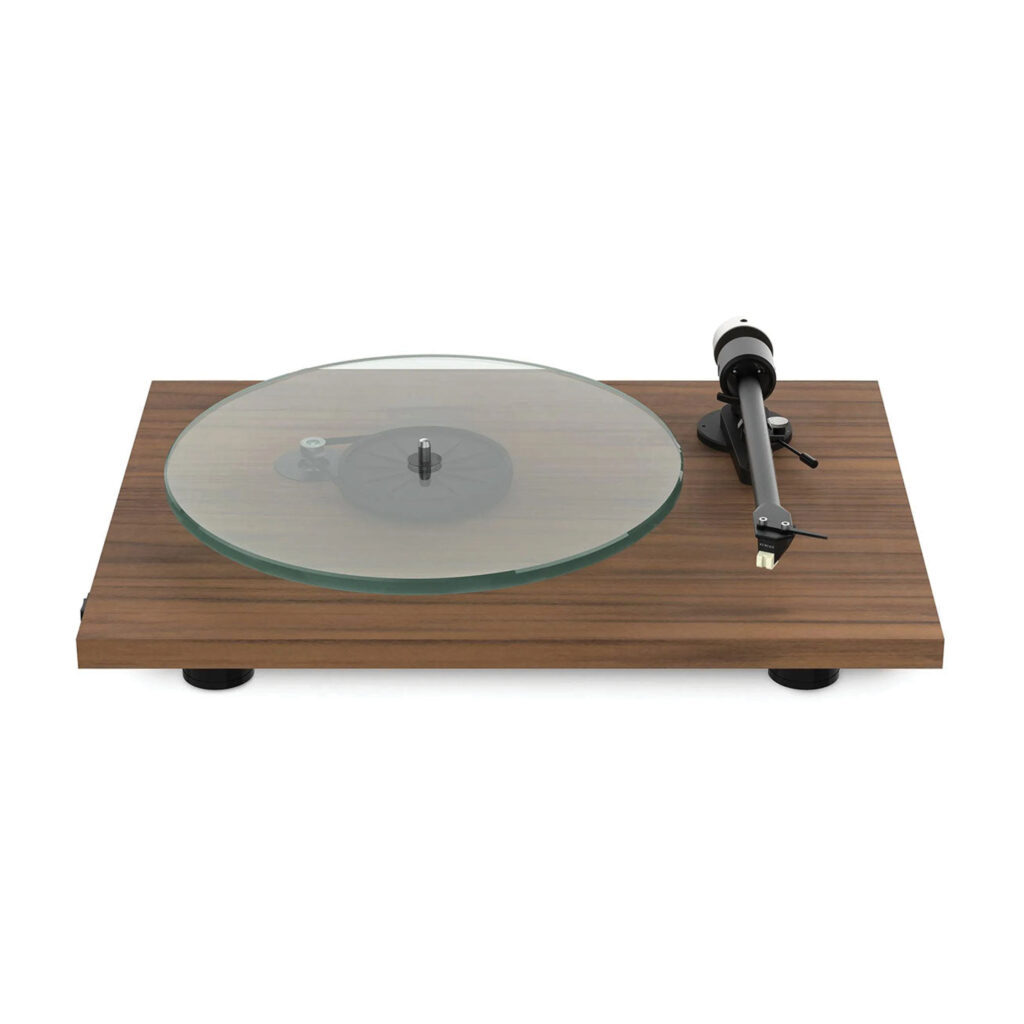
The Pro-Ject T2 Super Phono is designed to make a proper analogue system easier to assemble. A fitted Sumiko Rainier moving-magnet cartridge and switchable phono stage reduce the number of additional boxes needed, while electronic speed selection simplifies ordinary record changes. It is a manual turntable for someone who wants a coherent starting package rather than an extensive cartridge-development project.
Pro-Ject T2 Super Phono — A complete starting point
The T2 Super Phono combines the turntable, cartridge and MM phono electronics in one package. That is useful when an integrated amplifier or powered speaker has only a normal line input. The owner still needs amplification and speakers, but does not have to choose a separate phono stage merely to begin listening. This makes the total system easier to understand and compare with competing packages.
Check the exact model name carefully. The standard T2 and T2 W occupy different roles in the range, and their functions should not be assumed interchangeable with the Super Phono version. A photograph of a similar Pro-Ject does not establish whether the phono stage is included or whether wireless playback is available. The model and supplied cartridge should be written on the invoice, especially when buying older or discounted stock.
The supplied Sumiko Rainier is part of the intended balance between simplicity and performance. Factory fitting reduces the initial alignment work, but it does not excuse ignoring the setup instructions or transport protection. Check what the retailer has already adjusted and what remains for the owner. Keeping a record of the cartridge and settings helps when the stylus eventually needs attention.
Construction and placement
A glass platter and conventional rectangular body give the T2 Super Phono a familiar appearance. The nine-inch aluminium arm has an integrated headshell, and the anti-skate mechanism is spring-based. The construction is intended to provide a practical settled package rather than a platform whose appeal depends on continual adjustment. That can be an advantage for a listener who wants to spend time choosing records instead of choosing another accessory.
The turntable still needs a level, stable surface. Keep it away from direct loudspeaker vibration and make sure the cover can open fully. A powered speaker should not share a small resonant shelf with the deck simply because the line-level connection makes that arrangement easy to wire. Good physical separation can be more valuable than a later cable upgrade. Check whether ordinary footsteps disturb playback before deciding the installation is finished.
Allow room for the arm and cueing lever to be reached comfortably. Daily handling is important at this price: an otherwise appealing turntable can become frustrating if it lives under a low shelf or behind another component. A demonstration should include placing a record, selecting speed and cueing the arm. Those practical details help establish whether the T2’s simplicity suits the owner.
Using the built-in phono stage correctly
The built-in MM stage can be switched out of the signal path. With it enabled, connect to a suitable line input. With it bypassed, the cartridge requires an appropriate external phono input or stage. Applying phono gain and equalisation twice produces the wrong result, so an amplifier input labelled phono should not automatically be used when the turntable’s own stage is active. Follow the selected output mode through the entire connection.
The bypass option offers useful flexibility if the rest of the system changes. An owner can begin with the internal stage and later compare an external one without replacing the turntable. That is a more sensible development path than assuming the built-in stage must immediately be upgraded. Start by checking that the system is quiet, correctly connected and enjoyable with the supplied package.
A future cartridge change also needs electrical planning. The integrated stage is an MM design, so a low-output moving coil would need suitable external gain with the internal stage bypassed. Mechanical compatibility and setup matter too. The presence of a bypass switch does not make every cartridge an automatically worthwhile upgrade. Ask the dealer whether the proposed change fits the arm and whether a different turntable platform would be a better use of the same budget.
Speeds and the manual routine
Electronic selection covers 33 and 45 rpm, which is convenient for a collection mixing LPs and singles. The model does not provide the broader three-speed facility of some alternatives. Buyers with a historical 78 collection should choose around that requirement from the beginning, including appropriate stylus and equalisation needs rather than considering speed alone. For ordinary modern records, the two-speed arrangement is straightforward.
The arm remains manual. The listener cues the stylus and returns it when the side has finished; the built-in phono electronics do not add automatic return. This is worth considering for someone who listens while occupied elsewhere. If unattended end-of-side operation is essential, compare a suitable automatic or semi-automatic design before paying for a more focused manual package.
There is no need to treat the ritual as complicated, but it does require care. Keep the stylus protected during assembly, use the cueing mechanism and follow the current instructions for tracking force. Avoid copying a setting from another cartridge simply because it is also a moving magnet. A small amount of correct setup is more useful than repeated attempts to cure avoidable distortion by changing downstream electronics.
Independent listening evidence
AVForums’ original T2 Super Phono review praised its lively, engaging sound, easy setup and attractive construction. It also noted limits to bass extension and a narrower upgrade scope than the Debut range. Those findings are useful because they evaluate the actual complete model rather than inferring performance from its internal phono stage. They are the reviewer’s observations, not an Audio Review listening test.
That evidence supports the T2 as a strong starting package for enjoyable record playback, with realistic expectations about its role. It should not be bought on the assumption that a few later accessories will turn it into every more expensive turntable. The integrated approach is valuable because the parts work together conveniently. Someone primarily interested in frequent cartridge changes and extensive arm adjustment may prefer another platform even if the T2 initially costs less.
A useful audition includes familiar clean records and the internal phono stage that will actually be used at home. Compare at similar volume, because phono stages can differ in gain. Listen to voices, sustained notes and a busy arrangement as well as bass-heavy material. A record player’s performance is also affected by the pressing and condition of the record, so one noisy or off-centre disc should not determine the whole judgement.
Value and sensible upgrades
The strongest value case is a buyer who wants to connect a well-considered manual turntable to an existing line-level system with little additional equipment. Cartridge and phono-stage costs are already represented in the package, making the total easier to compare than a bare deck. European retailer support and a proper setup can be worth more than a small saving on an unprepared box.
Early improvements should address real limitations: stable support, suitable speaker positions and clean records. A separate phono stage can be compared later if there is a specific reason, but it should not automatically take priority over those basics. If a much larger upgrade is already planned, compare the total cost with a Debut or another adjustable platform before investing repeatedly in the T2.
Long-term ownership includes stylus replacement and occasional mechanical checks. Ask about compatible replacement styli and local service support, and keep the packaging for transport. The T2 Super Phono is most appealing when its existing facilities already satisfy the intended use. It makes starting well straightforward, while leaving a sensible bypass route if the electronics change later.
Alternatives to consider
Pro-Ject Debut Carbon EVO: Compare if a more development-oriented platform matters and an external phono stage is already available.
Audio-Technica AT-LP70XBT: Consider when automatic operation and wireless convenience take priority over a focused manual routine.
Pro-Ject T2 Super Phono key specifications
- Drive / operation
- Belt drive / manual
- Speeds
- 33 and 45 rpm; electronic selection
- Cartridge
- Sumiko Rainier MM
- Phono stage
- Built-in MM; switchable bypass
- Tonearm
- 9-inch aluminium; integrated headshell
- Platter
- 10 mm glass, approximately 1.7 kg
- Weight
- 5.5 kg
Verdict
The Pro-Ject T2 Super Phono is a convincing ready-to-connect manual vinyl package, with a fitted MM cartridge, useful internal phono stage and electronic speed selection. Its value is strongest when the owner wants to use the supplied combination for the long term. More extensive cartridge development is a reason to compare other platforms first.
Primary documentation and independent reviews
Pro-Ject official T2 Super Phono information · Pro-Ject T2 Super Phono user guide · AVForums original T2 Super Phono review
Editorial record
Sources and updates
Product specifications and factual claims were checked against Official Pro-Ject T2 Super Phono product page ↗. Scores and buying advice follow our category-specific editorial methodology.
- Published
- November 8, 2026
- Last updated
- November 8, 2026