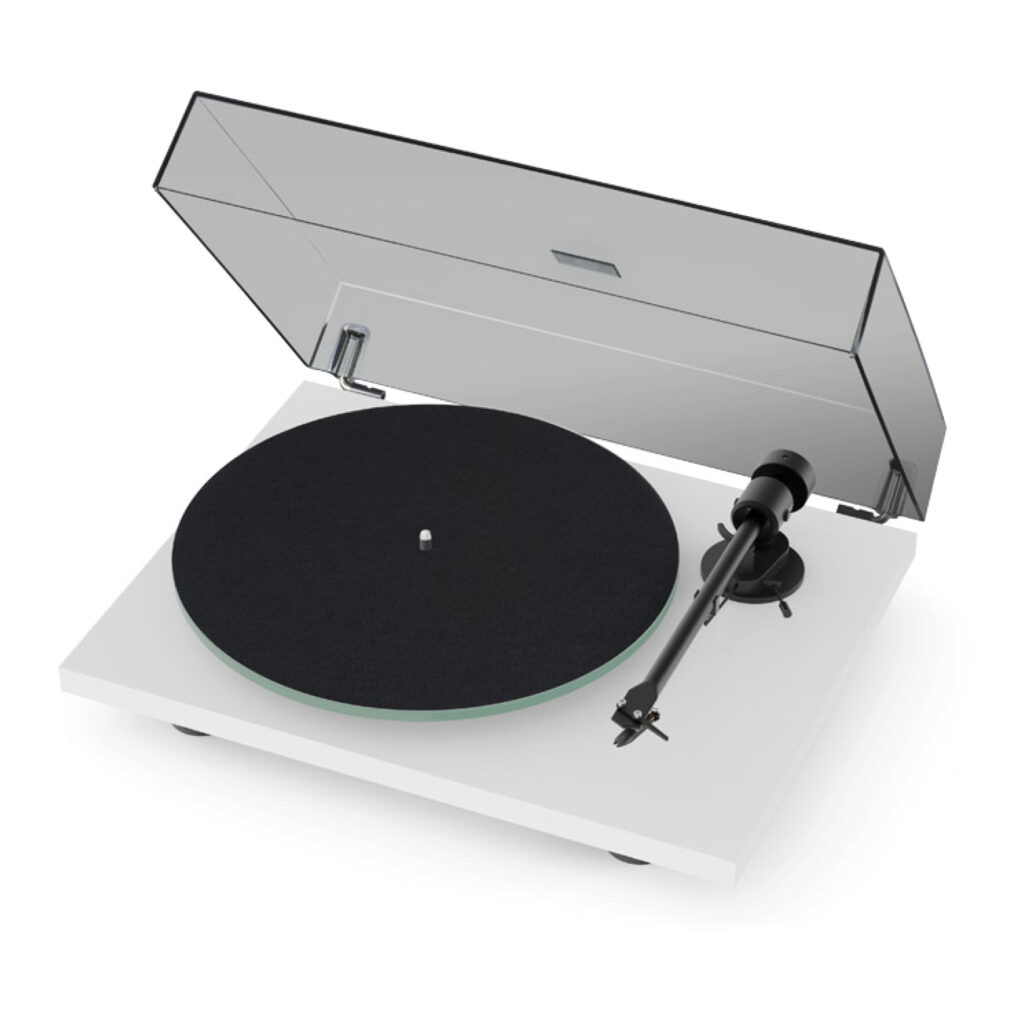
The Pro-Ject T1 EVO BT combines a traditional manual belt-drive format with electronic speed selection and Bluetooth transmission. It is intended to make a record system easier to assemble without discarding the usual arm-and-cartridge arrangement. The EVO designation matters: specifications from the earlier T1 should not be transferred to this model.
Pro-Ject T1 EVO BT — The EVO hardware is specific
Pro-Ject documents an 8.6-inch aluminium arm, an 8 mm glass platter and an Ortofon OM10 moving-magnet cartridge with an elliptical stylus. These details identify the package more usefully than a broad claim of audiophile construction. We have not measured speed behaviour or heard the cartridge in this deck.
The pre-adjusted cartridge and arm reduce initial work, but transport and installation still deserve attention. Follow the setup guide, use a level support and confirm the tracking arrangement remains as intended. Pre-adjusted does not mean the turntable can be placed on an unstable shelf beside a vibrating speaker without consequences.
Electronic speed change improves the routine
The documented speeds are 33 and 45 rpm with electronic selection. That is convenient when moving between common LP and single playback, because it avoids treating every speed change as a manual belt-handling task. It does not provide 78-rpm support.
The deck remains manually operated for cueing and side-end handling. Decide whether that routine suits the household. Someone who frequently leaves a room during a record may prefer automatic return, while a focused listener may be entirely happy to handle the arm. Convenience and attention requirements should be considered before the purchase rather than excused afterwards.
Bluetooth is an optional signal path
The product page lists Bluetooth 5.0 with aptX HD transmission. The matching codec requires a compatible receiving speaker or headphone; support at the turntable alone does not enable it at the other end. Check the receiver’s actual codec list rather than relying on a Bluetooth logo.
Wireless transmission converts and encodes the record signal, so it is not an unchanged analogue path. That does not make it inappropriate for convenient listening. It simply means the buying reason is freedom of placement and compatibility, not a claim of preserving every part of the signal without digital processing.
Wired setup and realistic value
The BT version includes the phono/line connection facilities described in the model manual. Use the output setting appropriate to the receiving input: an ordinary line input needs line level, whereas a phono input expects a cartridge-level route. Do not add another phono stage to an already equalised line signal.
Pro-Ject gives dimensions of 415 by 100 by 335 mm and a net weight of 3.8 kg. Allow space for lid movement and cable bends. Keep the turntable away from strong vibration and follow care instructions for the stylus and glass platter.
Compare the entire system cost with both a simpler wired deck and an automatic Bluetooth alternative. The included cartridge and connection options can reduce extra purchases, but a more expensive codec-compatible speaker may change that calculation. This review does not claim a measured noise floor or an auditioned sound signature; it identifies where the documented package is convenient and where its limits matter.
What to expect in a real setup
Does every Bluetooth speaker receive aptX HD? No. The receiver must explicitly support the codec. Otherwise the connection uses another mutually supported mode.
Is this the same specification as the original T1 BT? No. This review concerns T1 EVO BT. Check the EVO name, OM10 cartridge and electronic speed selection on the actual listing.
Alternatives to consider
Pro-Ject Debut EVO 2: Compare the more traditional manual upgrade path when wireless playback is unnecessary and the budget permits a different platform.
Audio-Technica AT-LP70XBT: An alternative for buyers who prioritise automatic operation and a simpler everyday routine.
The T1 EVO BT in a compact living space
Bluetooth can allow the turntable to occupy a stable accessible shelf while the receiving speaker sits elsewhere. That is a practical advantage only when the actual speaker or headphones support the required receiving role. Test pairing and normal playback at the intended positions before organising the room around the wireless route. A supported codec is a connection option, not proof that every receiver will use it or that the result has been independently measured here.
Keep the mechanical side of the installation just as deliberate. Wireless output does not protect a stylus from vibration, and a glass platter does not make unstable furniture suitable. Leave cover clearance and enough space to handle records without reaching across the arm. This model remains a manual record player, so comfortable access is part of its convenience even when no audio cable crosses the room.
What the EVO speed control changes
Electronic speed selection is useful for a listener who alternates albums and singles frequently. It removes one particular handling step compared with a belt-repositioning routine, but it does not provide automatic cueing or arm return. Think through the whole listening process instead of treating one convenience as full automation. Someone who values a manual ritual may like this balance; someone wanting push-button start should compare an automatic design.
The supplied cartridge and arm setup should follow the correct model instructions. Do not transfer tracking or replacement guidance from another Pro-Ject merely because the plinth looks similar. Keep the fitted cartridge identified and check the appropriate replacement stylus when maintenance is due.
Comparing the complete value
Establish the wired output route and receiving input before adding components. If a wireless speaker will be the normal destination, consider whether that same speaker also offers a useful analogue option. Match listening levels when comparing routes and note the receiver’s settings, since its own processing can affect the result. The T1 EVO BT’s appeal is strongest when electronic speed selection and wireless placement genuinely simplify a manual system. If Bluetooth remains unused, assess the cartridge package, setup and conventional connection on their own merits rather than assigning value to an unused feature.
Pro-Ject T1 EVO BT key specifications
- Drive
- Belt drive
- Operation
- Manual
- Speeds
- 33 / 45, electronic selection
- Cartridge
- Ortofon OM10 MM
- Arm
- 8.6-inch aluminium
- Platter
- 8 mm glass
- Bluetooth
- 5.0, aptX HD option
- Dimensions W × H × D
- 415 × 100 × 335 mm
- Net weight
- 3.8 kg
Verdict
The T1 EVO BT is a useful compromise for manual-vinyl listeners who want connection convenience. Choose it for the exact EVO package, electronic speed control and suitable receiver compatibility. Proper support and setup remain more valuable than broad wireless-quality claims.
Primary documentation
Specifications and feature descriptions were checked against the following official documents on 6 November 2026. Compatibility advice is our interpretation of those documented capabilities; it does not establish measured sound quality. Regional bundles, software features and service availability can change, so verify the exact European model and current support information before purchase.
Editorial record
Sources and updates
Product specifications and factual claims were checked against Official Pro-Ject T1 EVO BT product page ↗. Scores and buying advice follow our category-specific editorial methodology.
- Published
- November 7, 2026
- Last updated
- November 8, 2026