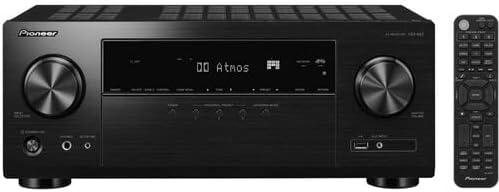
The Pioneer VSX-935 is a receiver for a manageable home cinema rather than a room filled with speakers. Its seven amplified channels can support a conventional surround system or a five-speaker layout with two height channels, while network playback and HDMI switching keep several everyday sources together. The appeal depends on buying the capabilities you will actually use, because this is not a platform for gradually building an eleven-speaker theatre.
Pioneer VSX-935 — Design and installation
The conventional black component design makes the VSX-935 easy to place alongside a disc player or console. Physical controls remain useful when a phone is elsewhere or a network connection is unavailable. A receiver can be operated primarily through the television, but direct access to basic functions is still valuable when diagnosing an input problem. The rear connections deserve a little planning before the cabinet is pushed back against the wall.
Leave ventilation space and allow for the depth of HDMI plugs and speaker cables. A specification for the metal enclosure alone does not describe the shelf depth a finished installation needs. Label cables at both ends, especially if the television and projector share the receiver. This small preparation reduces the chance of disconnecting a working source while trying to fix an unrelated problem. The VSX-935 makes more sense in accessible furniture than in a tightly sealed compartment.
Speaker layouts and realistic upgrade paths
Seven internal amplifiers create a clear choice: retain rear surround speakers in a seven-channel floor layout, or allocate two channels to height speakers in a 5.2.2 arrangement. Both can be sensible. A long room with seats well ahead of the rear wall may benefit from rear surrounds, while a smaller lounge can make better use of properly positioned heights. The receiver cannot turn those alternatives into a simultaneous nine-speaker installation.
Pioneer documents two subwoofer sockets carrying the same signal. That is convenient for feeding two active subwoofers, but it does not provide independent correction of each subwoofer. Placement and the controls on the subwoofers remain important. Buyers planning a more elaborate bass system should consider that distinction before choosing on connector count alone. Similarly, the absence of a full multichannel preamplifier-output bank limits the usefulness of a later external-power-amplifier upgrade. Choose the receiver around the finished speaker plan, not a hoped-for expansion that its architecture cannot deliver.
MCACC and everyday setup
MCACC provides an accessible starting point for speaker calibration. In its original test, Lyd & Billede found the process quick and straightforward, while noting that the system gave less insight into its equalisation decisions than some alternatives. That supports the VSX-935 as an approachable living-room receiver, but it is a reason to keep expectations realistic if detailed room-correction editing is a major hobby. It is not a Dirac Live receiver.
Start with sensible speaker placement, a quiet room and the supplied microphone at seated ear height. Afterwards, inspect the detected speaker configuration and levels instead of assuming every automatic choice suits the installation. A small speaker assigned an unnecessarily low crossover may struggle during loud effects. Correction also cannot move a speaker away from an obstructing cabinet or make a poorly placed subwoofer excite the room evenly. Spending time on placement before calibration is more productive than repeatedly rerunning the microphone routine without changing anything.
Sound and cinema suitability
Lyd & Billede described a substantial, warm presentation with an engaging sense of space, but wanted greater transparency and dynamic expression. Those are observations from that publication’s system, not listening results from Audio Review. They suggest a receiver whose strongest case is enjoyable mainstream cinema rather than a promise of class-leading resolution. Speaker choice, room acoustics and playback level can still outweigh a short tonal description.
For a lounge system, the practical priority is clean dialogue and consistent transitions between channels. Matching the centre speaker sensibly to the front pair, keeping its tweeter aimed towards listeners and avoiding excessive bass demands on small satellites are useful ways to support that goal. A good active subwoofer can handle demanding low-frequency effects, but it does not remove every power requirement from the receiver. Larger rooms and insensitive speakers deserve an audition at the intended seating distance.
Stereo music is also a reasonable part of the brief, especially when convenience matters more than maintaining a separate amplifier. Compare the calibrated mode with an appropriate direct mode at matched volume, because different bass management and level settings can make a casual comparison misleading. There is little value in declaring one mode universally better without considering whether the subwoofer remains active and how the room affects the result.
HDMI, television audio and music sources
The VSX-935 offers six HDMI inputs and two outputs, plus a moving-magnet phono input and network music options. That combination can replace several small boxes in a mixed television and music system. AirPlay 2 and Chromecast support provide familiar ways to start playback, while wired Ethernet is worth considering where Wi-Fi coverage is inconsistent. A stable connection usually matters more to everyday enjoyment than an impressive list of supported services.
For a games console or PC, check the exact input’s supported format in the current manual and select the corresponding enhanced HDMI setting. An HDMI version label alone does not establish every combination of resolution, refresh rate and colour format. Test the desired mode with the actual television and cable before hiding the wiring. Connecting a demanding source directly to the television and returning sound through eARC can be an alternative, provided the television passes the required audio format.
The phono input suits a compatible moving-magnet cartridge. A low-output moving-coil cartridge needs suitable additional gain, and a turntable with its own active phono stage should normally feed a line input. Avoid applying phono equalisation twice. These details are simple once the signal path is understood, but they make more difference to a turntable connection than choosing between network playback applications.
Value and who should buy it
The most convincing buyer has already decided on a seven-channel ceiling and wants convenient switching, streaming and an uncomplicated calibration process. In that situation, paying for additional processing channels that will never be installed may be unnecessary. The VSX-935 deserves consideration when its local price reflects that modest scope and leaves enough budget for a capable centre speaker, suitable subwoofer and practical installation.
It becomes less compelling if a similarly priced alternative includes more flexible room correction or the processing needed for four height speakers. Compare complete system costs rather than launch prices from another market. European stock, warranty arrangements and retailer support matter, especially for a receiver that sits at the centre of several HDMI devices. Buyers planning a large dedicated theatre should move up in architecture early instead of spending later on accessories that cannot change the receiver’s channel limit.
Alternatives to consider
Onkyo TX-NR6100: A useful comparison for another seven-amplifier living-room system; compare calibration and local pricing.
Pioneer VSX-LX305: The more appropriate direction when nine amplified channels and Dirac Live are central requirements.
Pioneer VSX-935 key specifications
- Amplified channels
- 7
- Typical Atmos layout
- 5.2.2
- HDMI
- 6 inputs / 2 outputs
- Room correction
- MCACC
- Subwoofer outputs
- 2 sockets; same signal
- Phono
- Moving magnet
Verdict
The Pioneer VSX-935 is a sensible shortlist option for an uncomplicated seven-channel or 5.2.2 cinema system. Its limitations are architectural: shared subwoofer signals, relatively basic correction and little scope for a larger speaker layout. Buy it for a clearly defined living room at a competitive price.
Primary documentation and independent reviews
Pioneer VSX-935 official specification sheet · Pioneer European rear-panel documentation · Pioneer current instruction manual · Lyd & Billede original VSX-935 test
Editorial record
Sources and updates
Product specifications and factual claims were checked against Official Pioneer VSX-935 product page ↗. Scores and buying advice follow our category-specific editorial methodology.
- Published
- November 7, 2026
- Last updated
- November 8, 2026