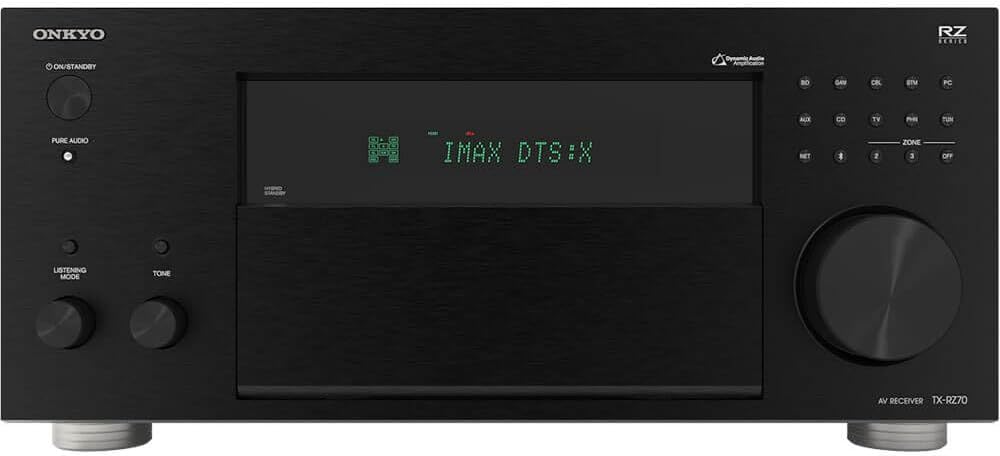
The Onkyo TX-RZ70 makes a strong case for an ambitious cinema through eleven internal power channels and an included full-bandwidth Dirac Live licence. It can run a substantial Atmos layout without another speaker amplifier, while optional bass-processing facilities provide room for further integration work. Its conventional appearance hides considerable flexibility, with careful installation and exact regional specifications still important.
Onkyo TX-RZ70 — Eleven channels and meaningful capacity
The RZ70 is an eleven-channel amplifier capable of a seven-speaker bed with four height speakers. Its 11.2 main processing architecture should be distinguished from models that process thirteen main speaker channels. Adding an external amplifier does not automatically create a larger decoding layout beyond the platform’s supported capacity.
The two subwoofer outputs are independent line-level connections for suitable powered subwoofers or external amplification. They provide useful integration options, but their value depends on placement and measurement. Two subwoofers in poorly chosen positions can still leave inconsistent bass across the seats.
Onkyo’s current manual specifies the European power rating as 210 watts per channel into six ohms at one kilohertz, one channel driven and one percent distortion. The 140-watt figure commonly seen in North American coverage uses eight ohms, a full audio-band test and two driven channels. Those are different conditions, not directly comparable measures of simultaneous eleven-channel output.
For a buyer, the meaningful demand is set by speaker sensitivity, impedance, distance and listening level. A suitable bass-management arrangement also matters. The RZ70 should be selected as part of a complete room plan rather than through the largest power figure printed on a shop page.
Sound quality and the original reviews
AVForums’ original RZ70 review is strongly positive about dynamic multichannel sound, clarity and bass integration. It also likes the music presentation and included correction package, while finding the crowded rear panel less refined than the front. That combination supports a serious cinema recommendation with practical installation reservations.
A useful audition should include the relationship between quiet detail and sudden action. The receiver needs to preserve dialogue and spatial continuity when the soundtrack becomes busy, not merely produce impressive peaks. Match levels when comparing another amplifier, because a louder demonstration can easily decide an uncontrolled preference.
Speaker and room matching remain fundamental. A centre speaker aimed away from the seats or hidden behind furniture can compromise intelligibility despite a capable amplifier. Check placement and crossover choices before treating a higher product tier as the only way to improve dialogue.
For music, compare stereo and appropriate multichannel material separately. A strong surround experience does not establish that every upmixing mode is preferable to the original recording. Choose processing deliberately and retain a straightforward reference setting.
The published evidence points towards a receiver able to serve both cinema and music convincingly within its category. It should still be auditioned with a representative speaker balance and normal listening habits rather than bought as a guarantee that every room will produce the reviewer’s result.
Dirac Live and the bass upgrade
Full-bandwidth Dirac Live Room Correction is included. That makes the complete cost more transparent for a buyer who already intends to use it. Comparing only hardware prices can undervalue this inclusion when a competing receiver requires another licence for the desired correction range.
Dirac Live Bass Control is an optional upgrade, rather than part of the basic included package. Confirm the current model licence and measurement requirements before purchasing it. Software descriptions referring to broad subwoofer support do not add physical outputs to the receiver; the RZ70 still has its documented connection architecture.
Begin with sensible subwoofer locations, correct wiring and the supplied calibration process. A sophisticated filter cannot make an unsuitable position work equally well at every seat. Measurement helps distinguish a placement problem from a target preference or a channel-level error.
Keep the microphone pattern representative of the listening area, reduce background noise and inspect the resulting crossovers and trims. A correctly measured system is more useful than an impressive licence left configured with rushed positions or a mistaken speaker assignment.
Save an established setup before making substantial target changes. Compare dialogue, bass notes and demanding film material at similar playback levels. The aim is reliable integration and enjoyable balance, not simply a more dramatic low-frequency boost during a short demonstration.
HDMI and source flexibility
The manual lists seven HDMI inputs, including a front connection, and three outputs. The six rear inputs are specified at 40 Gbps, while the front input is 9 Gbps. This difference matters for a gaming source: convenient temporary access does not mean that the front socket matches the rear paths for demanding formats.
The main and sub display paths are listed at 40 Gbps, with the zone output at 18 Gbps. Check the detailed format and assignment rules when planning several displays or another room. Three outputs are not a promise that every source and display combination works independently at the maximum format.
A high-refresh console or PC should be tested with the required resolution, HDR and variable-refresh settings together. Cable capability and the television’s input configuration remain part of the result. A successful lower-rate signal does not prove that the intended maximum mode is available.
Network playback, AirPlay 2 and Chromecast provide music flexibility, while the moving-magnet phono input serves a suitable turntable. Confirm current firmware and service support for any specific platform essential to the household. Older launch statements about future certification should be checked against the current status.
TV-app audio returned over eARC also depends on the display. A directly connected disc player can provide a different audio path. The receiver’s format support does not establish identical sound from every streaming app, pass-through setting or connection type.
Installation and value
The rear panel is densely populated, so cable access deserves planning. Label speaker leads, allow room for HDMI plugs and avoid arranging the component so tightly that ordinary changes require moving the whole system. The positive front-panel build assessment does not remove the practical demands of a complex installation.
Ventilation and shelf capacity matter with an eleven-channel amplifier. Follow the manufacturer’s clearance guidance and consider the space behind the chassis as well as its visible footprint. A closed furniture compartment is a poor place to discover that the system needs more airflow.
The strongest value comparison is against another complete eleven-channel system with the desired software included. The RZ70’s Dirac licence is a genuine advantage for a buyer who will use it. Optional Bass Control, measurement equipment and any installation work should still be included in the final budget.
A smaller nine-channel receiver may make more sense when four heights and rear surrounds will not all be installed. Conversely, a buyer planning more than eleven main speaker channels should choose an appropriate processing platform from the start. The RZ70 is capable within a defined architecture, not an unrestricted expansion system.
For European purchases, confirm the exact regional version, mains, accessories and warranty route. Regional power and tuner descriptions can differ from US pages. A supported unit that suits the room and everyday source routine is a stronger purchase than a superficially attractive import with uncertain facilities.
Alternatives to consider
Onkyo TX-RZ50: Compare the complete nine-channel-plus-external-amplifier route if suitable amplification is already owned.
Anthem MRX 740 8K: A different correction platform to assess with every required external channel included in the system cost.
Marantz CINEMA 50: A smaller internal channel count with a different design and optional calibration budget to compare carefully.
Onkyo TX-RZ70 key specifications
- Powered speaker channels
- 11
- Main processing
- 11.2 channels
- Example layout
- 7.2.4
- EU rated output
- 210 W/ch, 6 ohms, 1 kHz, 1% THD, one channel, IEC
- Calibration
- Dirac Live Full included; Bass Control optional
- Subwoofer outputs
- 2 independent line-level outputs
- HDMI
- 7 inputs including front / 3 outputs
- HDMI bandwidth
- Rear inputs: 40 Gbps; front: 9 Gbps; zone output: 18 Gbps
- Region
- Confirm European model and documentation
Verdict
The TX-RZ70 is a convincing eleven-channel cinema centrepiece with strong published sound assessments and included Dirac Live Full. Independent sub outputs and an optional Bass Control route add practical value. Check port-specific HDMI capabilities, regional power conditions and installation space, choosing it for a planned 7.2.4 system rather than an assumption of unlimited channel expansion.
Primary documentation and independent reviews
Onkyo official RZ70 information sheet · Onkyo current manual with EU power and HDMI tables · Onkyo official RZ70 features and licence distinction · AVForums original RZ70 review
Editorial record
Sources and updates
Product specifications and factual claims were checked against Official Onkyo TX-RZ70 product page ↗. Scores and buying advice follow our category-specific editorial methodology.
- Published
- November 7, 2026
- Last updated
- November 8, 2026