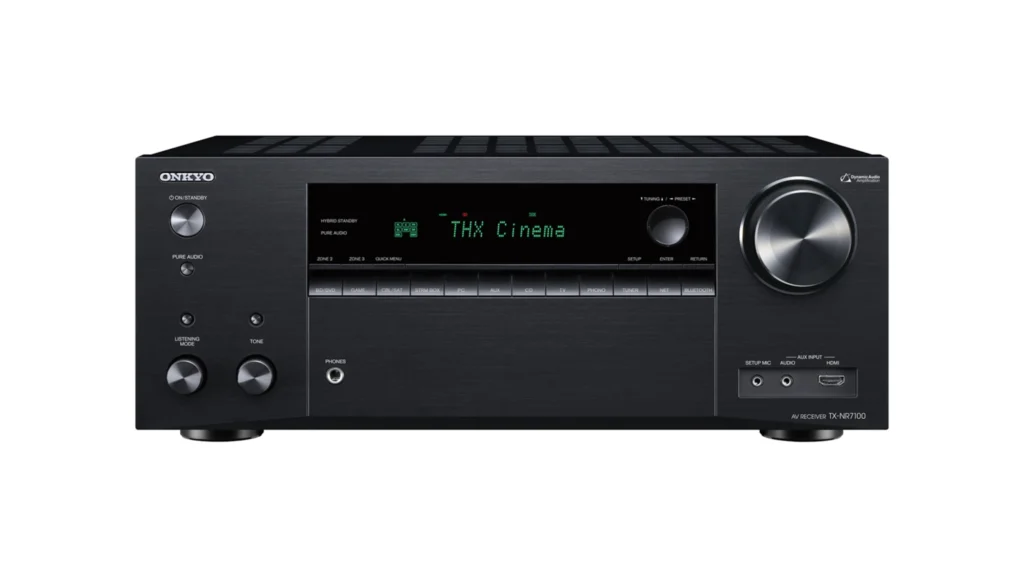
The Onkyo TX-NR7100 is attractive because it combines nine powered channels with an included full-bandwidth Dirac Live licence. That can simplify the budget for a substantial Atmos system. Its limits are equally important: it is not an eleven-channel expansion platform, and European connection details should be checked separately from early North American reviews.
Onkyo TX-NR7100 — Nine channels and European details
The TX-NR7100 supports a nine-speaker main system, such as a five-speaker bed with four heights or seven bed speakers with two heights. That is a useful step beyond a seven-channel receiver because it creates a choice about the height layer without immediately adding another component.
It should not be bought as a route to eleven main-zone speakers. An external amplifier does not increase the available processing count. If a full seven-speaker bed and four heights is already the goal, select a platform designed to process that layout rather than assuming more sockets or spare amplification can create it.
The current official manual distinguishes regions. Its European specification includes front-channel pre-outs, whereas older North American descriptions often emphasise their absence. Those front outputs are not a full set of multichannel pre-outs. Verify the rear panel of the exact regional unit, especially when buying used or imported equipment.
The European rating is 170 watts per channel into six ohms at one kilohertz, one channel driven and one percent distortion. That condition is different from an eight-ohm full-bandwidth two-channel figure. Compare ratings under matching conditions rather than treating the largest number as proof of greater usable multichannel power.
Dirac Live: the main buying advantage
Dirac’s current model page identifies Room Correction Full as included on the TX-NR7100. It also explicitly lists Bass Control and ART as unsupported. This is a meaningful distinction from a receiver that merely advertises compatibility with an additional paid calibration package.
For a buyer who intends to use full-bandwidth correction, the included licence changes the complete purchase calculation. Compare the receiver and desired software together. A lower hardware price elsewhere may be less attractive after adding a licence, while a buyer who never plans to calibrate may value the inclusion less.
Use a quiet room and a careful microphone-positioning pattern. Establish the speaker layout and connections first, then inspect levels, distances and crossovers after measurement. A technically sophisticated process cannot correct a speaker wired to the wrong position or make an impractical layout sensible.
The two subwoofer sockets do not imply access to Dirac Bass Control. Plan subwoofer placement and integration with the platform’s actual tools. Adding multiple subs is most useful when it improves coverage or meets output needs, rather than simply filling the available connections.
Save a known setup before experimenting with target changes. Compare results at similar playback levels and use familiar dialogue as well as music. Extra bass or a louder filter can create a quick impression of improvement without necessarily making the whole system more consistent.
Sound quality and system matching
Sound & Vision’s original TX-NR7100 evaluation reports solid audio performance and finds Dirac useful for bass control and midrange focus in its room. Its conclusion is positive about the overall performance and value. That is evidence for the core platform, with current EU connection details checked separately in the manufacturer’s documentation.
For an audition, listen to quiet speech, busy surround movement and a demanding action passage at a realistic level. The useful result is a coherent sound field with understandable dialogue. A receiver that sounds exciting only when played louder than its competitor has not necessarily demonstrated a meaningful advantage.
Speaker choice remains central. Efficient speakers in a moderate room place different demands on the amplifier from difficult loads and distant seating. If the actual system needs unusually high output, evaluate that requirement directly rather than relying on THX branding as a substitute for a complete load assessment.
The calibration result should complement sensible placement. A centre speaker hidden deep inside furniture can lose clarity, while subwoofer position can dominate bass consistency. Correct those physical conditions before assuming another receiver tier will transform the result.
Stereo music is also worth a separate comparison if it is part of daily use. Try a straightforward playback mode and the preferred calibrated setting. Choose the one that serves the room and recording rather than assuming that bypassing processing is always the most accurate result at the seat.
HDMI ports and everyday sources
The manual lists seven HDMI inputs, including one at the front, and two outputs. Their capabilities are not identical. Rear inputs one to three provide 40 Gbps paths, inputs four to six are listed at 24 Gbps and the front connection at 9 Gbps. Assign demanding gaming sources deliberately rather than connecting them to the most convenient socket.
The secondary output’s behaviour also depends on whether it is used as a sub display or a zone path. Check the manual’s rules when planning a television and projector, especially if the displays have different capabilities. The number of HDMI sockets does not establish unrestricted independent operation.
For a console or computer, test the required resolution, refresh rate and HDR combination together. Cable suitability and the display’s selected input mode remain part of compatibility. A picture at a lower rate does not confirm that the highest intended signal is working.
AirPlay 2, Chromecast and network playback provide music options beyond physical players. A moving-magnet phono input supports a compatible turntable. European radio and connection facilities can differ from US descriptions, so use the exact local model and current support information when a particular feature is essential.
TV-app audio returned over eARC is a different path from a player connected directly to the receiver. The television’s pass-through support determines which formats arrive. Atmos decoding in the Onkyo does not guarantee identical audio from every app or connection route.
Value and ownership
The NR7100 is strongest as a complete nine-channel purchase with Dirac already included. It is less compelling for someone who needs a large external-amplifier expansion path or expects advanced Dirac bass facilities later. Those limitations should be resolved before the system is built around it.
Compare the actual European offer with TX-RZ50 and competing nine-channel models. The RZ-class alternative may have a more useful development path, while a less expensive seven-channel receiver may be sufficient for a smaller room. The right value comparison follows the planned system rather than a model hierarchy.
Check warranty, supplied microphone and exact regional rear panel. This is especially important when an older review sample differs from a current European listing. A supported unit with known facilities is worth more than a small saving accompanied by uncertain compatibility.
Allow ventilation, cable clearance and access for calibration. A dependable setup that the household can operate easily is the objective. The NR7100’s inclusion of sophisticated correction is a genuine advantage when it helps achieve that objective, rather than becoming another feature left unused.
Alternatives to consider
Onkyo TX-RZ50: Compare the expansion architecture if future external amplification and a larger layout are part of the plan.
Denon AVC-X3800H: A flexible alternative to compare with the desired calibration licences included in the total budget.
Pioneer VSX-LX305: Another nine-channel option to assess for included correction, physical connections and current European support.
Onkyo TX-NR7100 key specifications
- Powered speaker channels
- 9
- Example layouts
- 5.2.4 or 7.2.2
- EU rated output
- 170 W/ch, 6 ohms, 1 kHz, 1% THD, one channel, IEC
- Calibration
- Dirac Live Full included; AccuEQ also available
- Dirac limitations
- Bass Control and ART not supported
- HDMI
- 7 inputs including front / 2 outputs
- HDMI bandwidth
- Inputs 1–3: 40 Gbps; 4–6: 24 Gbps; front: 9 Gbps
- Pre-outs
- EU front-channel pre-outs documented; not a full multichannel set
- Region
- Verify current EU model and rear panel
Verdict
The TX-NR7100 is a strong-value nine-channel cinema receiver when included Dirac Live Full meets the calibration requirement. Check the exact European connections and assign HDMI sources to suitable ports. It is best treated as a capable self-contained nine-speaker platform, with Bass Control, ART and eleven-channel expansion excluded from the buying assumptions.
Primary documentation and independent reviews
Onkyo TX-NR7100 official EMEA information sheet · Onkyo current manual with regional and HDMI tables · Dirac official NR7100 inclusion and limitations · Sound & Vision original NR7100 evaluation
Editorial record
Sources and updates
Product specifications and factual claims were checked against Official Onkyo TX-NR7100 product page ↗. Scores and buying advice follow our category-specific editorial methodology.
- Published
- November 7, 2026
- Last updated
- November 8, 2026