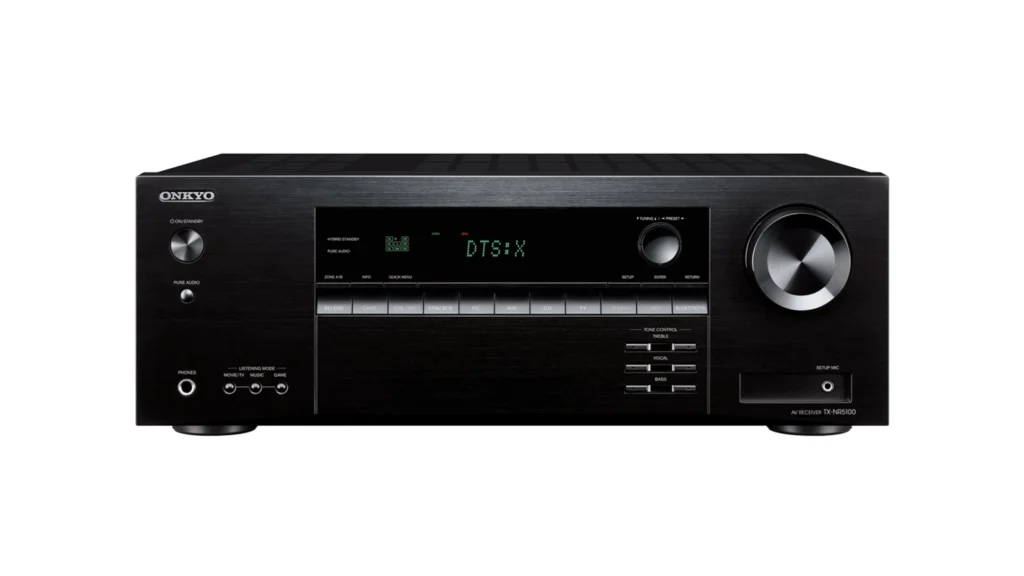
The Onkyo TX-NR5100 is aimed at a straightforward first surround system rather than a large expandable cinema. Seven powered channels, network playback and eARC cover many everyday needs, while AccuEQ provides the calibration route. Its strongest value is in a modest room at a suitable price, with the HDMI format limits and regional specification details understood before buying.
Onkyo TX-NR5100 — A practical seven-channel system
The NR5100 can support a conventional seven-speaker surround layout or a five-speaker bed with two height channels. Those are alternative uses of its seven internal amplifiers, not two complete layouts operating simultaneously. A buyer planning four height speakers should begin with a nine-channel model instead.
The European manual and EMEA sheet rate output at 135 watts per channel into six ohms, one kilohertz, one channel driven and one percent distortion. That differs from the 80-watt two-channel eight-ohm figure commonly quoted in North American reviews. The conditions explain the different numbers; they do not indicate that the European unit suddenly supplies 135 watts continuously to all seven speakers.
This is a receiver for sensible speaker loads and listening distances. Efficient speakers in a moderate room make a more appropriate match than a difficult large system expected to play at extreme levels. A suitable powered subwoofer and sensible crossover settings can also reduce the low-frequency demand on the main channels.
Do not assume that every feature from the more expensive Onkyo models carries down to the NR5100. Its purpose is an affordable complete system, with fewer expansion and calibration facilities. Identify the required layout first, then decide whether the simpler platform meets it.
Sound quality and expectations
Home Media Entertainment’s original evaluation praises its surround performance in a smaller-system context, while noting that pushing levels far enough exposes its power limits. The review also criticises some physical and connection compromises. That is a more useful starting point than either dismissing an entry model or treating it as a budget flagship.
A first cinema system can sound convincing without reaching the scale of a dedicated room. Clear dialogue, smooth movement around the seats and correctly integrated bass are realistic goals. Those qualities depend on the speakers and setup as much as the receiver’s position in the range.
During an audition, use the sort of material that will be watched regularly. A dialogue-led programme, a busy action scene and a familiar music recording reveal different strengths. Keep the level realistic rather than asking a modest receiver to demonstrate an output the household will never use.
Two height speakers add an overhead layer, but they cannot offer the same front-to-back height separation as four well-placed speakers. Choose their positions carefully and keep expectations aligned with the layout. Virtual surround options are additional choices rather than a replacement for every physical speaker arrangement.
Stereo music should also be evaluated in an ordinary playback mode. The NR5100’s broad streaming features are useful only if the result suits the owner’s speakers and listening habits. A long source list does not establish a preferred tonal balance.
AccuEQ and installation
The included correction system is AccuEQ, not the full-bandwidth Dirac licence found in NR7100 and higher models. This is a meaningful distinction for someone comparing complete calibration packages. The NR5100 should not be selected on the assumption that a different software tier is included simply because other Onkyo receivers offer it.
Follow the supplied microphone process in a quiet room and inspect the resulting speaker settings. Check channel assignments, distances, trims and crossovers rather than assuming automatic setup removes all responsibility for the configuration. Incorrect wiring should be resolved before measuring.
Physical placement remains the most effective first step. Keep the centre speaker clear of obstructions and investigate subwoofer position before repeatedly changing equaliser settings. A deep cancellation at a seat cannot be reliably solved by adding large electronic boosts.
Early review samples attracted criticism for their spring-clip speaker connections. Current European listings and revisions should be checked by the exact rear panel rather than assumed identical to an older US sample. Verify the terminal arrangement and cable suitability before installation, especially if reusing thick existing speaker leads.
Allow ventilation and cable clearance even in a small system. A receiver that fits neatly at the front of a cabinet can still lack room for rear plugs or heat to escape. Straightforward access makes first-time setup and later source changes much easier.
HDMI: four inputs with qualifications
The official manual lists four HDMI inputs and two outputs, with 24 Gbps bandwidth across the HDMI paths. This is a concrete limitation behind the broad HDMI 2.1 and 8K branding. It should not be compared as though it were an unrestricted 40 Gbps implementation.
Some higher-rate formats depend on compression and compatible equipment. The manual’s table distinguishes uncompressed signals from DSC-dependent modes. A buyer with a particular console or PC requirement should verify that complete format, including colour and refresh settings, rather than assume every combination follows from the words 4K/120.
Four inputs may be ample for a console, disc player and streamer, but count the actual sources. If several gaming devices and older players need permanent connections, moving up to a more flexible model can be preferable to adding another switch immediately.
The main output supports eARC. Connecting a source directly to the TV and returning audio can be a practical arrangement, but the television’s audio pass-through behaviour then matters. The receiver’s Atmos support does not mean every TV app or connection supplies the same format.
Test standby, input switching and the desired picture mode with the actual display before hiding the cables. Basic reliable operation is a larger everyday benefit than a format label that the source or television cannot use.
Network features and value
AirPlay 2, Chromecast and network playback give the NR5100 useful music flexibility without requiring another main source component. The EMEA documentation also identifies European radio facilities and 220–240 V operation. Regional pages can show US data, so use the exact European model and documentation when confirming mains and tuner requirements.
Its analogue inputs are line-level facilities rather than a reason to assume a moving-magnet phono stage is present. A turntable without its own phono preamplifier needs a suitable external stage. Connector shape alone does not establish that the signal level is correct.
The strongest buyer wants a manageable seven-channel system and will use the network facilities. The weaker case is a buyer already planning more speakers, advanced correction or multiple demanding high-refresh sources. In that situation, a more capable platform may prevent an early replacement.
Compare current European offers with the TX-NR6100 and other entry receivers, including warranty, microphone and return arrangements. A low price is useful when the complete package meets the room’s needs. It is less helpful if a small initial saving immediately creates another compatibility purchase.
The NR5100 is best judged as a purposeful entry product. With suitable speakers, careful placement and realistic levels, it can form an enjoyable cinema system. Its limitations deserve acknowledgement because choosing correctly at this stage is more valuable than assuming every missing facility can be added later.
Alternatives to consider
Onkyo TX-NR6100: Compare the step-up model for physical connections and the complete current offer if the NR5100 feels too restricted.
Denon AVR-X1800H: A different entry-level seven-channel package to assess for setup, fit with existing equipment and actual HDMI requirements.
Yamaha RX-V4A: A smaller-channel alternative if a straightforward five-speaker system and Yamaha’s music platform better match the room.
Onkyo TX-NR5100 key specifications
- Powered speaker channels
- 7
- Example layouts
- 5.2.2 or 7.2
- EU rated output
- 135 W/ch, 6 ohms, 1 kHz, 1% THD, one channel, IEC
- HDMI
- 4 inputs / 2 outputs; eARC on main
- HDMI bandwidth
- 24 Gbps; higher formats may require DSC and compatible equipment
- Calibration
- AccuEQ with supplied microphone
- Mains
- European model: AC 220–240 V, 50/60 Hz
- Phono stage
- External stage needed for a turntable without built-in phono preamp
Verdict
The TX-NR5100 is a capable entry receiver for a modest seven-channel cinema, with useful network playback and a straightforward calibration route. Its 24 Gbps HDMI implementation and limited development path require realistic expectations. Choose a verified European unit at a competitive price when its existing facilities meet the plan, rather than relying on future additions to fill major gaps.
Primary documentation and independent reviews
Onkyo official EMEA NR5100 information sheet · Onkyo current manual with EU power and HDMI tables · Onkyo official NR5100 product information · Home Media Entertainment original NR5100 review
Editorial record
Sources and updates
Product specifications and factual claims were checked against Official Onkyo TX-NR5100 product page ↗. Scores and buying advice follow our category-specific editorial methodology.
- Published
- November 7, 2026
- Last updated
- November 8, 2026