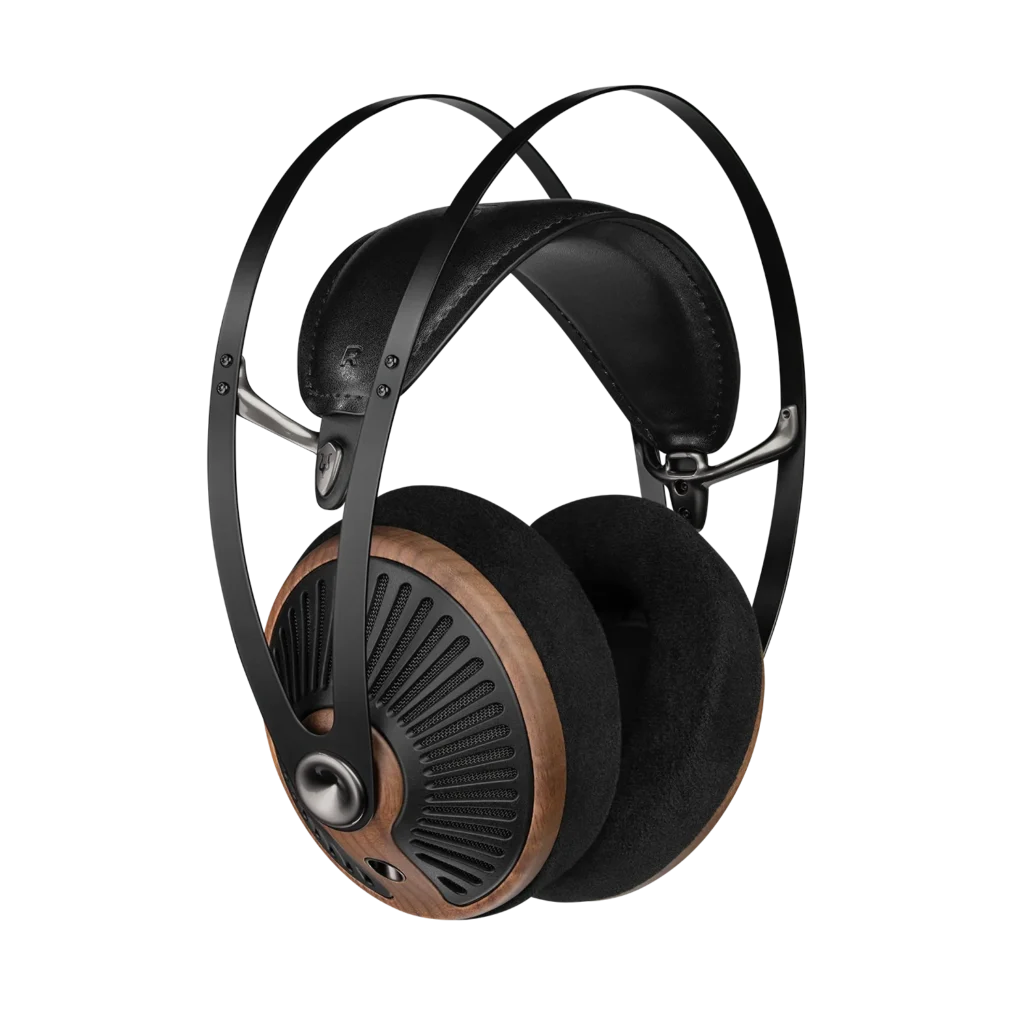
The Meze 105 Silva makes a strong argument that a home headphone should be enjoyable to own as well as interesting to analyse. Walnut details, a suspended fit and an open dynamic design give it a distinctive identity. Its buying case depends on whether the sound suits the listener as convincingly as the physical design.
Meze 105 Silva — Design and build quality
The official specification describes a 50 mm dynamic driver, 42-ohm impedance and a weight of 354 g. The earcups combine walnut with PC-ABS components, and detachable cables connect through dual 3.5 mm earcup sockets. These are useful practical facts; they do not establish that wood necessarily sounds better than a less decorative housing.
The Silva is especially relevant to buyers who find plain studio headphones visually uninspiring. It can form part of a carefully chosen home system without looking like a professional tool temporarily borrowed for entertainment. That is a legitimate preference, provided the budget accounts for how much of the purchase is about appearance and construction.
A detachable cable reduces the inconvenience of cable damage and gives more flexibility when arranging a desk. Before purchasing a replacement, confirm that its plugs fit the openings and that its wiring is appropriate. Two products using 3.5 mm connectors need not accept every physically similar cable.
Comfort and practical fit
Resolve’s original Headphones.com review is particularly useful because it separates enthusiasm for the design and comfort from reservations about the tuning. The reviewer praises the physical execution while finding that the treble still does not fully match his preference. That distinction is healthier buying guidance than assuming a beautiful headphone must also sound ideal to everyone.
The suspended headband and generously shaped pads make comfort a central part of the product’s appeal. Nevertheless, a published positive fit report is not a guarantee for a different head. Check the pad opening around your ears, the pressure below the jaw and whether the band settles into a stable position after several minutes.
Glasses users should listen with their usual frames, and anyone who often reclines should test that position too. A headphone that feels light while sitting upright may shift when leaning back. The aim is to establish that this particular design works naturally in the place where it will be used.
Sound quality and tonal balance
The independent evidence supports treating the 105 Silva as an appealing but audition-dependent model. Resolve regards its treble as an improvement over the 109 Pro in this respect, while still identifying unevenness that he would address with equalisation. His preference is one informed assessment, not a universal hearing standard or an Audio Review listening result.
For a buyer, the important issue is whether percussion, consonants and bright string recordings remain comfortable. Extra high-frequency emphasis can make small details stand out during a quick comparison. Over a longer session it can also make some recordings tiring. Use familiar music with naturally bright instruments rather than choosing only smooth demonstration tracks.
Do not evaluate the upper range in isolation from the rest of the balance. The apparent prominence of vocals changes with the bass and treble around them. Listen to a spoken voice, a sparse acoustic arrangement and a dense production at similar perceived levels. If all three sound convincing, the headphone has passed a more useful test than simply making one recording sound exciting.
Equalisation is an option for a listener who already uses a computer-based system, but it should not be a hidden requirement. Start with small, reversible adjustments and preserve headroom when boosting any range. If the buyer wants an entirely plug-and-play system, preference for the stock tuning should carry more weight than the promise of a future preset.
Connections and amplification
The official sensitivity specification is 112 dB SPL per milliwatt at 1 kHz. Together with the 42-ohm impedance, it suggests that unusually large amplifier power is unlikely to be the main purchasing challenge. Actual source quality still matters: hiss, poor volume adjustment and an unsuitable output impedance are more useful concerns than an impressive power rating by itself.
Try the existing source first if it is suitable for wired headphones. A compact USB DAC can add a convenient connection when a phone or computer lacks an analogue socket. A desktop amplifier can make control easier, but the Silva does not automatically justify an elaborate stack of electronics.
Keep listening comparisons level matched. An amplifier with higher gain can seem more energetic simply because a small movement of its control produces more volume. Check that quiet listening remains easy and that the system has enough clean reserve for less loudly mastered albums. Those practical qualities have a clearer value than treating a particular connector as an upgrade in its own right.
Home use and ownership
This is an open-back headphone. It belongs in a room where music leakage is acceptable and background noise is low. It is a poor substitute for noise-cancelling travel headphones on public transport, even if the wired connection avoids battery charging and Bluetooth compatibility questions.
For games, the Silva can be used as the listening half of a separate headphone and microphone arrangement. It is not a complete headset with an integrated communications system. Check that microphone placement does not pick up leakage at your normal volume, especially when talking during quiet passages.
The absence of wireless electronics can be attractive for long-term ownership. There is no internal battery to manage as part of everyday listening. Mechanical parts still wear, however, so establish the price and availability of replacement pads rather than assuming the purchase has no future maintenance cost.
Value and the right buyer
The 105 Silva makes the most sense for someone who has already identified a preference for a comfortable open headphone and wants a more distinctive physical object. If appearance, fit and ease of use all contribute to daily enjoyment, its premium can be rational even when a less expensive headphone competes strongly on tonal accuracy.
The case is less convincing for a buyer who ranks frequency balance above every other consideration and expects to use no equalisation. At this level there are several established alternatives with very different presentations. An audition should determine which compromise is easiest to live with.
When comparing European offers, include the authorised warranty, return arrangements and exact cable package. A lower advertised price is less helpful if resolving a fit problem requires an awkward international return. The best purchase is the version that sounds right, fits reliably and can be supported throughout its useful life.
Alternatives to consider
Meze 105 AER: Compare the sibling model before paying extra for the Silva’s combination of styling and tuning.
Sennheiser HD 600: An established open dynamic alternative for listeners who prioritise vocal balance and a straightforward studio-derived design.
HiFiMAN Sundara: A planar alternative that changes the fit and sonic proposition; compare rather than assuming driver type decides the result.
Meze 105 Silva key specifications
- Driver
- 50 mm dynamic
- Design
- Open-back
- Impedance
- 42 ohms
- Sensitivity
- 112 dB SPL/mW at 1 kHz
- Weight
- 354 g
- Earcup connections
- Dual 3.5 mm TS
Verdict
The Meze 105 Silva is a persuasive home headphone when its comfort, walnut-accented design and lively balance align with the listener’s taste. Its treble deserves a proper audition, and competing models can offer stronger value for a strictly sound-first purchase. Personal tonal preference decides the final recommendation.
Primary documentation and independent reviews
Meze 105 Silva official specifications · Headphones.com original review and transcript · Pragmatic Audio original review
Editorial record
Sources and updates
Product specifications and factual claims were checked against Official Meze 105 Silva product page ↗. Scores and buying advice follow our category-specific editorial methodology.
- Published
- November 7, 2026
- Last updated
- November 8, 2026