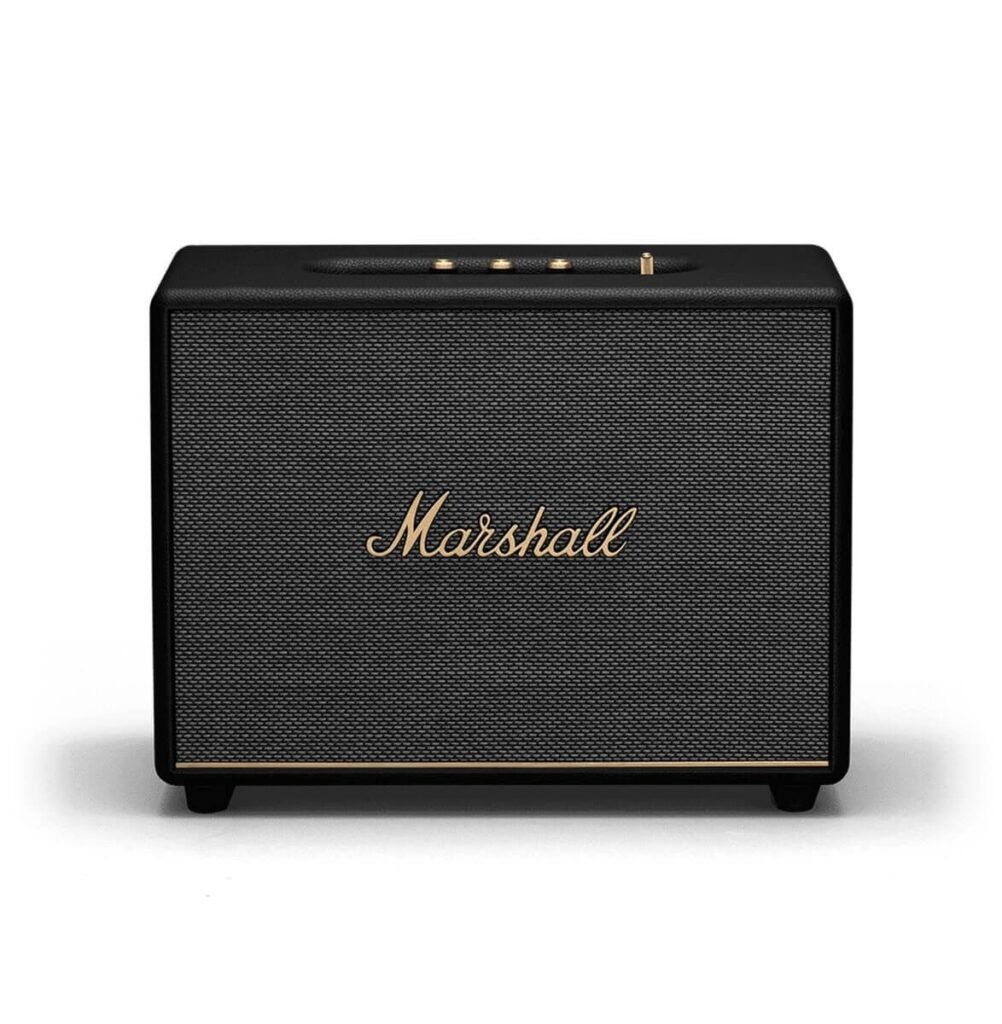
Marshall Woburn III brings substantial three-way hardware and the brand’s familiar home-speaker styling into a single enclosure. Unlike the smaller Acton III, it includes RCA and HDMI ARC alongside Bluetooth and a 3.5 mm input. That makes stereo television use a genuine part of the source plan, but it remains a standalone mains-powered speaker without Wi-Fi or a native multiroom platform. Original listening evidence is positive about clarity, balance and scale. Its large cabinet and precise television requirements are just as important to the buying decision as the musical appeal.
Research-based review. This assessment draws on manufacturer documentation and the original published evaluations linked below. Audio Review has not performed a hands-on test of this model.
A substantial music presentation with encouraging evidence
Louder’s original evaluation finds detailed, balanced reproduction and strong room-filling output across its music selections. Those observations support an audition for someone who wants more scale than a small tabletop speaker. They do not turn one enclosure into a separated stereo pair or establish unlimited output in every room.
Listen first at the ordinary household level. Include a clear vocal recording and something with a dense rhythm section, then assess a quieter piece without changing the system dramatically. Check whether bass remains controlled near the intended furniture and whether the sound is comfortable over time. Avoid choosing purely from the loudest part of a demonstration. A system that feels impressive for a minute still needs to make sense for everyday music. The one-box format is attractive where two speakers cannot be positioned sensibly, and its physical controls can be useful for shared use. A dedicated stereo listener should still compare a properly placed pair at the same complete budget. The original evidence makes Woburn III worth hearing, while leaving the room and personal balance preference to settle the final decision.
The cabinet height matters particularly beside a television
Marshall specifies a cabinet around 400 mm wide, 317 mm high and 203 mm deep. It is therefore a substantial object, not a low-profile soundbar. Its size can be easy to underestimate in a product photograph that lacks a screen or furniture reference.
Measure the television stand and check the lower screen edge, sensor and everyday viewing position. A speaker directly in front of a low-mounted display may obstruct more than expected. An offset location may fit physically but should be assessed for its relationship to dialogue on screen. Provide stable furniture with enough depth for plugs and safe access to the top panel. The mains lead should not be stretched across a route where it can be caught. Leave the documented operating space around the enclosure rather than squeezing it into a sealed recess. A single-box arrangement is convenient only when one good location exists. If the cabinet compromises the screen or the controls are inaccessible, a different format may be the more professional and usable installation.
HDMI ARC is a two-channel television route
The official manual specifies connection to the television’s ARC socket and selection of PCM two-channel output. Woburn III is not a Dolby Atmos or DTS surround decoder. HDMI also adds useful control behaviour, subject to the actual television and its settings.
Follow the documented route rather than leaving an unsupported bitstream selected. Test ordinary television, internal apps and any external console or player used regularly. Confirm volume and standby operation with the intended remote. Marshall notes that the speaker must be left powered for the documented television behaviour, which is different from switching it off at the wall. Check that the household understands that routine before relying on it. Night Mode can be useful where sudden film effects are unwelcome, but it should be evaluated at the normal seat rather than assumed to improve every programme. A working HDMI arrangement makes the Woburn more versatile than a Bluetooth-only home speaker. It still provides stereo television sound from one enclosure, not an expandable cinema installation.
Analogue inputs need a proper line-level source
The RCA and 3.5 mm inputs accept analogue sources. The official manual makes clear that a turntable must contain a suitable RIAA stage or use a separate phono preamplifier. RCA sockets do not imply that the speaker includes that stage internally.
Identify the record player’s output and select the correct chain before purchasing cables. If a switchable internal phono stage is enabled, use the resulting line signal appropriately. A conventional low-level cartridge needs the matching external stage instead. Begin conservatively with sources that have their own adjustable output, and confirm which control will be used for ordinary listening level. Keep the record player on stable support rather than assuming a convenient shared shelf is mechanically ideal. For a disc player or other line source, check that the actual output matches the input selected. The extra wired connections broaden the Woburn’s usefulness, but they do not remove the need to understand the source. A simple, correctly matched route is preferable to adding unnecessary conversion boxes around an otherwise straightforward system.
Physical controls and app adjustment support the room
Dedicated volume, bass and treble controls provide immediate access, while the Marshall Bluetooth app supports additional settings and updates. Placement compensation can help tailor the result to a chosen position, and Dynamic Loudness is part of the documented design.
Start with sensible placement and familiar material before making a tone change. If bass becomes excessive near a boundary, try a moderate adjustment or a practical move rather than assuming the largest setting is desirable. Keep a reference balance so another user can restore it easily. The app is useful supporting control, but it is not evidence of built-in Wi-Fi streaming. Confirm current firmware through the official route and avoid buying on vague promises of later wireless features. A tactile top panel is particularly valuable when it can be reached comfortably during music use. It becomes less convenient if the system lives behind a screen or deep inside furniture. The best setup allows physical control, source operation and sound quality to work together rather than making one compensate for the others.
Standalone value depends on the actual source routine
Woburn III has no Wi-Fi, voice-command microphone, battery or water resistance. Marshall also documents that it cannot form native pairs or multiple groups. Its Bluetooth connection is a source route, not an integrated whole-home platform.
Test phone pairing, reconnection and a switch back to television with the actual devices. If network services are essential, compare a product with the required platform or include an appropriate external source in the total cost. Do not buy a second Woburn expecting it to become a documented left/right system automatically. Compare the current local price and warranty with other large single speakers, soundbars and proper stereo pairs, accounting for their different roles. The Marshall is strongest when its existing combination of music, physical controls and two-channel TV already meets the plan. It becomes less attractive when several missing facilities need workarounds. A purchase justified by the exact working arrangement is more durable than one based mainly on the appearance of a powerful amplifier in miniature.
Alternatives to consider
Audio Pro C20 W: Compare this connected one-enclosure system if network services and its wider source plan suit the household. Check actual television control and placement rather than choosing only from cabinet styling.
KEF LS50 Wireless II: A properly placed active stereo pair offers another spatial presentation and source platform. Include stands and complete installation cost, since a separated pair solves a different room arrangement.
Marshall Woburn III key specifications
- Generation
- Woburn III
- Format
- Three-way single-enclosure home speaker
- Amplification
- 90 W bass, two 15 W mid and two 15 W treble channels, manufacturer ratings
- Wireless
- Bluetooth 5.2
- Wired
- 3.5 mm and RCA line-level; HDMI ARC
- TV format
- PCM two-channel as specified in official manual
- App
- Marshall Bluetooth app
- Controls
- Physical volume, bass, treble and playback; app settings
- Night Mode
- Available for TV use
- Wi-Fi / voice
- Not provided
- Native pairing / groups
- Not supported
- Power
- Mains only; no battery
- Size / weight
- 400 × 317 × 203 mm / approximately 7.45 kg
Verdict
Woburn III is an appealing substantial home speaker with encouraging original music evidence and a genuine HDMI ARC stereo route. Its size, PCM television requirement and standalone nature deserve careful checking. Choose it when one well-placed enclosure and its existing source set meet the household routine. Buyers planning network multiroom or surround expansion should compare a system built for those needs.
Documentation and original reviews
Marshall official Woburn III specifications and control guidance · Marshall official Woburn III manual including PCM TV setup · Louder original Woburn III listening review
Editorial record
Sources and updates
Product specifications and factual claims were checked against Official Marshall Woburn III product page ↗. Scores and buying advice follow our category-specific editorial methodology.
- Published
- November 17, 2026
- Last updated
- November 17, 2026