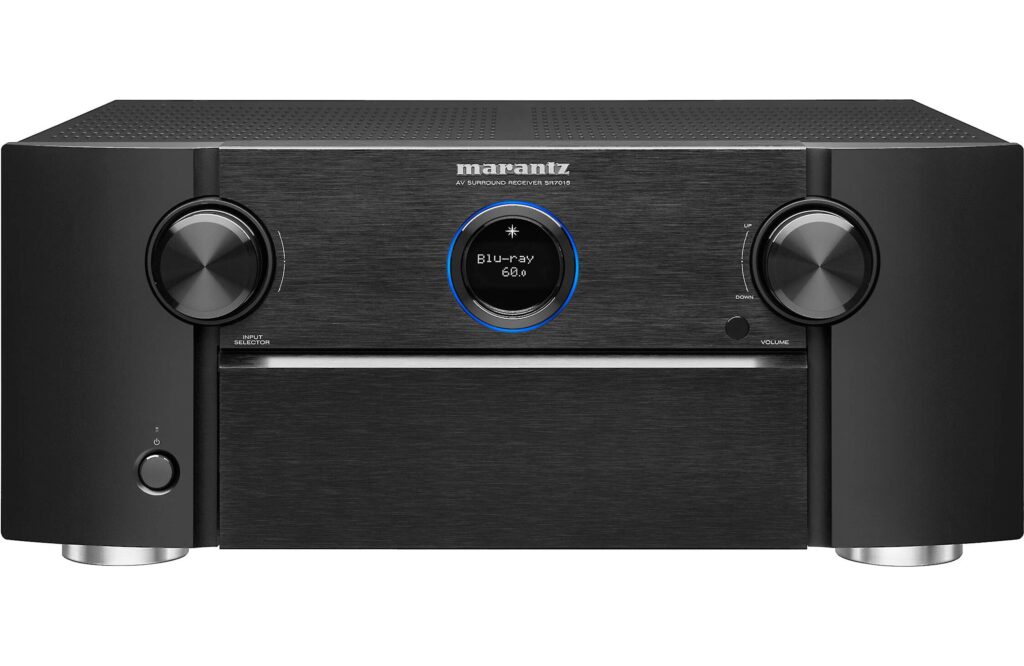
Marantz SR7015 remains an interesting older-generation AV amplifier because it combines broad connections, nine internal amplifier channels and eleven-channel processing. The European version has no ordinary radio tuner, despite often being grouped with AV receivers. Its original listening evidence is encouraging for both music and cinema, but a present-day purchase needs more than a favourable launch review. The single high-rate HDMI input, individual hardware history and the cost of any additional amplification should shape the decision. This assessment keeps those practical points beside the musical appeal.
Research-based review. This assessment draws on manufacturer documentation and the original published evaluations linked below. Audio Review has not performed a hands-on test of this model.
The original sound assessment favours coherence and drive
AVForums’ original evaluation finds an accomplished musical presentation and convincing surround steering, with clear dialogue and useful dynamic headroom in its test system. That supports a serious audition, rather than a guarantee that every room and speaker combination will behave identically.
Start with familiar two-channel material and a film passage combining dialogue with a busy soundtrack. Check whether the centre remains easy to follow and whether transitions between speakers feel consistent. Keep playback levels similar when comparing alternatives, since a louder demonstration can seem immediately more impressive. The speaker system, calibration and room all contribute to the result. A different complete system may be a valid buying comparison without proving the amplifier alone caused the preference. The strongest reason to choose this older model is that its actual supplied performance remains satisfying at the current price. Avoid paying for a historic reputation if the demonstration does not work equally well with the sources and listening habits that matter at home.
Nine amplifiers and eleven processed channels are different capacities
SR7015 processes more main channels than it amplifies internally. A conventional seven-speaker bed plus four heights therefore needs suitable additional amplification. The number of binding posts does not mean all corresponding speakers can operate together from eleven built-in amplifiers.
Draw the intended layout before comparing total prices. Identify which channels the receiver will power and which will use the external amplifier, then follow the documented assignment. Include the extra component, trigger or control needs and cabling in the installation plan. For a five-speaker bed with four heights, the internal capacity may already be sufficient. For a larger configuration, the pre-out route can be useful when the supporting amplifier is sensibly matched. Do not add channels solely because the receiver can process them if the room cannot accommodate good positions. The practical benefit is a defined growth path, not an obligation to fill every possible role. A simpler well-installed system can be a more coherent purchase than an ambitious layout assembled without attention to placement.
One high-rate HDMI input is a real present-day limit
The HDMI total is generous, but only the designated rear 8K input provides the high-rate route discussed in the original specification. That distinction matters more to a multiple-console buyer than to someone using ordinary film sources.
List the actual source devices and required video modes. Decide which one needs the high-rate input and whether another can connect directly to the television with an appropriate audio-return arrangement. Test the full path, including the display’s audio-format support and the intended cables. Do not assume that a working picture proves every desired gaming feature is active. If an external switch is proposed, include its cost and confirm the specific source and receiver combination. A newer receiver with more suitable inputs may be simpler overall. Conversely, an owner whose sources fit the available arrangement may have little reason to reject an otherwise attractive offer. The useful decision comes from the connection map, not a generic HDMI version label or an input count without speed distinctions.
Older HDMI hardware requires a unit-specific check
The original review records the early high-rate HDMI compatibility issue, while Marantz’s later guidance describes the VS3003 switcher as an alternative to the SPK618 adapter. This does not establish that every SR7015 needs an adapter, or that historical support offers remain available on the same terms today.
Ask the seller and Marantz support to identify the actual hardware and any required remedy for the intended source. For a used unit, obtain the relevant history rather than assuming the model name settles compatibility. Test the demanding video mode and audio together during the return period. A firmware update should not be treated as proof that a hardware-related requirement has disappeared. Equally, an old report should not be applied automatically to a later unaffected example. The right answer is specific to the unit and current installation. If the seller cannot establish it clearly, compare a supported newer alternative. A discounted older amplifier is attractive only when the practical route works reliably without an uncertain sequence of extra purchases.
Audyssey and bass setup are part of the listening result
The model includes MultEQ XT32 and facilities for a dual-subwoofer system. These are useful setup tools rather than a substitute for sensible speaker and subwoofer placement. They should be understood separately from optional editing software and from calibration systems on newer products.
Follow the microphone procedure in a quiet room and check the resulting configuration before judging the sound. Confirm that each speaker and subwoofer is assigned correctly and plays in the intended modes. Compare a familiar reference after saving a working baseline, changing one relevant setting at a time. Do not assume a mode called direct retains the same processing or bass arrangement as another mode. For two subwoofers, placement still deserves attention across the listening area. The ability to connect them does not guarantee uniform bass everywhere. A carefully established ordinary setup can be more useful than immediately buying additional software. Value comes from a repeatable result that works for the actual seats and content, with optional tools chosen to solve a clear limitation.
Legacy connections and regional identity can still add value
European documentation lists a useful set of analogue and older video connections, including MM phono and multichannel analogue input. It also confirms the absence of an FM/AM tuner. These details can make the model relevant to a mixed older-and-newer system without implying every archived service feature remains unchanged.
Identify which connections are genuinely required before letting a long rear-panel list influence the purchase. A turntable’s cartridge type must suit the phono route, and an ordinary line source should use the appropriate input. For network playback, verify current service availability and software support rather than copying a launch-era catalogue. Check the regional model, remote, calibration microphone, condition and local service arrangement when buying older stock. Measure the furniture with plugs and ventilation space included. Then compare the complete ready-to-use cost with a newer alternative. SR7015 is most persuasive when it solves real connection and expansion needs at a competitive price. It is less convincing when missing accessories, uncertain HDMI history or unused complexity erase the apparent saving.
Alternatives to consider
Marantz CINEMA 50: CINEMA 50 is a relevant newer-generation comparison. Evaluate the actual HDMI and calibration requirements and complete expansion cost rather than choosing only from launch-era model hierarchy.
Denon AVC-X3800H: AVC-X3800H offers another system route to compare when video inputs, bass management and expansion are important. Confirm which current facilities require additional purchases before comparing total cost.
Marantz SR7015 key specifications
- Regional version
- European SR7015 AV amplifier
- Built-in amplifier channels
- Nine
- Maximum main processing
- 11.2 channels
- Example layout
- 5.2.4 internally; 7.2.4 with suitable additional two-channel amplification
- Rated stereo power
- 125 W/ch, 8 ohms, 20 Hz–20 kHz, 0.05% THD, two channels driven
- HDMI
- Eight inputs including front / three outputs
- High-rate input
- One designated HDMI 7 (8K) input
- Surround
- Dolby Atmos, DTS:X, Auro-3D; IMAX Enhanced support
- Room setup
- Audyssey MultEQ XT32; dual-sub facilities
- Analogue
- 11.2 pre-outs, 7.1 input, MM phono input
- Network
- HEOS, AirPlay 2 and supported services
- Tuner
- No FM/AM in European specification
- Size / weight
- Approximately 440 × 185 × 411 mm, horizontal antenna position / 14.2 kg
Verdict
SR7015 is a capable older-generation AV amplifier with strong original music and cinema evidence, useful legacy connections and a defined expansion route. Its single high-rate HDMI input and individual hardware history need careful checking. Confirm the European version, accessories and complete installation cost. Choose it when the actual working package meets the source and speaker plan, with a clear advantage over supported newer alternatives.
Documentation and original reviews
Marantz official SR7015 archive specifications · Marantz official European SR7015 information sheet · Marantz official VS3003 / SPK618 compatibility guidance · AVForums original SR7015 listening and setup evaluation
Editorial record
Sources and updates
Product specifications and factual claims were checked against Official Marantz SR7015 product page ↗. Scores and buying advice follow our category-specific editorial methodology.
- Published
- November 17, 2026
- Last updated
- November 17, 2026