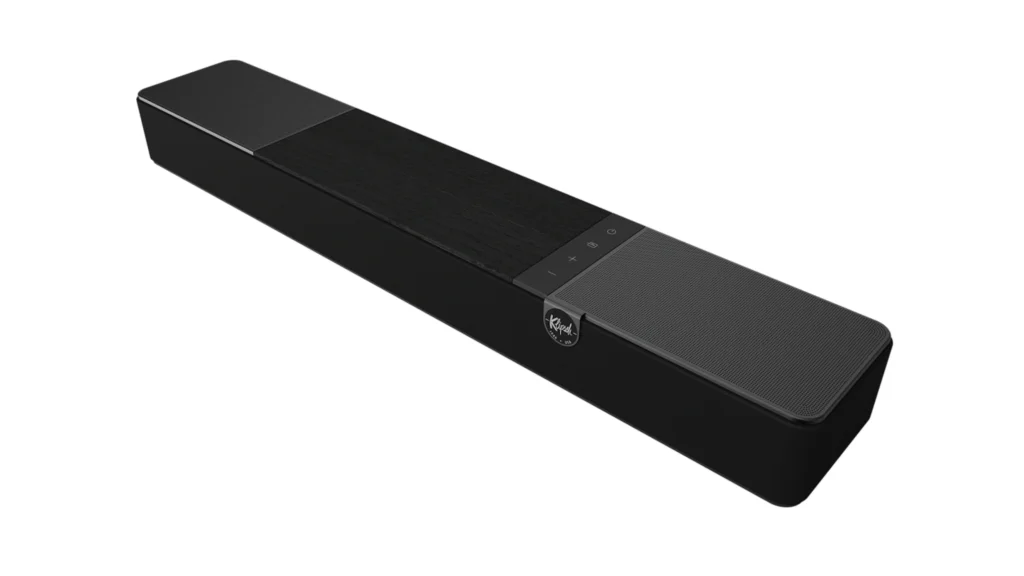
Klipsch Flexus Core 100 is a compact 2.1 soundbar with built-in bass and virtual Dolby Atmos processing. Its appeal is a straightforward television upgrade rather than a full network music system or physical-height installation. HDMI eARC, optical, Bluetooth and useful app controls cover ordinary sources, while compatible Flexus accessories provide a possible expansion route. This research-based review weighs those practical strengths against the limitations identified in original listening evidence, especially musical subtlety and the reach of virtual height effects from a small front-only enclosure.
Research-based review. This assessment draws on manufacturer documentation and the original published evaluations linked below. Audio Review has not performed a hands-on test of this model.
Dialogue and bass are more persuasive than the Atmos badge
TechRadar’s original evaluation finds clear speech and substantial bass for the compact size, but is less impressed by height effects and music refinement. It also notes that some left-to-right movement can sound less continuous than on a system with a dedicated centre. Those observations support an everyday television recommendation more strongly than a promise of spectacular overhead effects.
Start an audition with a normal programme at the usual listening level. Check low-pitched speech, quieter dialogue and a busy passage with music underneath voices. Then compare the preferred sound mode without changing the volume unnecessarily. The extra bass should support the programme rather than make every voice sound larger. A small bar can be a substantial improvement on a thin television speaker, but that comparison does not establish how it performs against another soundbar at the current price. A buyer who mainly watches news, drama and occasional films may reasonably value clarity and simple operation above a more ambitious spatial layout that the room cannot accommodate.
A 2.1 arrangement has clear physical boundaries
The basic Core 100 does not contain a dedicated centre channel or separate height-channel drivers. Its built-in bass drivers should not be mistaken for a physical Atmos height arrangement. The Dolby Atmos facility is a virtual-processing approach within the compact front enclosure.
Place the bar where its sound can reach the seats clearly, and assess the normal side position as well as the central seat. Do not expect a small front unit to create the same localisation as speakers installed around and above the room. That does not prevent useful width or a more engaging film soundtrack. It simply defines the compromise being purchased. If convincing height or rear placement is the main objective, compare a documented system with the necessary physical speakers before committing. If simplicity is the priority, the modest enclosure may be an advantage. The most appropriate choice is the system that improves everyday viewing within the feasible layout, rather than the one with the most ambitious format name on its packaging.
The television is the main source hub
HDMI eARC and optical provide the television routes, with no separate HDMI input for an external player or console. Klipsch’s manual lists the supported incoming Dolby and PCM formats, but the television’s own handling still determines what can be delivered from connected sources.
Connect a console or player to the appropriate display input and check the television’s audio-return settings. Test internal apps separately from external sources. A programme producing sound does not establish that the desired format is reaching the bar, and a format indicator does not guarantee a particular spatial impression. Check synchronisation and normal remote volume operation after standby. Optical may be useful for an older screen, but it should not be assumed to carry everything possible through eARC. Avoid adding adapters before understanding the existing signal path. The Core 100 is easiest to recommend when the television already provides a reliable route for the sources used most often. A system needing several direct source connections may be better served by a different design.
App control is different from independent network streaming
Klipsch Connect Plus provides useful control and sound adjustment, while Bluetooth handles a phone music source. The presence of a companion app does not turn this model into the independent Wi-Fi streaming platform offered by the larger Core 300. The manual also documents a USB local-file input, whose format and connection requirements should be checked before planning a library around it.
Use the actual household phone to test connection, volume adjustment and return to television playback. Check the basic tasks another user will need, rather than exploring every setting once and leaving an unclear configuration. A Bluetooth route may be entirely adequate for occasional music or podcasts. It is less suitable for a buyer expecting the bar to appear directly in every network music application or an existing multiroom system. Decide which facility is genuinely required before purchase. A simpler system can be easier to live with when it matches the use case; a missing platform becomes frustrating when it was assumed to be part of the product because an app was advertised.
Expansion is useful when its total cost remains sensible
The official documentation supports compatible Flexus surrounds and subwoofers, and the bar provides an RCA subwoofer output. The basic package should still be described as the bar with built-in bass, without implying that external bass or rear speakers are included. Compatibility should be checked by exact product and connection type.
Price the intended accessories before deciding that this is the cheapest route to a complete system. Include their power sockets, suitable positions and any required transport hardware or cabling identified by the manufacturer. A wireless signal link does not remove the need for powered components to receive electricity. If an existing active subwoofer is being considered through the RCA output, follow the documented connection and level guidance rather than assuming every cable or setting is interchangeable. Starting small can be sensible when the standalone bar already meets the immediate requirement. It is less convincing when the planned upgrades make the final price comparable to a package designed around a more suitable channel layout from the outset.
Compact width does not remove the need for a fit check
The official dimensions are approximately 711 mm wide, 76 mm high and 127 mm deep, with a weight around 4.54 kg. The width suits furniture that cannot accommodate a large premium bar, while the height still needs checking against the screen and remote receiver.
Measure the unit with rear cable clearance rather than using width alone. Follow the supplied mounting guidance if wall placement is intended, and keep the front display readable from the sofa. Test the night and dialogue settings with ordinary content instead of leaving the strongest enhancement engaged automatically. For music, compare the available mode with a familiar vocal and a dense arrangement, listening for separation and timing as well as bass quantity. Judge value from the current local offer, warranty and exact included components. The Core 100 is most persuasive for a compact film-and-television role. Buyers seeking a primary album system, an established network platform or a convincing physical height arrangement should give those alternatives equal attention.
Alternatives to consider
Sonos Beam Gen 2: Compare music, spatial presentation and the network platform against the simpler Klipsch arrangement, using the actual complete local price.
Sennheiser AMBEO Soundbar Mini: A different compact virtual-surround approach to hear if height impression and network music are higher priorities. Check the source connections and any planned optional bass.
Klipsch Flexus Core 100 key specifications
- Base layout
- 2.1 with virtual Dolby Atmos
- Dedicated centre / height channels
- Not provided in the basic arrangement
- Main drivers
- Two 2.25-inch front drivers; dual 4-inch built-in bass drivers
- TV connections
- HDMI eARC; optical
- Separate HDMI source input
- None
- Phone playback
- Bluetooth
- Network music streaming
- No independent Wi-Fi streaming platform
- Subwoofer output
- RCA
- Expansion
- Compatible Flexus subwoofer and surround hardware
- Control
- Remote; display; Klipsch Connect Plus app
- Dimensions
- Approximately 711 × 76 × 127 mm
- Weight
- Approximately 4.54 kg
- USB
- Documented local-file role; check supported format and connection guidance
Verdict
Flexus Core 100 offers a credible compact television upgrade with useful bass, speech clarity and control. Its virtual-height and music limits should be understood before purchase, while optional expansion deserves a complete price calculation. Confirm the television route and everyday fit. It is a practical shortlist choice when its simple 2.1 starting point matches the room and priorities.
Documentation and original reviews
Klipsch official Flexus Core 100 specification sheet · Klipsch official Core 100 operating manual, inputs and playback modes · Klipsch official UK Core 100 product and expansion information · TechRadar original Flexus Core 100 listening review
Editorial record
Sources and updates
Product specifications and factual claims were checked against Official Klipsch Flexus Core 100 product page ↗. Scores and buying advice follow our category-specific editorial methodology.
- Published
- November 17, 2026
- Last updated
- November 17, 2026