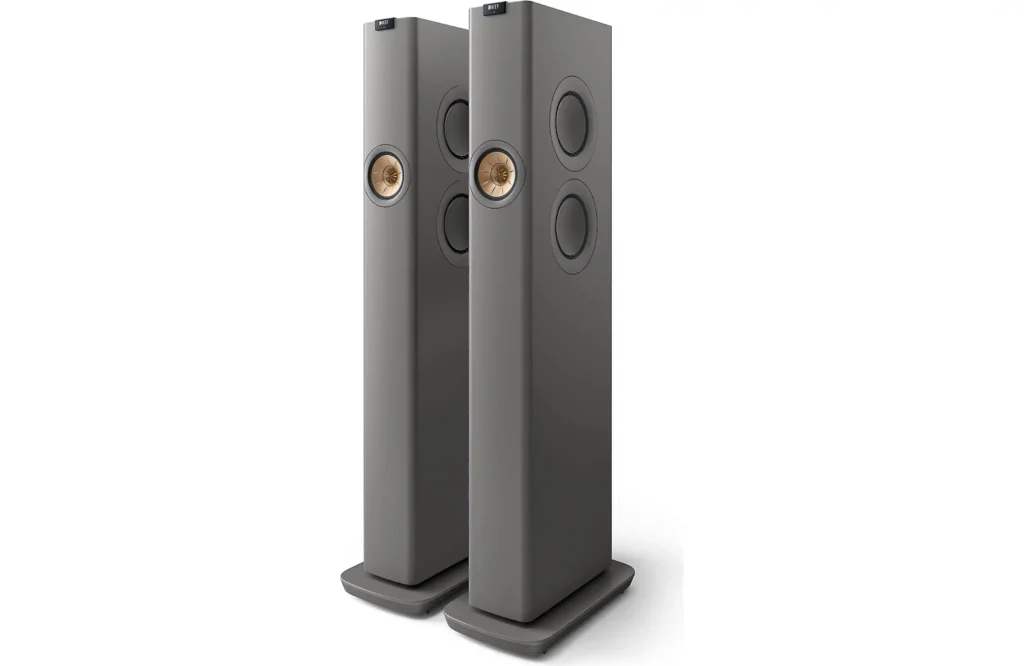
KEF LS60 Wireless is a complete active floorstanding stereo system with streaming, digital conversion and amplification inside the two speakers. The narrow cabinets create an unusually tidy visual proposition, while the driver and amplifier arrangement aims at much more than background listening. Original testing is strongly positive about integration, imaging and dynamic scale. The practical buying decision is still substantial: both towers need power, the pair is heavy, and the network and service arrangements deserve the same attention as the sound.
Research-based review. This assessment draws on manufacturer documentation and the original published evaluations linked below. Audio Review has not performed a hands-on test of this model.
A complete stereo system changes the budget comparison
There is no separate speaker amplifier to buy for the LS60 Wireless. The internal amplifiers and processing are designed around the drivers, while the primary speaker accepts the external sources. Compare the price with a complete passive-speaker, amplifier and streamer arrangement rather than with bare speaker cabinets alone.
That can make the integrated approach attractive without making it automatically cheaper or better for every owner. Someone who already owns a suitable amplifier may value the freedom to keep it. Someone building from scratch may prefer fewer boxes and a coordinated control system. List the sources, cables and supporting furniture involved in both options. A fair comparison also includes where the equipment will sit and how other household members will start playback, not only the number printed beside the speakers in a shop.
Strong original evidence for integration and scale
What Hi-Fi’s original evaluation is highly positive about the focused stereo image, coherent driver integration, bass authority and dynamic expression. It also reports successful television use in its tested setup. Those findings support a serious audition, without establishing the same result in every room or with every television.
Include familiar voices, busy arrangements and music that moves between quiet and loud passages. Listen for a stable centre image from the normal seat and try more than one position. The slim appearance should not be used to predict limited bass, just as the large amplifier total should not be used to predict limitless output. The relevant evidence is the complete system’s behaviour in a suitable room. Compare at similar level and allow enough time to decide whether its precise, energetic presentation remains enjoyable across the library.
Wireless describes a signal choice, not the power supply
Both speakers require mains power. The signal between them can use the wireless link or the documented wired connection. The two paths operate at different internal PCM resolutions, with the source data resampled accordingly. A high network-input ceiling is therefore not the resolution carried unchanged through every stage.
Choose the interspeaker arrangement for reliability and installation as well as format preference. If a cable route is easy, it may be a sensible option even in a product called Wireless. If avoiding that cable is important, test the intended spacing and radio environment. Keep power sockets accessible and plan where the source cables reach the primary speaker. A visually clean room is achievable, but it comes from a considered layout rather than the assumption that no wires are involved.
Room settings help, while placement still matters
KEF Connect provides room-oriented EQ choices. These allow a deliberate adjustment for the installation, but should not be described as automatic microphone-based room measurement merely because the app asks about placement. Start with physical positioning and a stable support arrangement.
Compare a familiar bass line and voice after each modest adjustment rather than changing several settings at once. Leave enough space for the cabinets, side drivers and rear connections, and consider the full plinth footprint rather than the narrow cabinet width alone. A dealer-assisted home demonstration is especially useful for a purchase of this scale. Processing can improve a suitable installation, but it is not a substitute for checking how the pair interacts with the actual listening area and furniture. Save a known baseline before exploring more elaborate settings.
Television and vinyl need the correct signal path
The official guide specifies an HDMI eARC or ARC television connection with PCM output and the appropriate control settings. This remains a stereo system, not an Atmos surround decoder. Test everyday volume, wake-up and application behaviour with the real television.
The RCA input accepts an appropriate analogue line signal. A turntable needs a suitable phono stage before that input unless the turntable already provides line output. The USB service port is not a general music or computer-audio input. These distinctions matter when replacing an existing system with fewer boxes. Confirm every essential source before removing the previous equipment, and include any extra phono stage or conversion required in the complete budget. Connection flexibility is valuable when it matches the actual sources, rather than when a socket’s shape is assumed to promise a function it does not provide.
Installation, updates and long-term ownership
The pair’s substantial weight makes delivery and final positioning part of the purchase. Arrange assistance rather than treating the narrow towers as lightweight objects. Keep appropriate space for ventilation and access, and retain packaging if future transport is likely.
For an integrated active system, ask about service arrangements and demonstrate the current software and essential streaming accounts. Verify condition carefully with used stock, including both speakers, inputs, controls and the interspeaker connection. A working streaming demonstration is more informative than an old feature list. The system can reduce the number of separate purchases, but its electronics and software are also part of what must remain supported. Compare current offers on that complete basis, including installation help and returns, rather than choosing only from a historical award or a discounted headline price.
Alternatives to consider
KEF LS50 Wireless II: LS50 Wireless II offers a smaller standmount route within the KEF ecosystem. Include stands and any desired subwoofer in the footprint and price, then compare at the listening level required in the room.
KEF LSX II: LSX II is relevant for a much smaller space and budget. It is not a direct scale-for-scale substitute; decide whether the room needs the LS60 floorstanding capability before paying for a system larger than the use requires.
KEF LS60 Wireless key specifications
- System
- Active streaming floorstanding stereo pair
- Driver arrangement per speaker
- 19 mm tweeter / 100 mm midrange Uni-Q plus four 135 mm bass drivers
- Amplifier ratings per speaker
- LF 500 W, MF 100 W, HF 100 W
- Amplifier classes
- LF and MF Class D, HF Class AB
- Inputs
- HDMI eARC, optical, coaxial, analogue RCA and network
- Network
- Ethernet and dual-band Wi-Fi
- Interspeaker wireless signal
- Resampled to 24-bit / 96 kHz PCM
- Interspeaker wired signal
- Resampled to 24-bit / 192 kHz PCM
- Subwoofer output
- RCA output on each speaker
- USB
- Service connection, not USB music input
- Power
- Mains connection to both speakers
- Weight
- 62.4 kg per pair
- Dimensions (H × W × D)
- 1090 × 212 × 394 mm per speaker
Verdict
LS60 Wireless is a persuasive modern stereo system with strong original evidence for sound quality and an unusually integrated design. Its floorstanding scale, source flexibility and coordinated amplification can make a complete installation much tidier than a conventional stack.
Plan power and signal routes, verify the room and source requirements, and compare current total cost with a complete alternative system. For a buyer who wants this level of performance with fewer separate components, it can be an excellent match. The recommendation rests on a successful installation and service arrangement as much as on the striking cabinet design.
Documentation and original reviews
KEF official European LS60 Wireless product information · KEF official LS60 Wireless technical information sheet · KEF official LS60 Wireless connection and operation manual · What Hi-Fi original LS60 Wireless listening and system evaluation
Editorial record
Sources and updates
Product specifications and factual claims were checked against Official KEF LS60 Wireless product page ↗. Scores and buying advice follow our category-specific editorial methodology.
- Published
- November 17, 2026
- Last updated
- November 17, 2026