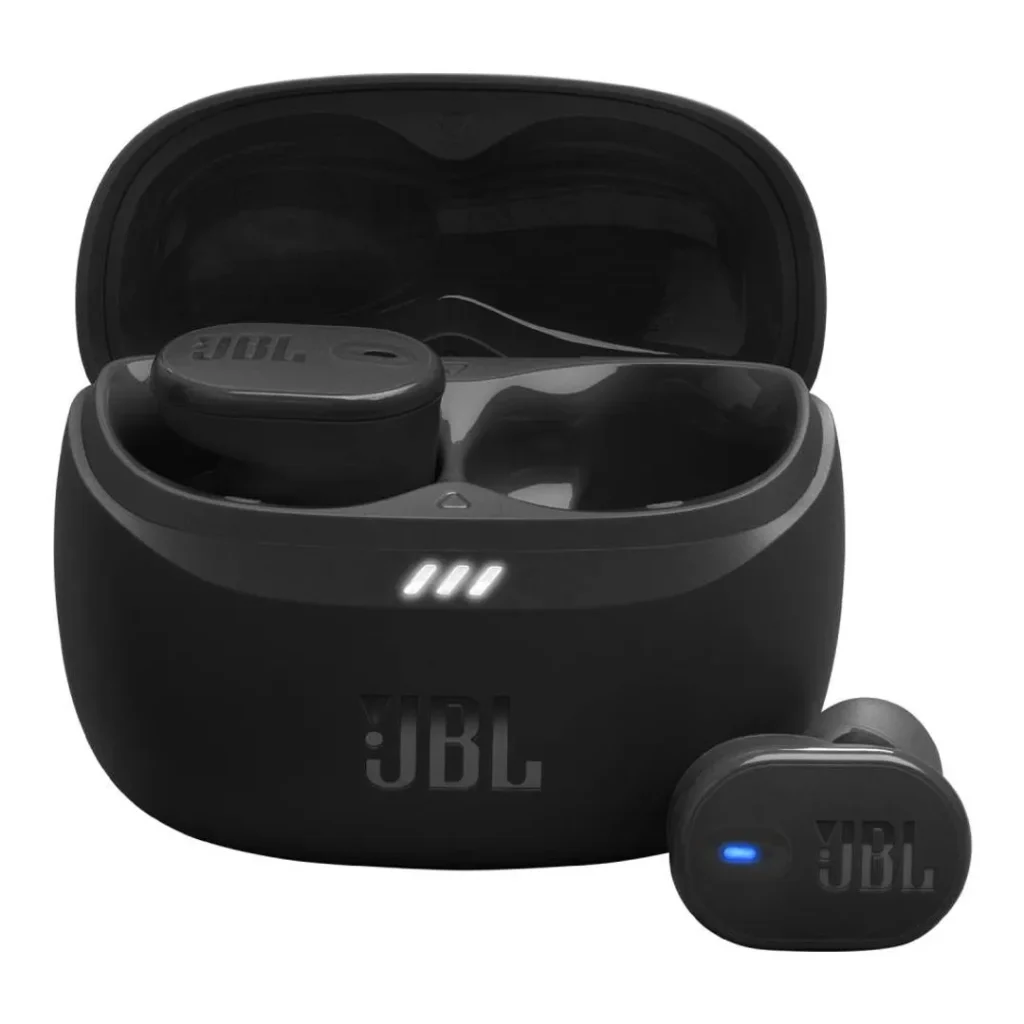
JBL Tune Buds 2 combines a compact stemless shape with adaptive ANC and a broad app feature set. Its long manufacturer runtime claims are a major attraction, but original listening evidence describes a bass-led balance with a more recessed midrange. The package is aimed at convenient casual listening rather than neutral monitoring. It is worth considering when the bud shape fits comfortably and the energetic character suits the listener, with spatial processing treated as an option rather than the reason to overlook the basic sound.
Research-based review. This assessment draws on manufacturer documentation and the original published evaluations linked below. Audio Review has not performed a hands-on test of this model.
The stemless fit is the first distinction
Tune Buds 2 uses a compact sealed body rather than the extended stem of Tune Beam 2. JBL specifies a 10 mm driver and 5.5 g per earbud. The name should also be kept separate from the older original Tune Buds when comparing reviews or spare parts.
Try the supplied tip sizes and check both sides independently. Audio46’s original evaluator finds the fit comfortable, but that does not make a small-looking shell suitable for every ear. Include talking and normal movement, and listen long enough to assess pressure. A secure seal should not depend on repeatedly pushing the earbuds into place. Check whether the touch surface can be reached without changing the fit. The correct shape can make ordinary listening much easier even when another model has similar electronics. Conversely, an unsuitable shell is a reason to choose a different design rather than accept discomfort because the specification looks economical.
Punchy bass comes with a midrange compromise
Major HiFi’s original evaluation describes a V-shaped presentation with substantial bass and less impressive midrange detail. Audio46 also finds a bass-forward character and notes that complex material can become heavier in the lower range. The overall evidence supports an enjoyable consumer balance with clear preference limits.
Use familiar voices, guitars and piano as well as electronic bass tracks. Decide whether the added weight makes the music more engaging or leaves the centre of the mix too restrained. Compare a modest EQ adjustment at similar loudness rather than choosing the most dramatic preset immediately. Someone who likes a relaxed upper presentation may find the result comfortable over time. Someone who needs a more explicit vocal focus should audition alternatives. A ten-millimetre driver does not settle these questions, and the Pure Bass label should describe the intended character rather than replace an actual listening decision.
Spatial Sound is an optional presentation change
The official feature set includes JBL Spatial Sound and Personi-Fi 3.0. Major HiFi finds the spatial effect limited in height even when it changes the perceived presentation. That is a reasonable boundary: processing ordinary stereo does not turn a pair of earbuds into a room of physical surround speakers.
Compare the normal profile with the available music or movie setting using the same material. Check whether voices remain natural and whether the effect is enjoyable over a complete programme. A demonstration that initially feels larger may not be preferred for every recording. Treat personalisation similarly: use it to explore preference, not as proof of a clinically correct or universally accurate response. Save a consistent setup so comparisons with another pair are meaningful. The best feature is a choice that can be used or ignored comfortably. There is no need to keep every sound option active merely because the app provides it.
ANC and ambient modes support everyday use
JBL provides adaptive cancellation, Ambient Aware and TalkThru. Major HiFi’s original account finds the isolation useful for steady background noise while still allowing larger disturbances through. That is a practical description rather than a promise that the outside world is removed entirely.
Establish a good seal before comparing the modes. Check recurring ventilation or transport sound separately from nearby conversation. Decide whether the actual reduction is sufficient for the intended journey or work setting. Ambient Aware and TalkThru should also be tried for ordinary interactions rather than assumed to sound identical to an unsealed ear. A person wanting awareness for short exchanges may find them convenient. Someone whose main priority is the strongest travel isolation should compare more specialist options. The useful balance depends on the environment, and a successful result at a quiet desk should not be promised unchanged beside louder traffic or machinery.
App and connection functions need a working routine
Multipoint and Google Fast Pair are included, with sound and gesture options in the JBL app. The standard charging case should not be confused with the touchscreen cases in JBL’s Live or Tour ranges. A charging connector also does not establish wired audio playback.
Pair with the actual phone and computer, then test an incoming call and the return to music. Check which touch commands can be assigned together in the current app. A broad list of functions is useful only if the frequently used actions remain easy to access. For calls, ask another person about voice clarity from the normal location and confirm the application has selected the correct microphone. Do not turn a six-microphone specification into a guarantee of perfect speech in wind. Test video and games in their actual applications as well, because a Bluetooth version or spatial preset alone does not establish the complete audio delay. Practical consistency should lead the purchase decision.
The runtime claim is substantial but conditional
JBL specifies up to 12 hours from the earbuds and 48 hours including the case with ANC off, or ten and 40 with ANC on. These are manufacturer figures, not independent Audio Review measurements. The cumulative total includes recharging intervals rather than one continuous session.
Plan around the mode and uninterrupted interval normally required. Volume, calls, processing and battery age can change the result. Check seating and charging contacts after use so both sides replenish reliably. The IP54 protection applies to the earbuds; keep charging equipment dry and follow the care instructions. Compare the actual current European price, warranty and return conditions with other affordable models. Tune Buds 2 is strongest when its compact shape, bass-led listening and useful charging interval meet the need together. It is less attractive if a more neutral balance or different fit is required. A longer maximum should support a good everyday match rather than compensate for a sound or comfort compromise that remains distracting.
Alternatives to consider
Nothing Ear (a): A relevant existing comparison when a lively consumer tuning and useful app functions matter. Try the fit and complete control routine at similar loudness before deciding which balance is more enjoyable.
Soundcore Liberty 4 NC: An affordable ANC alternative when isolation is the main priority. Compare the exact current price, comfort and calling experience rather than assuming that a longer feature list wins every practical comparison.
JBL Tune Buds 2 key specifications
- Design
- Sealed bud-style wireless
- Driver
- 10 mm dynamic
- Earbud weight
- 5.5 g each
- Bluetooth
- 5.3
- Noise control
- Adaptive ANC, Ambient Aware and TalkThru
- Connections
- Multipoint and Google Fast Pair
- Battery claim, ANC off
- Up to 12 h earbuds; 48 h including case
- Battery claim, ANC on
- Up to 10 h earbuds; 40 h including case
- Case weight
- 40.6 g standard version
- Charging
- USB-C
- Resistance
- IP54 earbuds
- App
- EQ, Personi-Fi 3.0 and Spatial Sound
- Bluetooth codecs
- SBC and AAC listed in the JBL quick start guide
Verdict
Tune Buds 2 offers a sensible affordable package for someone who likes its compact shape and punchy sound. The long manufacturer runtime claims and app flexibility are useful, with recessed mids and limited spatial realism setting sensible expectations.
Try the seal and familiar music before choosing. It can be good value for the right casual listening routine, while another tuning or construction is preferable when vocal neutrality, fit or specialist isolation requirements lead the decision.
Documentation and original reviews
JBL official Tune Buds 2 product information · JBL official Tune Buds 2 technical sheet · Major HiFi original Tune Buds 2 listening and control evaluation · Audio46 original Tune Buds 2 daily-use and listening evaluation
Editorial record
Sources and updates
Product specifications and factual claims were checked against Official JBL Tune Buds 2 product page ↗. Scores and buying advice follow our category-specific editorial methodology.
- Published
- November 17, 2026
- Last updated
- November 17, 2026