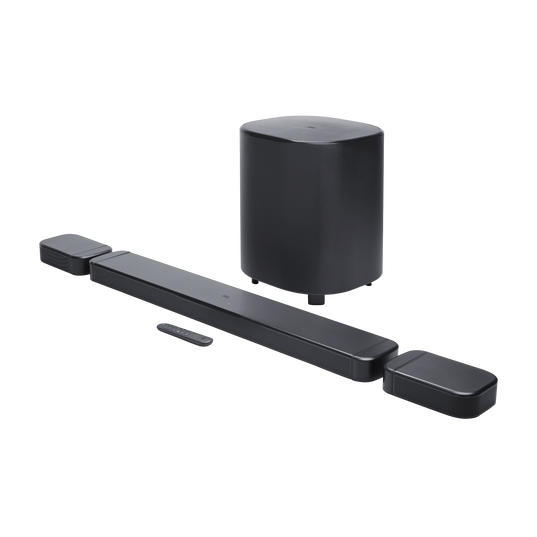
JBL Bar 800MK2 combines a soundbar, substantial subwoofer and two detachable battery-powered rear speakers in a 7.1 package. The rear units can sit behind the listener during playback without a permanent mains cable, then return to the bar for charging. Height is virtual rather than produced by up-firing drivers. That distinction shapes this research-based review: the most useful attraction is genuine rear placement in a flexible installation, supported by network music and app control, while the bass enclosure, charging routine and source path still need practical planning.
Research-based review. This assessment draws on manufacturer documentation and the original published evaluations linked below. Audio Review has not performed a hands-on test of this model.
Physical surrounds are the everyday attraction
The detachable speakers give the Bar 800MK2 a genuine practical distinction from a front-only system. JBL’s manual documents battery operation, docking and rear-speaker settings. The quoted maximum playtime is conditional on content and volume, so it should not be read as a guarantee for every listening session.
Choose stable rear positions before deciding that the system solves the room. A convenient table beside the sofa may work well; a narrow unstable edge is less convincing. Check the route back to the bar for charging and whether the full attached width fits the furniture. Test the ordinary routine over several evenings rather than only detaching the speakers once during setup. Their value depends on being used in the intended positions, not remaining attached at the front because relocation is awkward. Battery operation removes a cabling obstacle during playback, but it adds a small maintenance task. That trade can be excellent for a shared living room, provided every user understands when the speakers need to be returned and charged.
Strong bass and dialogue, with different views on refinement
TechRadar’s original test is positive about bass control, dialogue and the expansive surround presentation. HIFI.DE also hears clear speech and effective rear integration, but finds height less convincing and quieter music less precise. Its bass assessment suggests that some rooms benefit from a lower subwoofer setting. These are room- and listener-dependent observations, not universal presets.
Start with normal television and a familiar music track, then introduce a demanding film passage. Check the relationship between low bass and speech instead of judging the package only by its strongest impact. A setting that sounds exciting for an action sequence may be less suitable for a long evening of mixed programmes. Use moderate controlled adjustments, replaying the same passage after each change. The evidence supports a lively, substantial system while leaving musical finesse as a useful comparison point. Buyers who mostly watch films may reasonably value physical rear involvement more highly than the final degree of stereo delicacy. Those who mainly play albums should audition that role with equal attention.
Atmos compatibility does not add up-firing drivers
This generation is documented as 7.1, with no physical up-firing height speakers. MultiBeam 3.0 and virtual spatial processing aim to extend the presentation, while the detached rears provide actual sound from behind. Those are complementary facilities with different physical foundations.
Run calibration with the rear speakers in their planned positions and the room quiet. Then assess appropriate height material from the normal seats. A convincing result in one room does not guarantee the same impression beneath a different ceiling or beside an open-plan space. Do not compare the model with its predecessor solely from the shared number, because the driver arrangement matters. A buyer who specifically wants a physical height approach should compare a documented up-firing or separate-speaker system before purchase. For someone who mainly wants a more enveloping soundtrack without permanent rear wiring, the JBL may be the more practical compromise. The decision should follow the effect that matters in the actual room, rather than the assumption that every Atmos-compatible package uses the same hardware.
The HDMI route needs a gaming check
The Bar 800MK2 provides a source HDMI input and an eARC output, alongside optical and network connections. Original installation evaluations identify the source passthrough as a 4K/60 route rather than a 4K/120 gaming solution. Dolby Vision and HDR10+ passthrough appear in the official specification.
Map each console, player and television app before connecting everything permanently. A demanding console may be better connected directly to the display, with audio returned through eARC, if that preserves the required video features. Confirm the television’s audio handling as part of that route. Test picture modes and soundtrack delivery separately, and check synchronisation with both internal and external sources. One HDMI input is useful, but it is not a complete switch for a large equipment collection. Avoid adding converters before establishing the capabilities of the existing display. Optical remains a useful fallback for simpler installations, with different format limits. A reliable system is one in which each source returns to the expected sound without repeated manual troubleshooting.
Useful listening modes without assuming extra hardware roles
The manual documents Audio Broadcasting for carrying programme sound through the detachable units and Night Listening that mutes the main bar and subwoofer while the rear speakers are placed nearer the listener. These specific supported modes are more useful than assuming the detachable units perform every function found on the larger 1300MK2.
Try the night arrangement at a considerate level and check whether it makes quiet viewing easier for the intended seats. Nearer speakers can improve practical audibility, but they should not be described as preventing sound transmission to another room. Keep the normal surround placement and special close-listening placement easy to distinguish. The JBL One app also supports setup and adjustments, while network playback includes several established casting and connect platforms. Verify the actual service and account used by the household rather than expecting a subscription to be included. For Europe, the USB port is service-only, so a USB music library should use another documented source path. Clear expectations make the flexible design useful instead of turning it into a collection of misunderstood modes.
The subwoofer and full package determine the fit
The supplied bass enclosure measures approximately 325 by 400 by 325 mm and weighs around 8.1 kg. It requires mains power despite its wireless signal link. The attached bar assembly is substantially wider than the main section on its own, which matters when the rear speakers are docked.
Measure both configurations and the available floor space. Leave appropriate operating clearance, keep the bass unit secure and assess its position from the normal seats before hiding it permanently. Compare current complete-system prices against rivals with different rear power and height arrangements. An all-in-one bar may look cheaper until optional speakers are added, while a larger complete bundle may offer capabilities this model lacks. Do not allow an impressive wattage headline to substitute for an assessment of tonal balance, layout and usability. The Bar 800MK2 is most persuasive when the included package already solves the room. It is less compelling when the subwoofer is too intrusive, the rear charging routine is inconvenient or physical height reproduction is the buyer’s main priority.
Alternatives to consider
Samsung HW-Q990F: Compare a complete physical-height surround package, including its rear power requirements and current final price, against the JBL battery-based routine.
Sonos Arc Ultra: Consider a different ecosystem and modular route, but include the required optional bass and rears in the comparison instead of comparing a bar-only price with this JBL package.
JBL Bar 800MK2 key specifications
- Configuration
- 7.1 with supplied subwoofer and detachable surrounds
- Height reproduction
- Virtual; no physical up-firing drivers
- Bass unit
- 10-inch / 260 mm driver
- Surround power
- Rechargeable batteries; up to 10 hours claimed, use-dependent
- HDMI
- One source input; one eARC output
- Other audio
- Optical; Bluetooth 5.3
- Network
- Wi-Fi; Ethernet; AirPlay; Google Cast; Spotify / Tidal Connect; Roon Ready
- App
- JBL One; EQ and calibration
- Attached overall dimensions
- 1163 × 52 × 128 mm
- Main bar without surrounds
- 854 × 52 × 128 mm, manufacturer specification
- Subwoofer dimensions / weight
- 325 × 400 × 325 mm; approximately 8.1 kg
- EU USB
- Service only
- Special rear modes
- Audio Broadcasting; Night Listening
- Audio formats and spatial processing
- Dolby Atmos decoding, DTS Virtual:X spatial processing and JBL MultiBeam 3.0.
Verdict
The Bar 800MK2 offers a practical route to physical surround without permanent rear power cables during playback. Its supplied bass and broad connectivity strengthen the film-system case, while height remains virtual and original views on musical refinement differ. Plan stable rear positions, charging and the HDMI route before buying. Those details determine whether its flexibility becomes a daily advantage.
Documentation and original reviews
JBL official UK Bar 800MK2 specifications and included components · JBL official Bar 800MK2 operating manual and rear-speaker modes · TechRadar original Bar 800MK2 listening evaluation · HIFI.DE original Bar 800MK2 listening and installation review
Editorial record
Sources and updates
Product specifications and factual claims were checked against Official JBL Bar 800MK2 product page ↗. Scores and buying advice follow our category-specific editorial methodology.
- Published
- November 17, 2026
- Last updated
- November 17, 2026