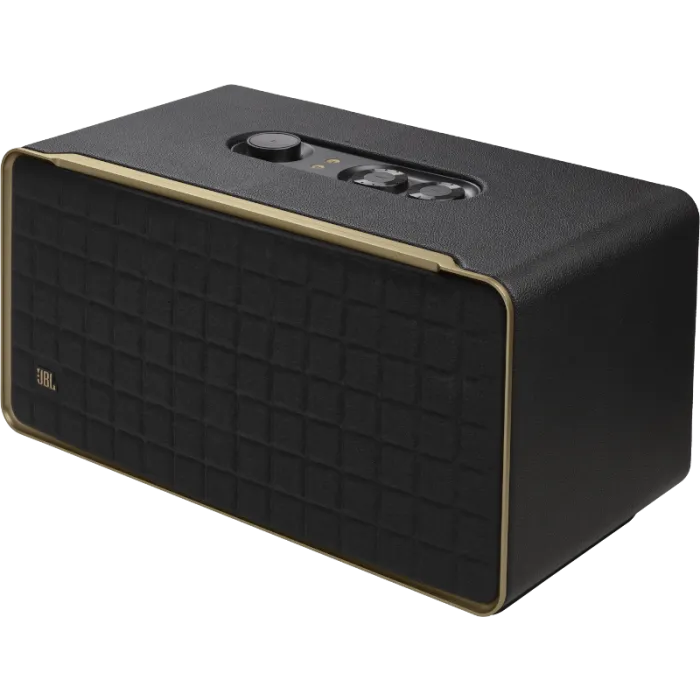
JBL Authentics 500 is a large network music speaker with an intentionally visible retro design and a more ambitious internal arrangement than the smaller Authentics 200. It combines substantial bass hardware with virtual Dolby Atmos Music support, physical tone controls and modern network sources. It remains one enclosure, powered from the mains, without HDMI ARC or optical audio. Original review evidence is encouraging about both ordinary music and the sense of openness from suitable spatial material. The strongest buying case depends on a verified service path and a room that accommodates its size.
Research-based review. This assessment draws on manufacturer documentation and the original published evaluations linked below. Audio Review has not performed a hands-on test of this model.
Scale and an engaging balance are the core attractions
AVForums’ original evaluation finds convincing bass weight and an energetic presentation that remains reasonably forgiving across recordings. With suitable Atmos mixes, it hears a reduced sense that all the sound comes from one box. It does not describe the speaker as reproducing a full installation of overhead and surround speakers.
Begin an audition with ordinary stereo music before changing to spatial material. That establishes whether the basic balance is enjoyable with the library actually used every day. Include a vocal-led track and something with a strong low-frequency rhythm, listening at a realistic household level. Check whether bass stays intelligible near the intended furniture. A demonstration can make the system seem immediately impressive through sheer weight, but it should also handle quieter music comfortably. The original evidence gives the 500 a clear musical reason to be considered. The spatial option is an additional attraction rather than a reason to overlook a stereo presentation that does not suit the room or the listener’s preferences.
Dolby Atmos Music needs the correct content and route
JBL documents Atmos Music through compatible network services, with the effect applied to supported material. The official manual excludes Atmos over Bluetooth. A track label in a phone app does not prove that every casting or connection path delivers that format to the speaker.
Demonstrate the actual service, account and JBL One playback route intended for use. Check the current service requirements rather than repeating an old subscription-tier name from launch documentation. JBL’s release notes record Atmos Music additions for supported TIDAL and Amazon paths, while TIDAL’s current guidance makes clear that capability depends on the playback device and system. Not every album has an equivalent Atmos mix, and a comparison may involve different mastering choices as well as a different format. Use the option because the result is enjoyable, not because every familiar recording must be replaced by a spatial version. If most listening will use Bluetooth or ordinary stereo sources, assess value mainly from those routes. This keeps the recommendation useful even when the available content or account changes.
A large one-box system needs a deliberate location
At approximately 447 mm wide and 7.8 kg, Authentics 500 is a substantial object. It needs suitable furniture, mains power and room for its connections. Automatic self-tuning and tone controls do not remove the practical influence of the position.
Measure the available depth with cables attached and make sure the support is stable. Avoid placing the speaker somewhere that blocks a screen or leaves the top controls inconvenient to reach. Listen from the actual seats before committing to a narrow recess or corner. If bass dominates, consider a reasonable placement change before applying an extreme EQ adjustment. A one-enclosure system can be easier to fit than a separated pair, but that advantage depends on having one genuinely good location. Where two cabinets can be placed well, a conventional stereo system remains a relevant comparison. Choose the JBL for its achieved combination of scale and convenience rather than assuming that a larger single box automatically produces a better result than every smaller or separated alternative.
Network, local music and voice have different requirements
The documented platform provides network streaming, Ethernet and Bluetooth, with JBL One and physical controls. Voice integration is subject to country, language and service availability. These are distinct facilities; the presence of one does not establish every possible local-library or multiroom arrangement.
Test the actual music account and phone, including standby recovery and a change between sources. If a local library is central, demonstrate its specific route rather than assuming generic Wi-Fi compatibility proves direct library browsing. A wired network connection may be useful where it simplifies reliability, but it is not a substitute for the correct software path. For voice, use the assistant already associated with the household and verify a few ordinary commands. Keep a clear app or physical-control route available as well. The best smart-speaker experience is one the household can repeat without technical explanation. A broad platform should make access easier, not force the buyer to work around missing source support that could have been identified before purchase.
European wired-source limits rule out some tempting uses
The official manual identifies USB music playback as a US-version feature, while other versions use that connection for service. The European model should not be bought as a USB computer-audio system. There is a 3.5 mm line input, but no HDMI ARC or optical input.
That makes television a particularly important pre-purchase check. This is not an Atmos soundbar accepting a film soundtrack over HDMI, despite the Dolby name and internal 3.1 description. If a display or other source supplies a suitable analogue output, establish the volume and synchronisation routine before relying on it. A turntable likewise needs the proper phono stage before feeding line level. Avoid collecting adapters merely to turn the music speaker into a different product category. The result may be less convenient and less economical than a dedicated television system or a pair with the required inputs. The JBL is most convincing when its network and ordinary music routes are already the desired solution. Its substantial enclosure does not imply an equally broad physical input panel.
Software history matters to present-day value
JBL has documented later additions including stereo-pair support, Roon Ready functionality, expanded EQ and connectivity changes. Early reviews therefore describe a particular software point, not an immutable current feature list. The actual available configuration should still be checked in the current instructions and app.
Update through the official route and test the single-speaker system before expanding it. For two speakers, distinguish left/right pairing from ordinary multiroom grouping and confirm the supported sources and control behaviour. Compare the full price and furniture requirement with a proper stereo pair before buying another large enclosure. Include regional warranty and local support, particularly with imported stock. The 500 is a premium purchase because of its complete music presentation, styling and platform, not simply a power figure or badge. Its strongest value is achieved when those advantages are used regularly. A smaller speaker may be the better answer for background listening, while a separated system may suit a dedicated stereo seat. The choice should follow the actual room and routine.
Alternatives to consider
Sonos Era 300: Compare this spatial-music speaker if its platform, placement and household integration are a better match. Confirm the actual service path used for Atmos and any input-adapter cost before comparing complete packages.
KEF LS50 Wireless II: A properly spaced active stereo pair offers a different listening arrangement from a large single box. Include stands, source support and room space when comparing the complete installation.
JBL Authentics 500 key specifications
- Format
- Large single-enclosure mains-powered network speaker
- Internal arrangement
- 3.1 with virtual Dolby Atmos Music
- Drivers
- Three 25 mm tweeters, three 2.75-inch midrange drivers, 6.5-inch bass driver
- Power rating
- 270 W maximum at 1% THD, manufacturer figure
- Connections
- Wi-Fi, Ethernet, Bluetooth 5.3 and 3.5 mm analogue
- USB in Europe
- Service only
- App
- JBL One
- Dolby Atmos Music
- Supported content through compatible network service path; not Bluetooth
- TV HDMI / optical
- Not provided
- Controls
- Physical volume, bass and treble; app EQ
- Battery
- None
- Size / weight
- 447 × 240 × 255.7 mm / 7.8 kg
Verdict
Authentics 500 offers substantial and engaging one-box music, with supported Atmos material adding a worthwhile sense of openness in the original evaluation. It needs deliberate placement and a verified network service path. Its EU USB and television limits remain significant. Choose it for a complete home-music role when that arrangement justifies the price over smaller speakers and conventional stereo alternatives.
Documentation and original reviews
JBL official Authentics 500 design and specifications · JBL official Authentics owner manual and regional USB distinction · JBL official Authentics software release notes · TIDAL official current Dolby Atmos playback guidance · AVForums original Authentics 500 evaluation
Editorial record
Sources and updates
Product specifications and factual claims were checked against Official JBL Authentics 500 product page ↗. Scores and buying advice follow our category-specific editorial methodology.
- Published
- November 17, 2026
- Last updated
- November 17, 2026