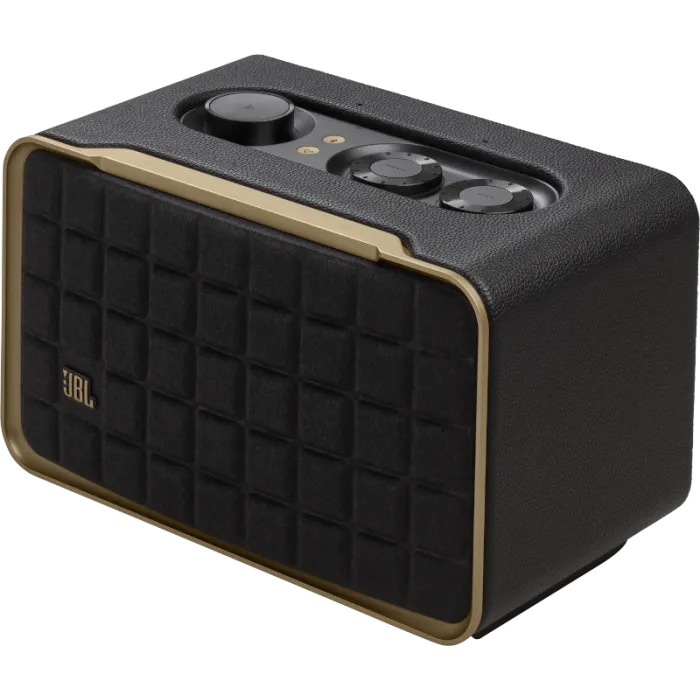
JBL Authentics 200 combines retro styling with a modern network music platform. Physical volume, bass and treble controls give it a more tactile character than many app-first speakers, while Wi-Fi, Ethernet, Bluetooth and an analogue input cover several useful source routes. It is mains powered and intended for the home. It does not share the Authentics 500’s Dolby Atmos Music capability, and European USB specifications differ from the US version. Original listening evidence is strongly positive, but the right purchase still depends on the actual services, room and everyday controls.
Research-based review. This assessment draws on manufacturer documentation and the original published evaluations linked below. Audio Review has not performed a hands-on test of this model.
A full single-box presentation rather than a separated stereo pair
TechRadar’s original evaluation finds powerful bass, clear treble and a rich midrange, with convincing separation for a single enclosure. Its praise supports the model as a serious everyday music speaker. It does not make one box equivalent to two speakers placed apart in a room.
An audition should include both a busy track and a familiar voice, at the level normally used at home. Check whether bass remains comfortable near the intended shelf or counter rather than judging only from an open showroom position. A single speaker can be a particularly useful answer where there is no practical route to two spaced cabinets. It also keeps installation and cleaning straightforward. A listener whose priority is precise stereo placement across a dedicated seat should compare a proper pair as well. The buying decision is about how well the system serves the space, not whether the word stereo appears in a specification. The original evidence makes the 200 worth hearing, with realistic expectations about its physical format.
Physical tone controls are a meaningful everyday feature
Dedicated bass and treble controls complement the volume control and JBL One app. JBL also documents automatic self-tuning. These facilities can help the speaker adapt to a useful location, but they do not remove the influence of furniture or guarantee identical sound everywhere.
Start with the speaker securely supported and with clear access to the controls. Listen to familiar music before changing the balance, then adjust gradually if a boundary position makes bass excessive. Keep a reference setting so another household member can return to a sensible baseline. Avoid treating a tone knob as a cure for every acoustic problem. If the speaker is tucked into a tight recess, moving it may help more than an extreme setting. The tactile interface is attractive for someone who wants to change level without reaching for a phone. It is less valuable if the unit will be hidden somewhere inaccessible. Choose its location around both sound and use rather than treating it only as a decorative object.
Network playback and Bluetooth are different routes
The documented network options include familiar casting and service connections, while Bluetooth offers direct playback from a compatible source. Ethernet is available where a wired network connection is practical. The exact service integration, account requirements and regional availability should be checked with the current app.
Demonstrate the service used most often with the intended phone or tablet. Confirm album selection, volume, standby recovery and a return after another source has been used. A network route can be convenient when the speaker plays independently of ordinary phone notification audio. Bluetooth can be a simple option for a guest or a source outside the main household setup. Neither should be assumed to reproduce every facility of the other. If a local library is important, test its actual playback path rather than inferring support from the presence of Wi-Fi. The practical value of a smart speaker is dependable access to the intended music. A long list of platform names is less useful than a short routine everyone can operate comfortably.
Voice assistance should be assessed as an optional convenience
JBL documents Alexa and Google Assistant integration, subject to country, language and feature availability. This is a useful distinction from a basic Bluetooth speaker, but it should not be treated as a guarantee that every service or command works identically through both systems.
Use the assistant already associated with the household and test the few commands that matter. Check starting music, changing volume and stopping playback with the actual account. If two systems are enabled, establish a clear routine rather than assuming commands will transfer seamlessly between them. The original reviewer found it easier to use one assistant consistently for a given task. Physical and app controls remain important even when voice is convenient. Consider the documented microphone control and place the speaker where the desired privacy setting is accessible. A buyer who does not need any voice function may find better value in a simpler music product. The advantage here is flexibility within a clear household routine, not an obligation to activate every connected feature.
European USB and television limitations need explicit attention
JBL’s official documentation distinguishes US USB playback from other regional versions, where the USB connection is for service. The ordinary analogue input is line level, and there is no HDMI ARC or optical input. Authentics 200 also does not support Dolby Atmos Music.
Do not buy a European example expecting it to act as a USB computer DAC merely because a US feature list mentions USB music. For a television or record player, identify an appropriate supported source route first. A turntable without its own phono stage needs a suitable external stage before feeding a line input. Bluetooth television playback should be checked for synchronisation rather than assumed to provide a soundbar-like experience. A single-box music speaker can serve several sources, but adding adapters may erase the simplicity that made it attractive. If television is a main priority, compare a system with the appropriate dedicated connection. These boundaries make it easier to choose the right product without mistaking a broad wireless platform for a universal audio interface.
Current firmware changes the launch-era comparison
JBL’s release notes document additions including stereo-pair support, Roon Ready functionality, expanded EQ and later connectivity improvements. This means an early review’s feature list should not automatically be used as a complete current specification. It also does not justify promising every possible grouping arrangement without checking the current instructions.
Update through the official app as directed, then test the intended configuration before purchasing another speaker. For multiroom or stereo plans, confirm compatible models, source restrictions and how volume is managed. Grouping several rooms is a different goal from a dedicated left/right pair in one room. Compare the complete price if two units are required to meet the actual ambition. Include mains locations and support terms, since this is a home speaker rather than a battery model. Authentics 200 is strongest as a usable single-box system with enjoyable music and clear controls. Its extras become valuable when they solve a real need, not simply because an evolving firmware list makes the product appear more complicated or more future-proof.
Alternatives to consider
Sonos Era 100: Compare this compact home speaker if its platform and household control arrangement are a better fit. Check the cost of any required input adapter and the current services used in the actual home.
Audio Pro C20 W: This is another connected one-enclosure system to consider when a broader physical source plan matters. Compare the actual inputs, placement and complete local price rather than design alone.
JBL Authentics 200 key specifications
- Format
- Single-enclosure mains-powered smart speaker
- Drivers
- Two 25 mm tweeters; 5-inch woofer
- Power rating
- 90 W maximum at 1% THD, manufacturer figure
- Connections
- Wi-Fi, Ethernet, Bluetooth 5.3, 3.5 mm analogue input
- USB in Europe
- Service only; US playback specification should not be applied
- App
- JBL One
- Controls
- Volume, bass and treble; app EQ
- Voice
- Alexa / Google integration subject to country and language
- Dolby Atmos Music
- Not supported on Authentics 200
- TV HDMI / optical
- Not provided
- Battery
- None
- Size / weight
- 266.3 × 171.7 × 167.4 mm / 3.12 kg
Verdict
Authentics 200 is an attractive everyday network speaker with encouraging original music evidence and unusually useful physical tone controls. Its mains-only design, European service-only USB and absence of Atmos or TV digital inputs define the limits. Confirm current service availability and choose it when one well-placed box fits the room better than a larger system.
Documentation and original reviews
JBL official UK Authentics 200 specifications · JBL official Authentics 200 / 500 owner manual · JBL official Authentics software release notes · TechRadar original Authentics 200 evaluation
Editorial record
Sources and updates
Product specifications and factual claims were checked against Official JBL Authentics 200 product page ↗. Scores and buying advice follow our category-specific editorial methodology.
- Published
- November 17, 2026
- Last updated
- November 17, 2026