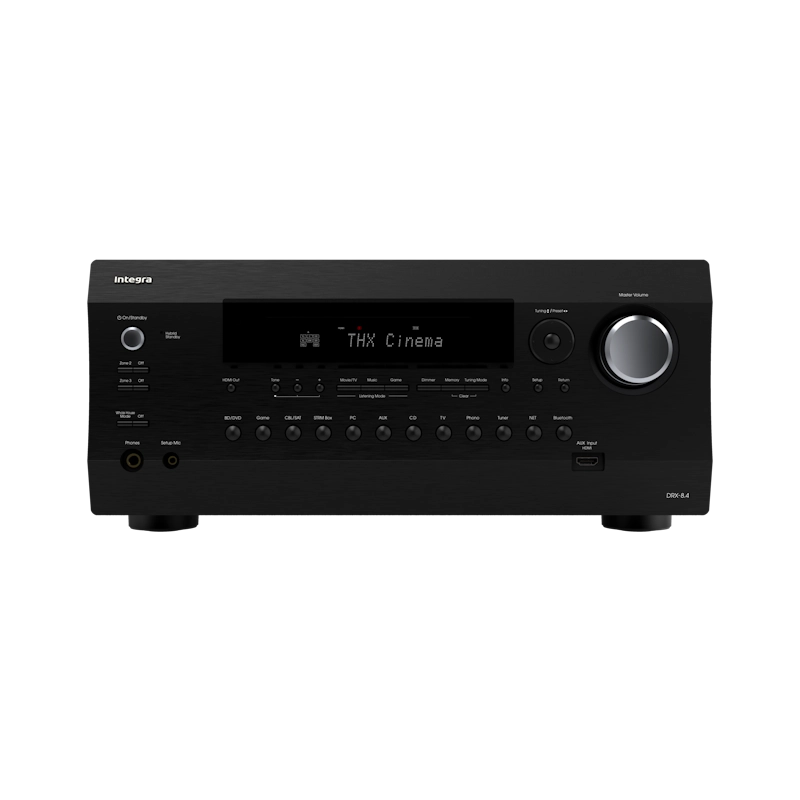
The Integra DRX-8.4 is a substantial eleven-channel receiver intended to run a complete 7.2.4 cinema without external power amplifiers. Included full-bandwidth Dirac Live, optional Bass Control and selected balanced connections make its appeal broader than channel count alone. Its most important specification needs careful reading: four subwoofer sockets represent two independent subwoofer channels, not four independently managed subs.
Integra DRX-8.4 — Design and system planning
The DRX-8.4 prioritises the needs of a serious installation over decorative minimalism. It is a large, heavy component with extensive connections, so cabinet dimensions and access should be checked before ordering. Allow for plug depth, cable bends and ventilation rather than measuring only the metal chassis. A receiver of this scope is easier to live with when the rack can be reached without disconnecting half the system.
Integra’s installation controls are a central part of the product. Web setup, remote-control integration and diagnostics are useful when several sources, displays and amplifiers must behave as one system. They can reduce the effort involved in identifying a failed HDMI link or restoring a known configuration. Ask an installer for a settings backup and a clear description of normal operation. The technology earns its place when any household member can start the required source reliably.
Eleven amplifiers and the actual subwoofer arrangement
Eleven powered channels support a 7.2.4 layout in one chassis. That is an attractive stopping point for a dedicated cinema or an ambitious living room: seven floor-level channels and four heights can form a complete immersive arrangement without another power amplifier. The processing ceiling remains eleven main channels. Adding external amplification does not create a thirteen-channel system, so buyers planning front wides or a larger height arrangement should choose a different architecture.
The subwoofer provision requires equal care. Integra explicitly documents two independent subwoofer channels plus two parallel outputs. Four physical sockets therefore provide connection convenience, while the independent management remains two-channel. This can work well for a planned two-subwoofer system, but it is not equivalent to a receiver with four separately managed subwoofer outputs. Anyone designing a four-sub layout should decide how placement, delay and level will be handled before treating the 11.4 marketing label as a complete specification.
Full RCA pre-outs allow external amplification, while balanced XLR outputs are provided for the front left, centre and right channels and the two independent subwoofer channels. That is useful where the front power amplifiers or subwoofers are some distance away. It does not mean every surround channel has a balanced output. Map the connections against the actual cable runs rather than assuming a single XLR photograph describes the whole preamplifier bank.
Dirac Live and optional Bass Control
Full-bandwidth Dirac Live is included, and Bass Control is an optional upgrade. The included correction already provides a serious basis for integrating speakers with the room. Bass Control adds a different set of subwoofer-integration tools; it should be budgeted as a separate purchase, not described as part of the standard package. Check the exact supported licence and installed firmware before buying software for a finished system.
Archimago’s original DRX-8.4 coverage includes practical work with Dirac Live and a later Bass Control evaluation. That is useful evidence because it examines the correction process in an actual multichannel installation rather than relying only on a launch feature list. It also reinforces a practical point: microphone placement, target choices and repeatable comparisons matter. The presence of a sophisticated algorithm does not make careless measurements harmless.
Measure around the seats that matter, keep a record of the uncorrected system and save the project before making major changes. A sensible target can preserve the preferred bass balance while addressing the room’s larger problems. Avoid chasing a visually perfect graph at the expense of comfortable listening. If several seats have very different bass responses, reconsider subwoofer positions as well as filters. Physical placement and electronic correction work together, and neither makes the other unnecessary.
Performance evidence and sound assessment
Archimago measured the DRX-8.4’s preamplifier outputs and reported low distortion, strong linearity and closely matched channels in the tested paths. Those findings support its credibility as a processor feeding external amplification. They are that reviewer’s measurements, not Audio Review laboratory results, and they do not establish every speaker-output performance condition. A clean pre-out test should not be repackaged as proof of continuous eleven-channel amplifier power.
Integra specifies 150 watts per channel into eight ohms across 20 Hz to 20 kHz at 0.08 percent distortion with two channels driven. The qualification is essential when comparing receivers. It is a useful published reference, but it is not the same as driving all eleven channels continuously. Loudspeaker efficiency, listening distance and the desired peak level still determine whether the system has adequate headroom. The pre-outs provide flexibility when a particular front speaker needs more power.
For film playback, the strongest reason to expect a convincing result is the complete combination of appropriate channel layout, calibration and capable amplification. Keep the centre speaker aimed at listeners and avoid forcing small height speakers to reproduce deep bass. For music, compare stereo and immersive modes at matched level rather than choosing by loudness. A well-configured receiver can serve both uses, but an elaborate signal path should remain understandable enough that the owner knows which processing is active.
Video connections and network listening
The six rear HDMI inputs support the receiver’s high-bandwidth video facilities, with a further front input for convenient temporary connections. Three outputs provide flexibility for displays and a zone, but their capabilities are not identical. Use the current manual to assign a high-refresh console or PC and confirm the required output path. A front socket or zone output should never be assumed to match the main high-bandwidth route without checking.
A practical acceptance test includes the actual console, television, refresh rate, HDR setting and audio format used in the household. Test a second display separately before assuming a splitter-like arrangement will preserve every capability. The receiver can be perfectly functional while a particular cable run or display setting prevents the desired mode. HDMI diagnostics are useful precisely because the whole chain, rather than the receiver alone, determines the result.
Archimago also documented Roon Ready operation on updated firmware, rather than merely repeating the original promise of a future update. Familiar network routes such as AirPlay 2 and Chromecast broaden everyday playback options. Choose a reliable primary route and use Ethernet where appropriate. A stereo network stream should not be confused with multichannel delivery from every application; the content format and playback route need to support the intended result.
Value and the right installation
The DRX-8.4 is most persuasive when eleven amplified channels, two independently managed subwoofer channels and the installation facilities all have a clear job. In that setting it can replace a more fragmented collection of processing and amplification boxes. The selected XLR outputs are also a useful practical benefit for some layouts. Their value comes from solving a connection problem, not from making an entire system automatically superior.
It is less suitable for someone who already knows they need thirteen main channels or four independently controlled subs. Those are architectural limits that an optional correction licence cannot remove. Compare the total European system price, including calibration, software and rack requirements, against alternatives with the precise processing layout required. The strongest purchase is the receiver that fits the completed room rather than the one with the most impressive headline label.
Alternatives to consider
Onkyo TX-RZ50: A lower-cost route to eleven-channel processing if external amplification is acceptable and the installation needs are simpler.
Marantz CINEMA 50: Compare subwoofer management and the cost of amplification and optional correction for the intended layout.
Integra DRX-8.4 key specifications
- Amplified / processed main channels
- 11 / 11
- Maximum Atmos arrangement
- 7.2.4
- Rated power
- 150 W/ch, 8 ohms, 20 Hz–20 kHz, 0.08% THD, 2 channels driven; published FTC figure
- Subwoofer architecture
- 2 independent channels plus 2 parallel sockets
- HDMI
- 7 inputs including front / 3 outputs
- XLR pre-outs
- Front L/C/R and 2 subwoofer channels
- Dirac
- Full Room Correction included; Bass Control optional
Verdict
The Integra DRX-8.4 is a compelling complete receiver for a carefully planned 7.2.4 cinema, with included Dirac Live and useful balanced connections. Its limits are clear: eleven main channels and two independent subwoofer channels. Choose it when that architecture fits the room, and budget separately for optional Bass Control.
Primary documentation and independent reviews
Integra official DRX-8.4 specification sheet · Integra official product information · Archimago original DRX-8.4 review and pre-out measurements · Archimago original Dirac Live evaluation · Archimago original Bass Control evaluation
Editorial record
Sources and updates
Product specifications and factual claims were checked against Official Integra DRX-8.4 product page ↗. Scores and buying advice follow our category-specific editorial methodology.
- Published
- November 7, 2026
- Last updated
- November 8, 2026