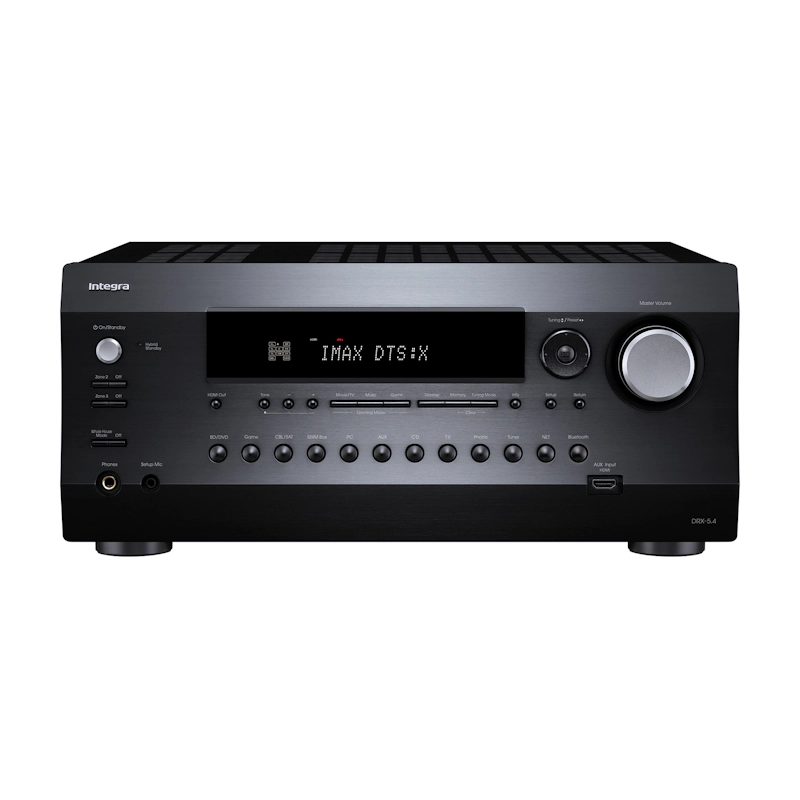
The Integra DRX-5.4 is a nine-amplifier receiver with an important extra capability: eleven-channel processing. A system can begin with the receiver alone and expand to 7.2.4 using external amplification. Included full-bandwidth Dirac Live and extensive installation controls make it especially relevant to a planned home cinema where the final speaker layout is already known.
Integra DRX-5.4 — A receiver built around direct control
The DRX-5.4 looks unapologetically like a substantial AV component. Its metal front and many physical buttons give direct access to functions that other designs hide behind menus. Audio magazine’s original Polish test highlighted that traditional approach and the readable display. Buyers who regularly change sources or troubleshoot equipment may appreciate it, while someone seeking a nearly invisible living-room component may prefer a simpler appearance.
Installation requires more than finding a shelf wide enough for the front panel. Allow rear space for cables, ventilation around the chassis and access to the microphone connection. If the receiver goes into a rack, plan how it can be serviced without dismantling the whole system. Label speaker runs by their eventual role, especially if a temporary nine-speaker arrangement will later become an eleven-speaker system. Clear labelling helps prevent an external amplifier being connected to the wrong reassigned output.
Understanding nine amplifiers and eleven channels
Nine internal amplifier channels support a 5.2.4 or 7.2.2 system without another amplifier. Eleven-channel processing and the multichannel pre-outs enable 7.2.4 when the missing amplification is supplied externally. That is a meaningful upgrade path, but it is not free extra power hidden in the chassis. Check the assignment instructions and the external amplifier’s gain, inputs and turn-on behaviour before purchasing it.
The distinction also affects zone use. Additional speaker terminals simplify wiring and switching, but they do not increase the number of internal amplifiers available simultaneously. A system that powers another room may have to reallocate channels from the main theatre. Write down which rooms must play at the same time, then confirm the corresponding assignment in the manual. This avoids discovering after installation that a desired second-zone arrangement changes the main-room speaker layout.
Do not infer independent subwoofer processing merely from two subwoofer connectors. For a multi-subwoofer project, the relevant questions are individual delay, level and correction capabilities, not the number of sockets. A carefully planned subwoofer system may need different control facilities from a straightforward installation where two subs receive the same bass programme. Make that decision while choosing the receiver, before adding correction software or extra hardware.
Dirac Live and current upgrade support
Full-bandwidth Dirac Live Room Correction is included. At the time of this research, Dirac’s model-specific page also lists Bass Control as available for the DRX-5.4, while Active Room Treatment is unsupported. That current listing matters because older launch coverage does not necessarily reflect later software support. Bass Control is a separate purchase, and the exact licence and firmware requirements should be checked for the unit before payment.
The included correction is already useful without buying every optional feature. Begin with good speaker positions and a sensible listening area, measure carefully and save the original project. An exported target curve should be treated as a starting point for listening, not a requirement to make every frequency perfectly flat. If the result seems thin, compare target curves and bass-management settings before concluding that the amplifier lacks warmth. Calibration, level and crossover changes can dominate a casual comparison.
For a household with several regular seats, measure around the actual listening area rather than spreading positions across an entire room that is rarely occupied. Conversely, do not optimise a family sofa as though only one narrowly defined point matters. Decide the goal first. Professional calibration can be a worthwhile part of an installation budget when the owner wants repeatable results without learning every control personally.
Sound evidence and amplifier expectations
Audio magazine’s original DRX-5.4 evaluation described an open, expressive presentation with prominent detail and a broad sense of space. Its laboratory summary characterised output as moderate but unusually consistent as more amplifier channels were driven. Those are findings from that publication’s sample and methods, not measurements performed by Audio Review. They support a more useful discussion than simply repeating the largest wattage in a sales listing.
Integra’s published full-bandwidth figure is 120 watts per channel into eight ohms, at 0.08 percent distortion with two channels driven. It should not be read as continuous output from all nine channels together. The final result still depends on speaker sensitivity, impedance and distance. Buyers with demanding front speakers can use the pre-outs to add suitable amplification without replacing the receiver’s processing section. That flexibility is one of the DRX-5.4’s stronger practical arguments.
In a typical cinema, a capable centre speaker and properly integrated subwoofer are likely to matter more than a small difference in nominal amplifier rating. Keep the centre unobstructed, avoid putting small speakers under unnecessary deep-bass strain and audition at the intended volume. A receiver with extensive adjustment facilities can help refine a good installation, but it cannot compensate completely for a centre speaker hidden behind furniture or a subwoofer placed solely for visual convenience.
HDMI and source flexibility
The connection provision includes seven HDMI inputs, one on the front, and two outputs. The rear inputs do not all share the same bandwidth, so allocate demanding gaming sources using the current manual rather than plugging them into any spare socket. The front input is particularly convenient for temporary equipment, but convenience should not be confused with the highest video capability. Test the required refresh rate, HDR mode and audio format together.
The second HDMI output can serve another display or a zone according to configuration, and the main output supports eARC. A television-first connection can be useful for a particular games source, but only if the television passes the needed audio formats. Network music options, an MM phono input and legacy connections broaden the receiver’s usefulness beyond film playback. Avoid paying for redundant source hardware until the built-in routes have been tried in the finished system.
Integra’s web setup, serial control and programmable triggers are most useful when several components must operate as one system. Ask for a backup of installation settings and a simple explanation of normal operation. The success of a custom installation is measured by how easily someone can watch a film, not by the number of control options enabled. A reliable everyday workflow is worth more than unused automation complexity.
Value and buying advice
The DRX-5.4 has a clear buyer: someone who wants nine amplified channels now, a credible path to eleven later and control features suited to a more involved installation. In that context, its processing and pre-outs can reduce future replacement costs. For a permanent five-channel lounge system, much of that flexibility may never be used, so a simpler receiver could leave more money for speakers and acoustic improvements.
Compare European supply, support and total installed cost. Include external amplification if 7.2.4 is the actual goal, and add any optional correction licence that the project requires. A discounted receiver is not automatically the cheapest finished system. The best reason to choose the Integra is that its particular combination of processing, calibration and integration fits the intended installation.
Alternatives to consider
Onkyo TX-RZ50: A close architectural comparison for a nine-amplifier receiver with an eleven-channel upgrade path.
Marantz CINEMA 50: Compare the different correction options, subwoofer facilities and local installed price.
Integra DRX-5.4 key specifications
- Amplified / processed main channels
- 9 / 11
- Maximum Atmos arrangement
- 7.2.4 with external amplification
- Rated power
- 120 W/ch, 8 ohms, 20 Hz–20 kHz, 0.08% THD, 2 channels driven; published FTC figure
- HDMI
- 7 inputs including front / 2 outputs
- Dirac
- Full Room Correction included; Bass Control listed as optional; ART unsupported
- Phono
- Moving magnet
Verdict
The Integra DRX-5.4 is a well-considered option for an expandable Atmos cinema, particularly when full pre-outs and installation control are useful. Budget for external amplification to reach 7.2.4, verify any optional Dirac licence against current firmware and choose it for the whole system rather than a headline power number.
Primary documentation and independent reviews
Integra official DRX-5.4 information · Integra current instruction manual · Dirac current model support · Audio magazine original review and laboratory evaluation
Editorial record
Sources and updates
Product specifications and factual claims were checked against Official Integra DRX-5.4 product page ↗. Scores and buying advice follow our category-specific editorial methodology.
- Published
- November 7, 2026
- Last updated
- November 8, 2026