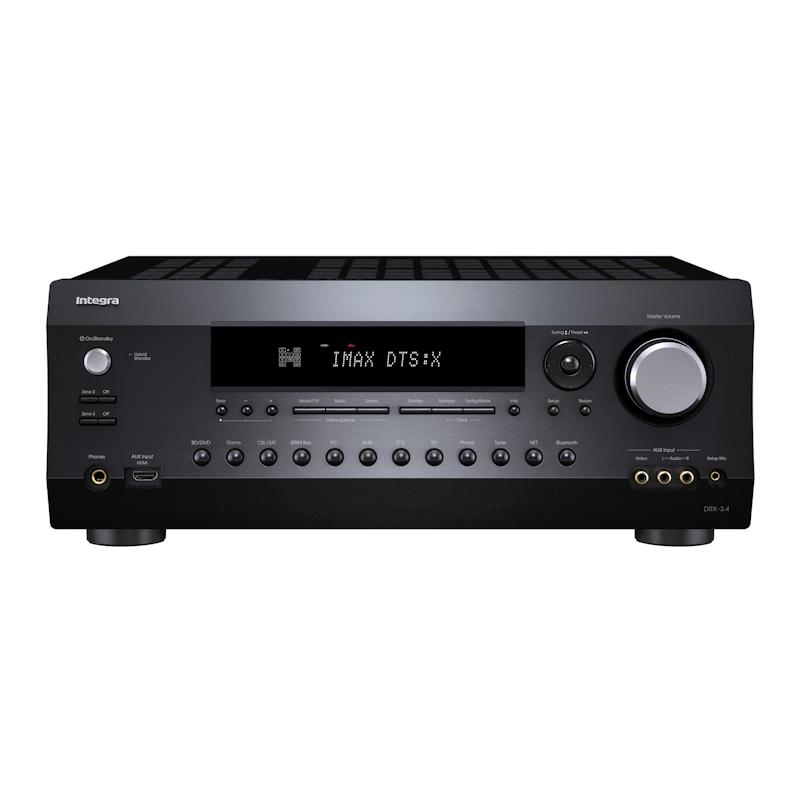
The Integra DRX-3.4 combines nine channels of amplification with full multichannel pre-outs and included Dirac Live correction. That makes it interesting both as an integrated home-cinema receiver and as a way to modernise a system that already has power amplifiers. Its strength is installation flexibility within a nine-channel main-room layout, rather than unlimited speaker expansion.
Integra DRX-3.4 — Design and installation priorities
Integra gives the DRX-3.4 an intentionally functional appearance. The aluminium front and physical controls favour direct operation over a minimalist display-only aesthetic. That is useful in an equipment rack, where changing an input without opening an app can save time. It also means the receiver has a more traditional visual presence than products designed primarily to disappear into a contemporary living room. Neither approach is inherently better; placement determines which is preferable.
The manufacturer’s installation facilities include web setup, serial control and trigger outputs. These are meaningful when the receiver must start other components or respond to a programmed control system. They are less valuable if the installation consists of a television, console and single remote. Ask an installer to explain which functions will actually be used and to provide a record of the finished settings. An elaborate control system should make daily operation simpler, not make basic listening dependent on remembering a complicated sequence.
Nine channels, with useful preamplifier flexibility
The nine internal amplifiers support 5.2.4 or 7.2.2 speaker arrangements. Choosing between them is a room-layout decision: four well-positioned height speakers can provide a more complete overhead layer, while rear surrounds can be useful where seating and room depth permit. Do not let the availability of empty terminals encourage an unsuitable speaker position. A coherent smaller layout is more useful than extra speakers crowded together around the sofa.
The full 9.2 pre-out bank is an important distinction from receivers that expose only selected channels. Existing external amplifiers can remain in service, or demanding front speakers can receive additional amplification later. That does not add processing channels. A power amplifier cannot turn the DRX-3.4 into an eleven-channel processor, so a planned 7.2.4 installation needs a different receiver from the start. This is a particularly important boundary when a buyer already owns enough amplifiers to assume that more connections automatically mean a larger Atmos layout.
Dirac Live and sensible calibration
Dirac lists full-bandwidth Room Correction as included for this model, with Bass Control and Active Room Treatment unsupported. The included licence is a substantial part of the package, but the distinction matters when budgeting a multi-subwoofer project. General Dirac availability across a brand does not mean every Dirac product can be added to this particular receiver. Buy on the current model-specific support list.
A good calibration starts with the physical system. Keep the microphone steady, follow the measurement guidance and make sure the room is quiet. Before exporting filters, inspect unusual results and confirm that the correct speakers were measured. A target curve is a listening choice as well as a technical setting: flattening every measured variation without considering the room and listening preference can produce an unconvincing result. Keep an untouched reference preset so that comparisons remain easy to understand.
An original DRX-3.4 owner account on the AVForums community described improved surround separation compared with an older receiver but preferred the sound with correction disabled. That is an individual system report, not an AVForums editorial test or a controlled conclusion about Dirac. Its useful lesson is to compare settings in the actual room. It does not establish that correction is ineffective, and it should not be turned into a universal description of the receiver’s tonal balance.
Amplification and sound expectations
Integra specifies 100 watts per channel into eight ohms across 20 Hz to 20 kHz at 0.08 percent distortion with two channels driven. Those conditions matter: it is not a promise that all nine channels continuously deliver that power together. Loudspeaker sensitivity, impedance and seating distance remain part of the decision. The full pre-outs provide a practical escape route if a particular front speaker proves too demanding for the intended level.
For most buyers, the more useful sound question is whether dialogue remains intelligible and the system stays composed at their normal volume. An active subwoofer and appropriate speaker crossovers can reduce unnecessary low-frequency demands on small speakers. They also make the receiver’s job more manageable, although they do not guarantee unlimited headroom. In a large room, audition with the actual front speakers if possible instead of treating a wattage number as a complete assessment.
There is insufficient independent bench evidence in the sources used here to promise a distinctive amplifier sound or a measured advantage over similarly priced rivals. The DRX-3.4’s recommendation rests more securely on its verified layout, calibration and connection facilities. That is still a useful basis for a shortlist, especially for an owner who wants to retain good external amplification rather than replace an entire system at once.
Sources, HDMI and music playback
Seven HDMI inputs, including a front connection, make temporary sources easier to accommodate. The two outputs serve the main display and a second display or zone according to the selected configuration. Use the manual’s input-specific format information when planning high-refresh gaming. The front socket should not be assumed to provide the same capabilities as the highest-bandwidth rear inputs merely because all are HDMI connectors.
AirPlay 2, Chromecast and network playback cover several familiar music routes. Choose one main route and test its behaviour with the phones used in the household. A feature can be technically available yet less convenient than an existing television app or small streamer. Wired Ethernet is attractive in a rack, where a reliable network connection also supports control and setup. Music-service availability and application behaviour can change independently of the receiver’s amplifier section.
The moving-magnet phono input provides a straightforward turntable connection, while digital and analogue inputs accommodate older sources. For a turntable with a built-in active preamplifier, use a line input or bypass that stage before using the phono input. When adding external amplifiers, also check gain and trigger behaviour so that the system turns on predictably and the calibrated channel levels remain sensible.
Value in a European system
The DRX-3.4 is most attractive when the installation tools and complete pre-out bank solve an existing problem. Someone retaining a multichannel power amplifier may find more value here than a buyer comparing only internal-amplifier counts. Conversely, a simple television system can end up paying for control features that will never be used. Compare the locally supplied European version, warranty and support rather than importing a different mains-voltage version to save a small amount.
Its main limitation is easy to understand once the final speaker plan is written down. Nine processed channels are enough for many rooms, but buyers already committed to eleven should step up before installing cables. Include any microphone, professional calibration and external-amplifier costs in the budget. A receiver that fits the final system is a better investment than one whose attractive purchase price leads to an early replacement.
Alternatives to consider
Onkyo TX-RZ50: Compare when eleven-channel processing and a larger eventual speaker layout matter.
Denon AVC-X3800H: A relevant alternative when subwoofer flexibility and a different calibration ecosystem take priority.
Integra DRX-3.4 key specifications
- Amplified / processed main channels
- 9 / 9
- Atmos layouts
- 5.2.4 or 7.2.2
- Rated power
- 100 W/ch, 8 ohms, 20 Hz–20 kHz, 0.08% THD, 2 channels driven; published FTC figure
- Pre-outs
- 9.2
- HDMI
- 7 inputs including front / 2 outputs
- Dirac
- Full Room Correction included; no Bass Control or ART
Verdict
The Integra DRX-3.4 makes a strong practical case for a nine-channel cinema that needs Dirac Live, full pre-outs and installation control. It is less suitable for an eleven-channel expansion plan, and the lack of Dirac Bass Control should be understood before designing a complex bass system.
Primary documentation and independent reviews
Integra DRX-3.4 official product information · Dirac model-specific licence support · Original owner evaluation on the AVForums community
Editorial record
Sources and updates
Product specifications and factual claims were checked against Official Integra DRX-3.4 product page ↗. Scores and buying advice follow our category-specific editorial methodology.
- Published
- November 7, 2026
- Last updated
- November 8, 2026