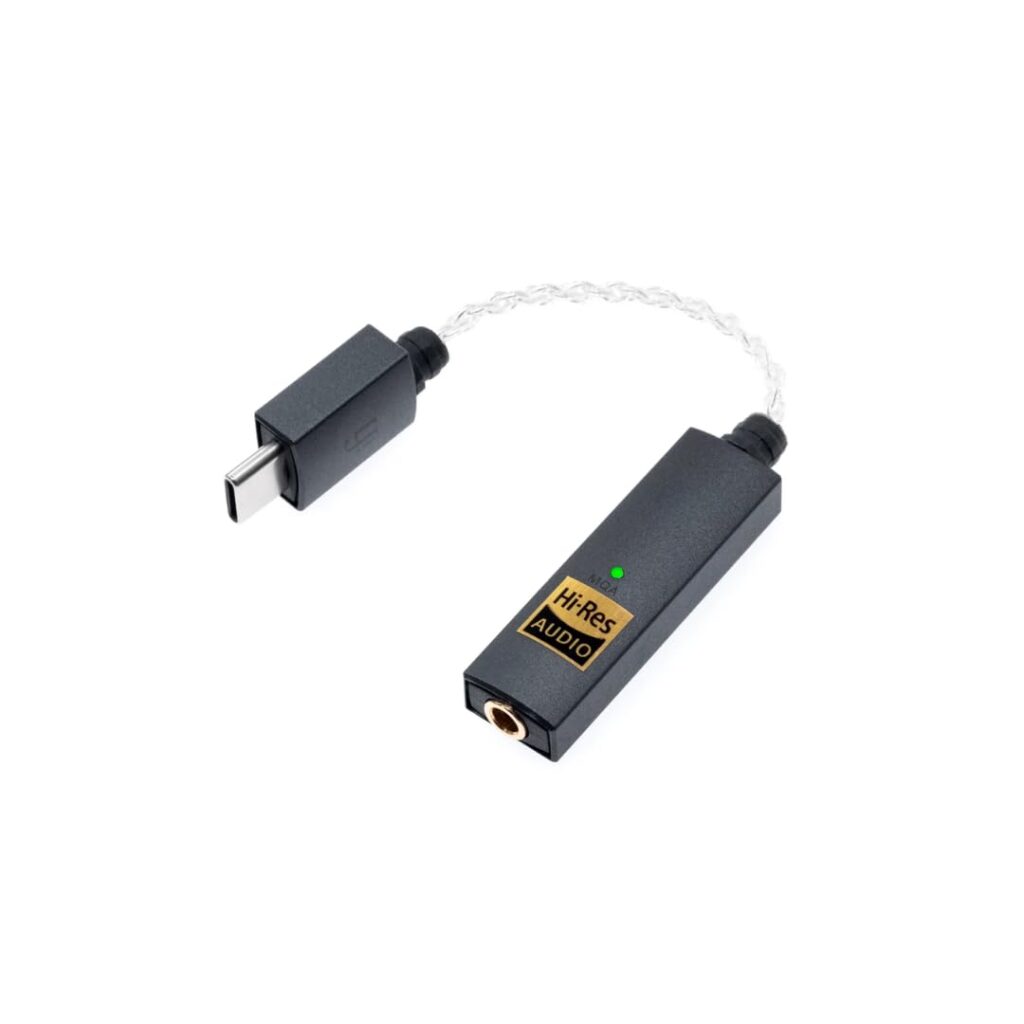
The original iFi GO link is a lightweight way to connect wired headphones to a compatible digital source. Its flexible short cable can make it easier to position than a rigid plug adapter. This review concerns the original GO link, not GO link Max or GO link 2, whose output arrangements and specifications should be checked separately.
iFi GO link — An active adapter with a clear role
The GO link receives digital audio through USB-C and supplies a 3.5 mm headphone output. It contains conversion and amplification rather than simply changing the connector shape. A compatible host must provide USB audio and operating power.
The official page lists a USB-A adapter in the package, which can be useful with a computer. It should not be treated as a guarantee for every television, console or restricted work machine. Check the intended host’s USB-audio support and operating-system requirements before assuming a physical connection establishes playback.
S-Balanced is not a four-wire headphone socket
iFi uses the S-Balanced name for the circuit feeding the standard 3.5 mm socket. That branding should not be confused with a 4.4 mm or four-pin XLR balanced headphone connector. Buy the cable and headphone termination that match the actual socket.
A connector label also does not establish audible superiority. The useful questions are sufficient output, acceptable noise with the intended earphones and predictable volume control. We have not measured those behaviours, so this review does not claim that the circuit eliminates noise for every sensitive IEM.
Power figures change with the load
The official specification gives at least 70 mW into 32 ohms and about 14 mW into 300 ohms, with corresponding voltage information. Those are different load conditions, not contradictory ratings. A higher-impedance headphone may need voltage headroom, while a low-impedance model can make current delivery more important.
Use sensitivity as well as impedance when matching headphones. A dongle can be entirely adequate for efficient earphones without being a universal replacement for a desktop amplifier. Begin at low volume and check that the required level is available without distortion; a louder maximum should not be mistaken for better everyday sound.
Formats, portability and the newer-model question
The original GO link supports PCM up to 384 kHz and DSD256 according to iFi. The source application and operating system determine what is actually sent, so the maximum supported format is not a promise for every streaming or playback route. An ordinary recording does not gain resolution through a setting alone.
The specified weight is 11 g, with a short flexible cable between the USB connector and output body. That is convenient for carrying, but the cable and phone port still need care. Avoid using the dongle as a load-bearing link when the phone is in a bag or pocket.
Because newer GO link products exist, compare the exact current model and local price. Do not copy the Max model’s connection features into an original GO link listing. If the existing headphone output already provides clean, adequate level, the benefit may be convenience rather than a demonstrated sonic upgrade.
What to expect in a real setup
Does S-Balanced mean I need a 4.4 mm cable? No. The original GO link uses a 3.5 mm socket. S-Balanced is iFi’s circuit terminology, not a different physical connector here.
Will the 70 mW rating apply to a 300-ohm headphone? No. iFi gives separate load-dependent figures. Match voltage, current and headphone sensitivity rather than transferring a 32-ohm rating to another load.
Keep the original GO link comparison in proportion
The original GO link is a small way to connect conventional wired headphones to a compatible USB source. Its role is different from a larger balanced-output dongle or a battery-powered headphone DAC. Check that the review, retailer and accessory advice all refer to the original model, because similarly named products can have different sockets and capabilities. The appropriate comparison begins with the headphone cable and host already owned. An unused extra output on another model is not automatically a reason to spend more.
The 3.5 mm S-Balanced connection accepts the intended conventional headphone arrangement; it should not be treated as a separate four-wire balanced socket. Choose a product with the required actual connection rather than buying adapters in pursuit of a label. A fixed headphone cable may make an ordinary single-ended output the most practical choice. Output suitability and a reliable connection matter more than having a matching word in the DAC and headphone descriptions.
Include the phone and cable in the value decision
Because the GO link is powered by its host, the complete listening session includes the phone or laptop’s battery demands. Try a representative period of playback and check reconnection after sleep. Confirm the preferred app uses the expected output and start with low volume when changing applications or hosts. A maximum-format LED is not a substitute for verifying the settings that affect everyday operation. A standard music library does not need to be replaced simply because the adapter supports higher-rate files.
The attached lead also deserves ordinary care. Avoid letting the device hang under the weight of a large headphone plug, and check the assembled fit with the phone case in place. For a laptop, position the cable where a hand or bag cannot continually pull it sideways. The small format can be convenient, but it also means the connection will often be handled more frequently than a fixed desktop DAC.
If the buyer uses demanding full-size headphones, compare the relevant output conditions rather than assuming that every external DAC is an amplifier upgrade. Sensitive earphones present a different question: useful volume control and quiet operation may matter more than additional maximum level. The GO link is most persuasive when it provides a comfortable, dependable route to familiar wired headphones. If an existing adapter already does that satisfactorily, the next improvement may be elsewhere in the listening setup rather than another small DAC.
Alternatives to consider
Qudelix-5K: A different portable approach when wireless reception and detailed EQ control matter more than a minimal USB dongle.
iFi hip-dac 3: A battery-powered option to investigate if additional controls and headphone-driving requirements justify carrying a larger device.
iFi GO link key specifications
- Assessed model
- Original iFi GO link
- Input
- USB-C
- Headphone output
- 3.5 mm S-Balanced
- PCM support
- Up to 384 kHz
- DSD support
- Up to DSD256
- Power claim, 32 ohms
- At least 70 mW
- Power claim, 300 ohms
- 14 mW
- Net weight
- 11 g
- Included adapter
- USB-A to USB-C
- Power
- Connected USB host
Verdict
The original GO link is a focused convenience product for compatible USB sources and suitable wired headphones. Its small format and standard socket are practical attractions. Confirm the exact variant and required headroom, and avoid paying for a claimed universal sound upgrade that has not been demonstrated in your system.
Primary documentation
Specifications and feature descriptions were checked against the following official documents on 6 November 2026. Compatibility advice is our interpretation of those documented capabilities; it does not establish measured sound quality. Regional bundles, software features and service availability can change, so verify the exact European model and current support information before purchase.
Editorial record
Sources and updates
Product specifications and factual claims were checked against Official iFi GO link product page ↗. Scores and buying advice follow our category-specific editorial methodology.
- Published
- November 7, 2026
- Last updated
- November 8, 2026