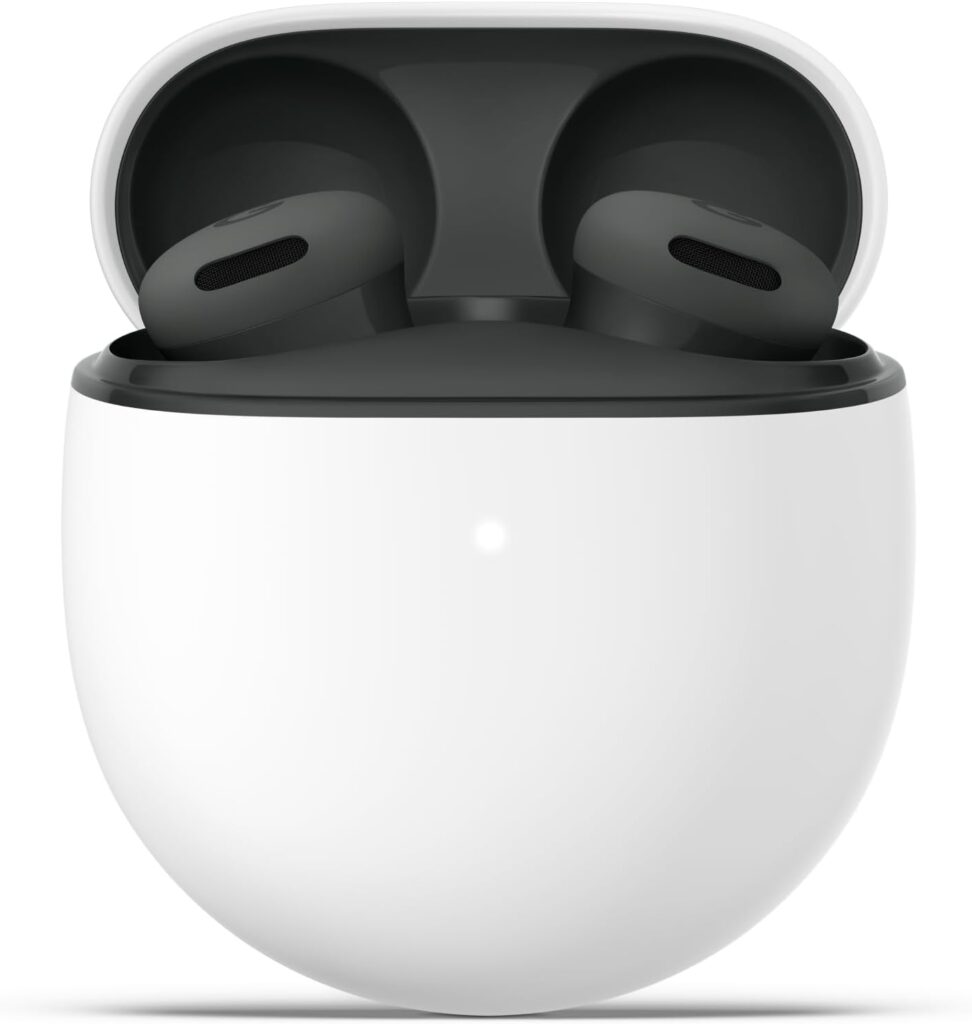
Google Pixel Buds 2a brings ANC and more recent Pixel integration into a less expensive part of Google’s earbud range. Its most useful attractions are ordinary ones: a small physical fit, convenient device management and the ability to change listening modes during the day. That is a different proposition from buying the most elaborate codec list or the most expensive Google model. For Android users, the complete routine may be more important than a single headline feature.
Research-based review. This assessment draws on manufacturer documentation and the original independent evaluations linked below. Audio Review has not performed a hands-on test of this model.
Fit and a small-ear starting point
Google specifies a weight of 4.7 g per earbud with the medium tip and supplies four tip sizes. The adjustable stabilising arrangement is worth trying rather than judging from a photograph. SoundGuys is positive about the gentle fit, including its relevance to smaller ears, but no review can guarantee comfort for every listener.
Check each ear independently, then move your jaw, speak and walk normally. A stable fit should not depend on pushing the earbud progressively deeper whenever you touch it. If you struggle with many sealed earbuds, the 2a is a sensible candidate for an in-person trial. A return policy is particularly useful because comfort, passive isolation and bass consistency all depend on the same physical match.
Sound quality and sensible expectations
SoundGuys regards the sound as broadly adequate for everyday listeners while being less enthusiastic about its appeal to demanding music-focused buyers. That is a useful qualification for a product whose wider feature package is attractive. It prevents the recommendation from becoming an assumption that an integrated phone ecosystem must also deliver the best tonal balance at the price.
Audition familiar voices and dense tracks before making the decision. If an EQ adjustment improves intelligibility or reduces a region you find tiring, save the change and compare it against the default at a similar level. Presets can be convenient, but they are not a reason to overlook a balance you fundamentally dislike. The most useful result is a presentation that works across your normal music and spoken content without constant intervention.
ANC, transparency and the ear-tip seal
The 2a includes active cancellation and a transparency mode, so it can support both quieter listening and short interactions without removing the earbuds. The passive seal still matters. A poorly fitted tip changes the acoustic conditions before any processing begins, making fit the first troubleshooting step if bass or cancellation seems inconsistent.
Try the modes with playback paused, then with music at your usual volume. This separates the change in environmental sound from the masking effect of the recording. Transparency can help with conversations, but is not the same as hearing without earbuds and should not be treated as a substitute for attention in changing surroundings. The best setting is the one that suits the current activity, rather than leaving every enhancement enabled simply because it is available.
Android integration and actual compatibility
Google lists basic pairing with a broad range of Bluetooth devices, including iOS and computers, while full access to features requires the appropriate companion phone, account and connection. Those are different promises. An iPhone can play audio without providing the same configuration experience as a compatible Android device.
Multipoint and supported Audio Switch are useful when moving between devices, but the exact applications still need checking. Test the sequence that matters to you, including calls and returning to a computer after phone playback. Gemini-related facilities also depend on software, account and service support; they are not a standalone assistant operating independently of the connected system. For value, give the greatest weight to features that are available in your actual setup today.
Battery, case and charging routine
Google claims up to seven hours of listening with ANC and twenty hours in total with the case. With ANC disabled, the stated maxima are ten and twenty-seven hours. These are manufacturer ratings, so allow for differences caused by volume, calls, settings and battery age. The case total includes recharging intervals and is not an uninterrupted listening figure.
The case charges over USB-C and does not support wireless charging. For a buyer who already uses a cable, that may be an easy compromise. For someone who routinely drops the case onto a charging pad, it changes the daily routine. Make this a conscious choice rather than assuming the feature exists because it appears on a more expensive Pixel model. Check the box contents before relying on a particular cable being supplied.
Calls, durability and the ownership decision
Google’s wind mesh and supported calling functions are useful design details, but call quality should still be checked in a real application. A phone network, laptop client and room can add processing of their own. Record a short sample in a quiet space and a typical working environment if meetings are a major use case.
The earbuds have IP54 protection and the case IPX4, which does not make either suitable for swimming or deliberate immersion. Keep charging contacts dry and follow the manufacturer’s care guidance. Google also specifies a minimum security-update period measured from initial availability, not from the date you happen to buy a discounted pair. Together, these details make the 2a a reasonable practical package, but the final comparison should include competing earbuds’ fit and sound rather than ecosystem convenience alone.
Alternatives to consider
Google Pixel Buds Pro 2: The Pro 2 is the relevant upgrade comparison for someone who already prefers the Pixel ecosystem. Check whether its additional facilities and listening performance justify the current price difference, rather than buying it solely because Pro appears in the name.
Soundcore Liberty 4 NC: The Liberty 4 NC offers another feature-rich ANC route. Compare its fit, app and actual local price with the 2a, especially if Google-specific integration is not central to how you use earbuds.
Google Pixel Buds 2a key specifications
- Design
- Sealed true wireless in-ear
- Driver
- Custom 11 mm dynamic
- Processor
- Google Tensor A1
- Bluetooth
- 5.4
- Bluetooth LE Audio codec
- LC3 with a compatible LE Audio source
- Noise control
- ANC with Silent Seal 1.5; transparency
- Multiple devices
- Bluetooth multipoint and compatible Audio Switch
- Battery claim
- Up to 7 hours / 20 hours including case, ANC on
- Battery claim, ANC off
- Up to 10 hours / 27 hours including case
- Charging
- USB-C; no wireless charging
- Resistance
- Earbuds IP54; case IPX4
- Weight
- 4.7 g per earbud with medium tip
- Supplied tips
- Extra small, small, medium and large
Verdict
Pixel Buds 2a is a useful shortlist option for Android users who value small earbuds, convenient switching and a coherent set of everyday controls. The fit is especially worth investigating for someone who finds larger sealed models uncomfortable. ANC and transparency broaden the product’s usefulness beyond quiet-room listening.
Our recommendation is more qualified for a buyer whose sole priority is the strongest music performance for the money. Compare the Liberty 4 NC and other well-priced rivals, and check the current Pro 2 offer if you want to remain within the Pixel family. Choose the 2a when the fit, available Android facilities and charging routine all suit you. It is the combination of those practical advantages, rather than an AI label, that makes the purchase convincing.
Primary documentation and independent reviews
Google UK official Pixel Buds 2a technical specifications · SoundGuys original Pixel Buds 2a review · TechGearLab original Pixel Buds 2a test
Editorial record
Sources and updates
Product specifications and factual claims were checked against Official Google Pixel Buds 2a product page ↗. Scores and buying advice follow our category-specific editorial methodology.
- Published
- November 17, 2026
- Last updated
- November 17, 2026