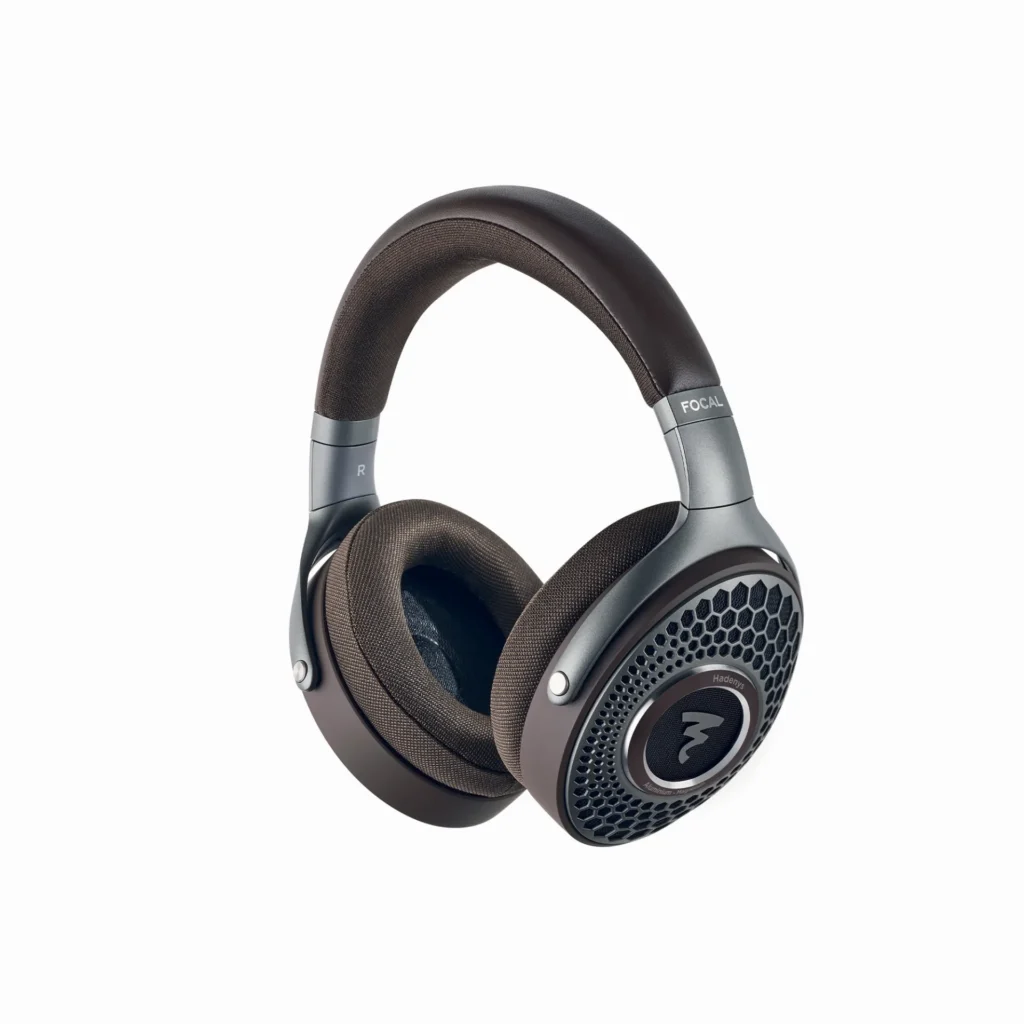
Focal Hadenys is a premium headphone built around a modest-sounding idea: connect a cable, sit somewhere quiet and listen. It leaves Bluetooth, batteries and active noise control to other products. The open enclosure is central to both its appeal and its limitations. This is a candidate for a settled home listening routine, not an all-purpose solution for commuting or a shared office. Its relatively manageable source requirements make the complete system less intimidating than the premium positioning might suggest.
Research-based review. This assessment draws on manufacturer documentation and the original independent evaluations linked below. Audio Review has not performed a hands-on test of this model.
Construction and the home-listening role
Hadenys uses Focal’s aluminium/magnesium M-shaped dome driver in an open-back enclosure. The official specification gives a weight of 294 g and a nominal impedance of 26 ohms. Those figures are useful when planning a system, but should not be treated as a listening verdict. A light headphone can still fit poorly, and an efficient driver can still have a tonal balance you do not enjoy.
The open rear grille means that the room remains part of the experience. Background conversation can compete with quiet passages, and other people may hear your music. The right setting is therefore a private room or a sufficiently quiet corner where leakage will not be a problem. That environmental match is more important than adding increasingly expensive electronics to an unsuitable location.
Comfort and the details that affect ownership
The comparatively low weight is a sensible starting point for longer sessions, but the pads and headband still need to distribute pressure in a way that suits your head. During a demonstration, use your normal glasses and change your posture. The cups should stay stable without needing frequent adjustment, and the pads should not press an ear against the inside surface.
The single-entry removable lead keeps one side of the headphone free of a second cable and allows the lead to be changed if it is damaged. SoundGuys also highlights this practical replaceability. For a desk, check that the length reaches the source without pulling across a keyboard or chair arm. A premium finish is pleasant, but cable routing, replacement pads and a convenient place to put the headphone are the details that tend to decide everyday satisfaction.
Sound quality and the evidence behind it
SoundGuys’ published measurements and listening assessment are broadly positive about the Hadenys’ tuning. Its report describes a substantial part of the bass and midrange as close to the publication’s preference target, while identifying a narrower upper-midrange emphasis. This supports treating it as a serious music-listening option, rather than assuming that an attractive finish is doing all the work.
Our interpretation is that the Hadenys deserves an audition for listeners who want a complete, straightforward tonal balance without treating equalisation as an essential first project. That is a recommendation about suitability, not a claim of personal listening. Try recordings that reveal vocal hardness, cymbal emphasis and bass-note separation for you. A preference target is useful context, but cannot replace your response to the headphone at a normal, sustainable listening level.
Amplification without unnecessary complexity
Focal’s 26-ohm specification, considered alongside the source checks in the independent review, makes Hadenys a relatively approachable load for many ordinary headphone outputs. A clean laptop socket, suitable dongle or desktop device can therefore be a sensible starting point. It is unnecessary to assume that premium headphones must be paired with a large amplifier before they can be assessed.
First establish that the existing source reaches your preferred level without strain, hiss or an inconveniently narrow adjustment range. If it does, use that arrangement while deciding whether you like the fit and tonal balance. An external DAC and amplifier can add useful connections or better physical volume control, but those are identifiable benefits to buy for. The price of the headphone itself does not establish the need for another expensive component.
Open-back listening, calls and concentration
No electronic setting turns Hadenys into a closed commuter headphone. The open construction is a fixed acoustic choice, so it cannot deliver an isolation mode for the train and then return to open listening at home. If your routine moves between very different environments, owning a separate portable product may be more sensible than trying to make one headphone cover everything.
Calls and online meetings also require a separate microphone arrangement because the supplied listening system is not a complete communications headset. A computer can use one device for output and another for microphone input, but the application must select the intended pair. For occasional gaming this can be entirely workable. For someone who wants a single wireless headset with a boom microphone and quick console switching, the product format is simply the wrong starting point.
What to compare before buying
The most useful comparisons control the things that can easily mislead. Use the same familiar tracks, a clean source and similar perceived volume, then allow enough time to notice fit. A slightly louder demonstration often sounds immediately more exciting, which can distort the decision. Do not buy a headphone you find tiring just because one short excerpt sounds impressive.
Also compare the complete cost. A headphone that works happily with your present output may leave more budget for music and comfortable working conditions than a different model that calls for additional hardware in your setup. Conversely, a cheaper model with the right fit can be the better purchase. Hadenys’ value is strongest when its particular presentation and physical design are what you want, rather than when it is bought as a status-led step up.
Long-term use and practical care
A passive design avoids battery wear and reliance on a companion application, but the physical components still age. Pads compress, headbands collect wear and cables can be damaged by chair wheels or sharp bends. Store the headphone so that nothing presses into the grille or driver area, and avoid leaving the lead stretched under tension.
Replacement parts should be considered part of ownership rather than an afterthought. Changing pad type can change the acoustic behaviour, so a visually similar third-party pad is not automatically an equivalent replacement. Before experimenting with accessories, establish a familiar baseline with the supplied configuration. That makes later changes easier to judge and avoids losing track of whether a perceived difference came from the headphone, fit, volume or the recording itself.
Alternatives to consider
Sennheiser HD 600: The HD 600 provides an established open-back reference and a different electrical load. Compare vocal balance and fit using a source capable of driving both cleanly; neither the brand nor the impedance decides the result.
Meze 109 Pro: The 109 Pro is another home-focused dynamic open-back with a distinct fit and construction approach. It is worth comparing in person if long-session comfort and the physical ownership experience matter as much as the published sound assessment.
Focal Hadenys key specifications
- Design
- Open-back, over-ear
- Driver
- 40 mm aluminium/magnesium M-shaped dome
- Nominal impedance
- 26 ohms
- Weight
- 294 g
- Connection
- Detachable single-entry analogue cable
- Source plug
- 3.5 mm; 6.35 mm adapter supplied
- Noise cancellation
- None
- Wireless connectivity
- None
- Primary use
- Quiet-room home listening
Verdict
Hadenys is a strong candidate for a quiet-room listener who wants a premium open-back without building an unnecessarily complicated source chain. The independent tonal evidence is encouraging, the cable is replaceable and the relatively light form is attractive for regular use. A personal fit check remains essential, especially when the alternative models already sound satisfying in your existing system.
Choose it for focused music listening, with the understanding that isolation, wireless convenience and a microphone are outside its brief. Compare the HD 600 and Meze 109 Pro on comfort and tonal preference, then assess current local value rather than launch-price prestige. The most convincing Hadenys system is a simple one that you enjoy using often; expensive accessories are not a substitute for getting that basic match right.
Primary documentation and independent reviews
Focal official Hadenys product information · SoundGuys original Hadenys review and measurements · Focal official Hadenys data sheet
Editorial record
Sources and updates
Product specifications and factual claims were checked against Official Focal Hadenys product page ↗. Scores and buying advice follow our category-specific editorial methodology.
- Published
- November 17, 2026
- Last updated
- November 17, 2026