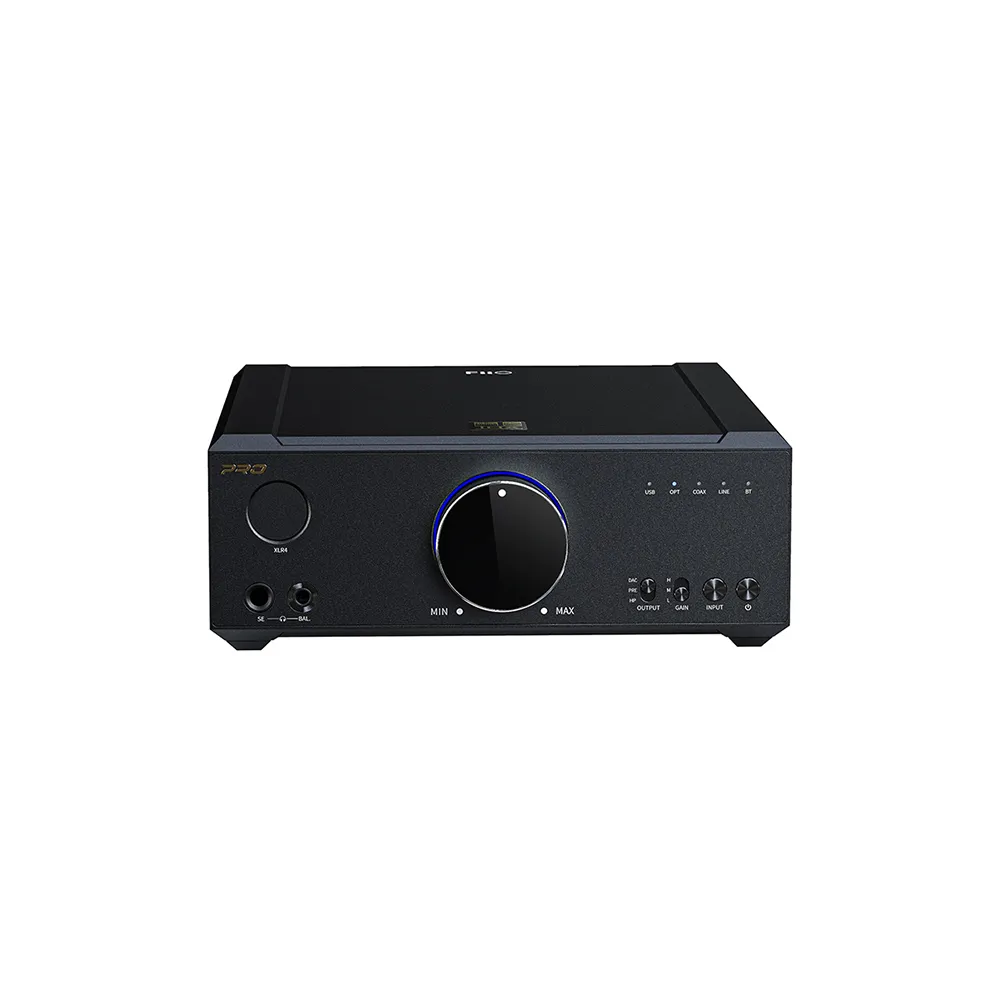
The FiiO K9 Pro ESS puts a DAC, headphone amplifier and line-level control into a single mains-powered desktop enclosure. It is a more substantial proposition than a basic USB headphone box, with analogue input flexibility and several output formats. The ESS suffix is important: this review covers the dual-ES9038PRO version, not the earlier AKM K9 Pro or the later K9 AKM.
FiiO K9 Pro ESS — Build and control layout
A large central dial, physical switches and a ring indicator give the K9 Pro ESS a direct, equipment-like interface. It is designed for a listener who sits close enough to reach the controls. The absence of a large information screen is not necessarily a disadvantage at a desk, but it changes the experience compared with a component intended for use across a living room. Place it where source and gain indications are easy to inspect rather than burying it behind a monitor.
Its mains-powered enclosure also needs deliberate placement. A supplied vertical stand can help where width is limited, but the stand does not remove the need for accessible headphone sockets and clear ventilation. Keep cable weight supported and avoid squeezing the side vents against other equipment. Before connecting the power, confirm that the voltage setting matches the installation. For an EU purchase, checking the exact version, power arrangement and local warranty handling is more useful than assuming all similarly named online listings describe the same package.
Input flexibility and the role in a system
Official specifications include USB, optical, coaxial and Bluetooth receiving, with RCA and 4.4 mm analogue line inputs. RCA and XLR line outputs support a downstream amplifier or active speakers. That makes the K9 Pro ESS more adaptable than a digital-only headphone unit: it can use its own converter or accept an analogue signal from an external DAC. The headphone amplifier need not become redundant if the source arrangement changes later.
The analogue input is for line-level equipment. A turntable requires a phono stage first, and a microphone requires suitable recording hardware rather than a simple adaptor. Likewise, line outputs do not provide the current required by passive speakers. A separate speaker amplifier is still necessary. These limits are worth understanding because the physical size and generous connectivity can otherwise suggest that the K9 Pro ESS replaces more components than it actually does.
Headphone connections and power
The front offers a conventional 6.35 mm output plus 4.4 mm and four-pin XLR balanced headphone connections. FiiO specifies at least 2.1 W into 32 ohms for balanced operation at THD+N below one percent. That indicates useful output capability but remains a manufacturer figure under stated conditions. Compare it only with ratings that describe the same load and distortion threshold; an isolated wattage number can conceal important differences.
Three gain settings help adapt the available range to different headphones. For easy-to-drive models and sensitive earphones, low gain should be the first choice. It is preferable to have a comfortable adjustment range than to run high gain simply because it is available. For a demanding full-size model, check its sensitivity and the level you need on quieter recordings. A connector alone cannot settle compatibility, and a balanced cable is not a universal remedy for an unsuitable pairing.
The separate line outputs broaden the role of the unit, but headphone and speaker listening should still have a clear switching routine. Start at a low level whenever changing equipment or output mode. That simple habit makes a flexible desktop system easier to manage, especially when a sensitive pair of earphones and active monitors share the same source component.
Sound quality and headphone pairing
Headfonics’ original review found the K9 Pro ESS detailed and energetic, with useful definition and strong low-gain performance with sensitive earphones. The same review cautioned that its presentation could be less flattering with already forward or bright headphones. This is useful matching evidence rather than proof of a measured tonal boost. A subjective listening account should not be converted into an invented frequency-response result.
The implication is to choose the headphones first. A listener who already finds a headphone tiring should not assume that a more expensive desktop DAC will soften it. Conversely, a relaxed headphone may be a more comfortable match for a presentation the reviewer perceived as lively. A home comparison, with equal playback levels and familiar material, remains more informative than treating chip families as fixed sound signatures. The ESS name identifies the hardware version, not a guarantee of how every system will be perceived.
For owners of a functioning converter and amplifier, the K9 Pro ESS should solve a clear problem to justify replacing them. Better source access, a more convenient control layout or an appropriate headphone drive arrangement can make the purchase worthwhile. If all those needs are already met, spending on headphone fit, speaker placement or the recordings themselves may bring a more obvious benefit than changing another digital component.
Bluetooth and computer use
Bluetooth receiving offers a quick route from a phone, while wired USB is a natural choice for a permanent computer desk. The product does not transmit Bluetooth audio to wireless headphones. A sending device remains responsible for the programme and the available codec, so check its capabilities before assuming a particular wireless format will be used. The FiiO Control app provides settings access, but that does not make the unit a standalone music player.
Official USB support reaches PCM 32-bit/384 kHz and DSD256. Those limits differ from later models and should be described accurately, but they remain well beyond the requirements of ordinary music libraries. There is no need to turn every track into a maximum-rate stream. Select the intended output device and a sensible playback mode, then confirm stable operation before exploring optional settings. If using processing or EQ, verify which input path supports it rather than assuming app visibility means every source is processed identically.
Line operation, cost and a realistic recommendation
FiiO’s parameter table lists 2.5 V RCA and 5 V XLR line levels. Check the receiving device’s sensitivity and decide where volume will be controlled before using the unit with speakers. An active monitor pair and a conventional integrated amplifier call for different gain arrangements even though both may accept a line-level signal. Begin conservatively and avoid leaving two controls in an unpredictable state.
As an older premium desktop model, its present value depends heavily on the actual offer. Compare EU prices including VAT, support and returns against newer alternatives with the features you need. A low price is less persuasive if the exact version is unclear or the service route is impractical. The K9 Pro ESS remains attractive as a flexible headphone centre, particularly when the analogue inputs are useful. It is less convincing for someone who needs only a compact USB output or expects independent network streaming from the box.
Alternatives to consider
FiiO K17: A newer published desktop option to compare on the complete feature set. Check the functions that affect your routine rather than assuming age alone settles the choice.
RME ADI-2 DAC FS: Consider this when detailed control and processing are central to the purchase. Its appeal is different from simply adding more headphone connector formats.
FiiO K9 Pro ESS key specifications
- DAC configuration
- Two ES9038PRO chips
- USB support
- PCM up to 32-bit/384 kHz; DSD256
- Analogue inputs
- RCA and 4.4 mm balanced line
- Headphone sockets
- 6.35 mm, 4.4 mm and four-pin XLR
- Balanced rated power
- At least 2.1 W at 32 ohms, THD+N below 1%
- Line level
- 2.5 V RCA; 5 V XLR
- Gain
- Low, medium, high
Verdict
A capable and flexible desktop headphone centre with useful analogue inputs, several output options and strong original review evidence. Exact-version checking and careful headphone pairing matter, while current EU pricing determines whether it remains the best value against newer rivals.
Primary documentation and independent reviews
FiiO official K9 Pro ESS parameters · Headfonics original K9 Pro ESS review · Headfonics sound and headphone matching
Editorial record
Sources and updates
Product specifications and factual claims were checked against Official FiiO K9 Pro ESS product page ↗. Scores and buying advice follow our category-specific editorial methodology.
- Published
- November 8, 2026
- Last updated
- November 8, 2026