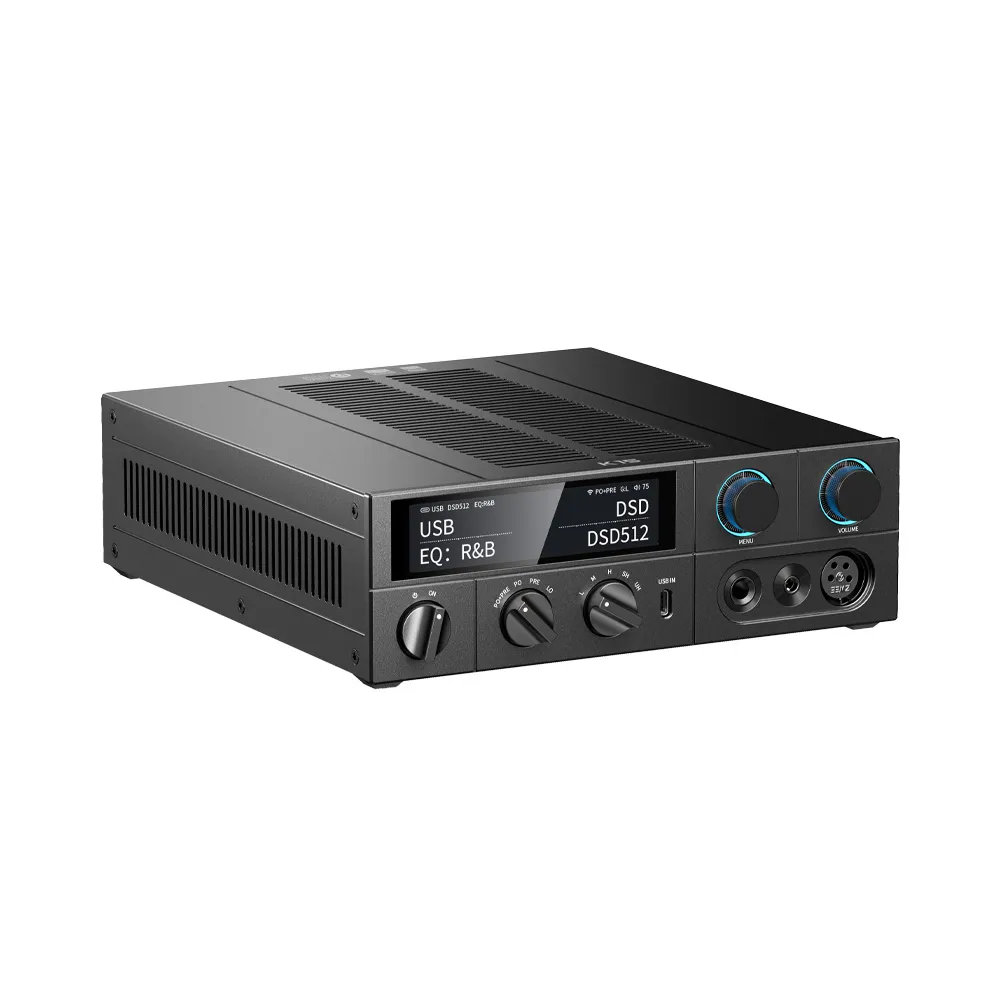
FiiO K15 combines several jobs in a desktop box: digital conversion, headphone amplification, analogue input handling and additional playback modes. That makes it interesting for a desk with more than one source, but also makes the specification easy to overread. A useful assessment needs to separate each signal path, its available processing and the control routine. The K15 should be bought as a practical hub for a known system, rather than because two DAC chips or a large display look impressive in isolation.
Research-based review. This assessment draws on manufacturer documentation and the original independent evaluations linked below. Audio Review has not performed a hands-on test of this model.
What the K15 actually connects
The official parameter list includes USB, optical, coaxial, analogue line and balanced-input modes, alongside Bluetooth, network receiving and local playback. This breadth is the main reason to consider it over a simple USB dongle. A computer, another digital source and an analogue component can potentially share the headphone system without repeated cable swapping.
Map the source and output roles before purchase. A headphone amplifier is not a power amplifier for passive loudspeakers, and a line connection is not a cartridge-level phono input. If speakers are part of the system, establish whether they are powered or require a separate amplifier and decide where volume will be controlled. A flexible desk becomes easier to use when each connection has a defined purpose.
Headphone matching and the published listening evidence
Headfonics’ original evaluation is broadly positive about the K15 as a flexible desktop DAC and amplifier, with useful matching options across headphones and IEMs. Its report supports the product’s role as a capable integrated hub rather than establishing that the DAC architecture alone guarantees a particular sound with every transducer.
Five gain settings allow the available range to be adapted to different headphones. Start with the lowest setting that gives comfortable adjustment and adequate clean level. Higher gain is not automatically a better-quality mode, especially with sensitive earphones. Listen for background noise and whether small volume changes are manageable. The practical goal is a quiet, controllable system with appropriate headroom, not using the most powerful setting simply because it is available.
The important PEQ limitation
FiiO explicitly states that the ten-band PEQ does not process the line input or balanced analogue input. This is a significant distinction if you want one correction profile applied to every source. The presence of both analogue sockets and an EQ menu does not establish that the analogue signal passes through the same processing path as digital playback.
If correcting a turntable or another analogue source is central to your plan, confirm the required signal chain before buying. For supported digital paths, make conservative adjustments and leave headroom when boosting. Save a clear baseline so that comparisons are repeatable. Useful EQ is about making a known correction in the intended mode, rather than assuming that every control applies globally to every input.
Network receiving and local playback expectations
The Wi-Fi and network-receiving modes add flexibility, but a screen is not proof that the unit offers the same application ecosystem as a phone or general-purpose tablet. Check the exact protocol and service workflow you need, including the role of a controller, computer or local storage device. Playback from one supported route does not establish support for every streaming service in the same form.
This can be a strength if you already have a compatible way to send music and want to avoid leaving a computer attached for every session. It can be a disappointment if you expected a particular native app without checking. Test browsing, track selection and volume control as a complete routine. The best sounding output stage cannot compensate for a source workflow you find awkward every time you want an album.
Digital formats and Bluetooth in proportion
The digital input selection and Bluetooth codec support cover several common source types, with the actual wireless codec depending on the sending device. A phone that lacks LDAC or a particular aptX variant does not gain it from the receiver. Likewise, a high-resolution format limit does not tell you whether the music service or file being played uses that format.
For a permanent desk, a stable wired connection can be the simplest baseline. Use Bluetooth when its convenience matters and network playback when the supported workflow is useful. If switching modes creates a problem, check the selected source and operating mode before changing several settings at once. Clear signal-path choices usually produce a more reliable system than treating every available connection as simultaneously equivalent.
Controls, space and value
The display, knob, remote and supported app settings provide several ways to control the K15. Decide which you will actually use and place the unit so the screen and volume control remain reachable. It is a desktop component with a meaningful footprint, so include ventilation and cable bends in the space calculation rather than measuring the front panel alone.
Value is strongest when the broad input and playback package replaces equipment you would otherwise need. If the only source is a computer and your headphones are easy to drive, a simpler device can make more sense. Compare the K17 for the facilities it genuinely adds and the DX5 II for a different integrated approach. The right purchase is the model whose supported paths and controls fit the desk, not the one with the longest feature list.
Alternatives to consider
FiiO K17: The K17 is the direct comparison for a buyer considering the more elaborate FiiO desktop platform. Check processing, inputs and the specific headphones you will use instead of assuming that a similar case and interface make the two models interchangeable.
Topping DX5 II: The DX5 II offers another integrated DAC and headphone-amplifier approach for a desk. Compare the sources, EQ workflow and controls you actually need; the K15’s network and local-playback roles are useful only if they fit the way you listen.
FiiO K15 key specifications
- Type
- Desktop DAC and headphone amplifier
- DAC configuration
- Dual AKM AK4497S
- USB interface
- XMOS XU316
- Digital source modes
- USB DAC, optical and coaxial
- Analogue source modes
- Line and balanced inputs
- Wireless source modes
- Bluetooth receiving and network receiving
- Wi-Fi
- 2.4 GHz and 5 GHz
- Bluetooth codecs
- SBC, AAC, aptX family and LDAC as supported by source
- Gain settings
- Five levels
- PEQ
- 10-band; not active on line or balanced analogue inputs
- Local playback
- Supported
- Display
- 3.93-inch LCD with touch control
- Control
- Knob, display, remote and supported FiiO app settings
- Weight
- Approximately 2.10 kg
- Dimensions
- Approximately 244.6 × 213 × 66.8 mm
Verdict
K15 is an attractive multi-source headphone hub when its combination of conversion, amplification, analogue input handling and additional playback modes is useful. The published independent assessment is encouraging, and the gain and control options make it adaptable to more than one listening arrangement.
The main qualification is to verify the intended workflow. PEQ does not process the analogue inputs, network receiving is not a promise of every service interface, and headphone amplification does not power passive speakers. Compare the K17 and DX5 II against those actual requirements. Choose the K15 when it makes the complete desk simpler and more flexible, rather than buying a collection of specifications that will mostly remain unused.
Primary documentation and independent reviews
FiiO official K15 technical parameters · FiiO official K15 product information · Headfonics original K15 review · Headfonics original K15 system matching and comparisons
Editorial record
Sources and updates
Product specifications and factual claims were checked against Official FiiO K15 product page ↗. Scores and buying advice follow our category-specific editorial methodology.
- Published
- November 17, 2026
- Last updated
- November 17, 2026