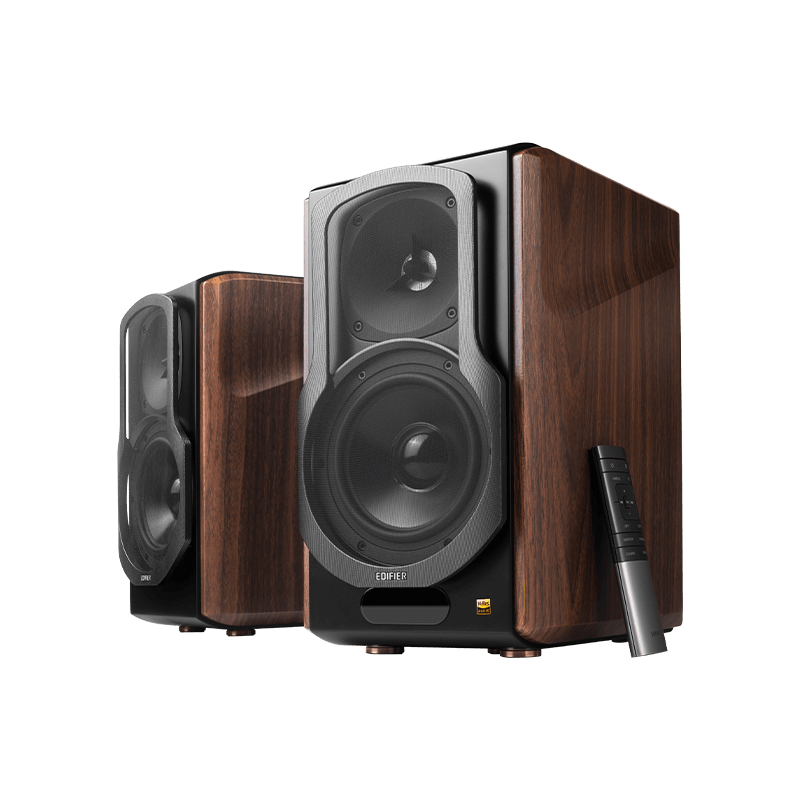
Edifier S2000MKIII is a powered stereo speaker pair for home listening, with built-in amplification, Bluetooth and several wired inputs. Its planar-diaphragm tweeters and substantial cabinets distinguish it from basic computer speakers, but it remains important to understand the connection brief. There is no built-in network streaming platform or HDMI ARC, so its strengths are best approached as a conventional stereo system with convenient wireless phone playback.
Research-based review. This assessment draws on manufacturer documentation and the original published evaluations linked below. Audio Review has not performed a hands-on test of this model.
A complete amplification arrangement, not cable-free speakers
The right cabinet houses the system’s connections and controls, and a supplied cable links the speakers. Built-in amplification removes the need for a separate speaker amplifier, but the pair still requires a planned physical layout.
Choose two stable positions with a useful distance between them and a clear path toward the listening seat. Check cabinet depth, rear connections and the route of the linking cable rather than only measuring the available shelf width. If the speakers will sit on a desk, leave room for the work surface and screen without pushing the cabinets into corners merely to make everything fit. The convenience of powered speakers is most valuable when it simplifies an already workable layout, not when the lack of a separate amplifier hides an unsuitable placement compromise.
The listening mode changes the recommendation
Audio Appraisal’s original evaluation prefers Monitor mode for a more natural, coherent presentation and useful detail. It finds Dynamic mode more suitable at low level, becoming overbearing at higher volume, while Vocal and Classical offer different deliberate tonal priorities. The mode choice is therefore part of the sound assessment, not a decorative menu option.
Start with a familiar recording and try the modes at similar perceived loudness. A dramatic increase in bass and treble may be useful for one listening situation yet less appealing for another. Return to the normal setting after experiments so another household user does not unexpectedly encounter a radically different balance. The mode called Monitor should be understood as a voicing choice; it is not a certificate that the speaker is a calibrated studio reference in your particular room.
Bass and stereo judgement in the actual room
The original review is positive about bass depth and the stereo presentation with the speakers on stands. It still treats the S2000MKIII primarily as a home-audio product rather than recommending it as a substitute for purpose-designed recording monitors.
Listen to bass lines that move through several notes, not only one impressive impact. Check whether the balance stays consistent from the main seat and whether voices remain clear when music becomes dense. If the room adds excessive weight, experiment with practical positioning and tone settings before deciding that more bass is automatically better. For recording work, compare requirements such as balanced connections, working distance and system calibration with appropriate monitor alternatives. A pleasing music system and a dependable production reference can overlap, but they are not identical purchasing briefs.
Digital inputs are for supported PCM
The manual specifies standard PCM operation over optical and coaxial. The connection list does not include HDMI ARC or USB computer audio. A television or computer therefore needs an appropriate output route rather than merely an available cable socket.
For a TV, check its digital-audio settings and test external sources as well as built-in applications. For a computer, choose an appropriate analogue or digital output and keep the volume-control path understandable. An optical connection is not evidence of Dolby Atmos decoding, and an HDMI-only console cannot be plugged directly into these speakers. If television is the principal job, compare the convenience of a soundbar before assuming stereo music strengths will compensate for an awkward daily control arrangement. Compatibility should be confirmed with the complete source chain.
Bluetooth convenience without a network promise
The official specification includes Bluetooth 5.0 and aptX HD support. That codec also requires a compatible source; its presence on the speaker does not make every phone use it, nor does it establish mathematically lossless playback.
Try pairing and reconnection with the device actually used for music. If several people will share the speakers, make sure they understand how to select the input and release an existing connection. For a permanent music source, a wired route may be simpler than repeatedly handling phone connections. If independent network playback and service integration are essential, compare a system that includes those features or cost a suitable separate streamer deliberately. Adding a streaming source can be sensible, but it should be part of the planned system price rather than an assumption that Bluetooth and Wi-Fi are interchangeable.
Remote operation and long-term value
The remote and front display make input and mode selection more visible than on a speaker pair with only a tiny status light. Analogue connections remain line-level inputs, so a turntable still needs an appropriate phono stage in the signal path.
During setup, test the complete everyday routine: power on, choose a source, adjust volume and change the sound mode. Check operation from the normal seat, not only at arm’s length beside the cabinet. With used stock, confirm that the remote and speaker-link cable are included and obtain replacement costs if necessary. Compare the whole package with smaller powered speakers and with separates offering the same sources. S2000MKIII is most convincing when its substantial stereo arrangement and adjustment options are genuinely useful, while its missing network and HDMI facilities do not require inconvenient workarounds.
Alternatives to consider
KEF LSX II: LSX II offers a different network-speaker route. Compare the value of integrated streaming and the physical layout rather than assuming the larger Edifier cabinets and smaller KEF system answer exactly the same need.
Audio Pro C20 W: C20 W suits a different one-box arrangement. Consider it if separate speaker positions are impractical, while recognising that a single enclosure is not the same physical stereo layout as the Edifier pair.
Edifier S2000MKIII key specifications
- System
- Powered stereo pair
- Drivers
- 5.5-inch aluminium mid/bass and planar-diaphragm tweeters
- Rated amplification
- 130 W RMS total
- Wireless input
- Bluetooth 5.0 with aptX HD support
- Wired inputs
- Two RCA line pairs, optical and coaxial
- Digital input formats
- Supported PCM at 44.1, 48, 96 or 192 kHz
- Listening modes
- Monitor, Dynamic, Classical and Vocal
- Controls
- Remote, volume and tone controls; front display
- Wi-Fi / HDMI ARC
- Neither
- USB computer audio
- No
- Speaker link
- Supplied interconnect required
- Power source
- AC mains
- Cabinet dimensions (W × H × D)
- 200 × 350 × 294 mm active speaker and 200 × 350 × 279 mm companion speaker (Edifier China specification)
Verdict
S2000MKIII offers a persuasive home-stereo combination of useful wired inputs, Bluetooth and adjustable voicing. The original listening evaluation is particularly encouraging in Monitor mode, while making clear that the different presets alter the result meaningfully.
Choose it for music listening in a layout that gives both cabinets room to work. Verify TV or computer output requirements and include any phono stage or streamer in the budget. Its value rests on a coherent, usable complete system, not on confusing a mode name with professional calibration or a Bluetooth connection with a full network platform.
Documentation and original reviews
Edifier official S2000MKIII product and amplification information · Edifier official S2000MKIII user manual · Audio Appraisal original S2000MKIII listening and mode evaluation
Editorial record
Sources and updates
Product specifications and factual claims were checked against Official Edifier S2000MKIII product page ↗. Scores and buying advice follow our category-specific editorial methodology.
- Published
- November 17, 2026
- Last updated
- November 17, 2026