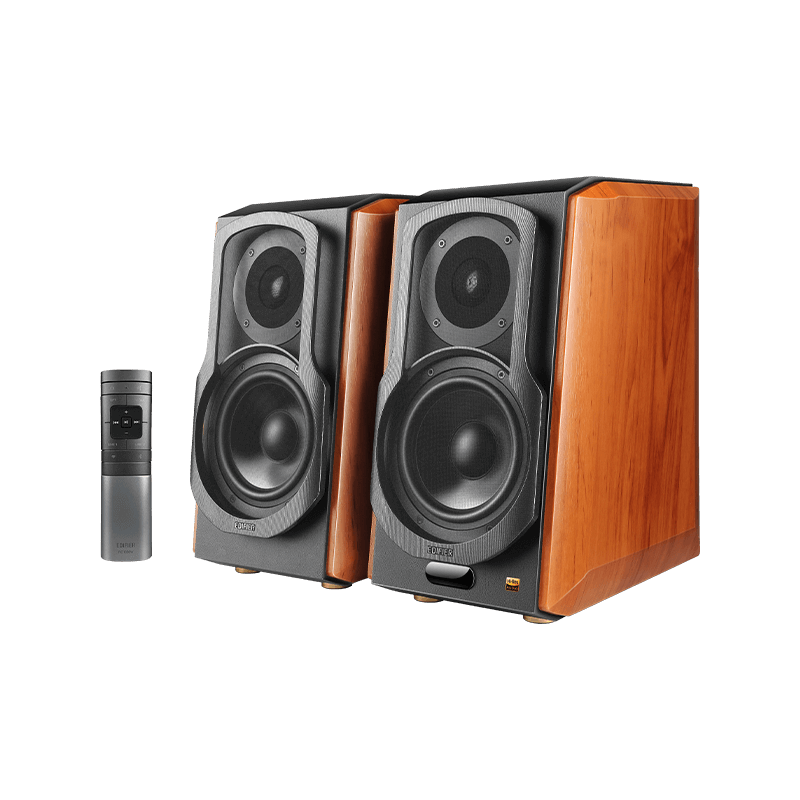
Edifier S1000W combines powered stereo speakers with Wi-Fi streaming, Bluetooth and several conventional inputs. It is more substantial than a small desktop accessory, and its appeal depends on having room to position two fairly large cabinets sensibly. For a listener mixing streamed music, a wired player and occasional television sound, it offers a useful middle route between a basic Bluetooth pair and a more elaborate separates system.
Research-based review. This assessment draws on manufacturer documentation and the original published evaluations linked below. Audio Review has not performed a hands-on test of this model.
A stereo pair needs a stereo layout
The system places amplification and connections in the right cabinet, with a cable linking the left speaker. The wireless description concerns source connectivity; it does not remove the link between the two cabinets or the need for mains power.
Decide where both speakers will sit before counting input sockets. Allow space for a useful separation and for the cabinets to face the listening area without being hidden behind a monitor or television. A pair squeezed together on one shelf gives up much of the practical reason for choosing separate speakers. Check the support surface, depth and cable route as well as front-facing width. A larger enclosure can be worthwhile in a living room but inconvenient on a shallow desk, especially when the rear panel must remain reachable for controls and connections.
Sound benefits from deliberate adjustment
SoundGuys’ original test finds the default presentation bass- and treble-forward, with some material making the extremes too prominent. It reports that using the physical tone controls helps rein in that emphasis and regards the overall result positively once space and setup are considered.
Begin with familiar music at an ordinary level, then adjust one control at a time. A setting that gives a dramatic first impression may make voices seem less prominent over an album. Compare a sparse vocal track with a busy arrangement and check the result from the normal seat. The goal is a balance that works across the music you enjoy, not the most immediately impressive bass note. Keep a note of a preferred setting so experiments are easy to reverse, and revisit it after a significant placement change rather than assuming the same adjustment suits every room.
Network music is its useful extra layer
The official product information lists AirPlay 2, Spotify Connect and TIDAL Connect alongside Bluetooth. Network setup uses Edifier Home, while the speaker’s wired inputs provide another way to keep the system useful with conventional sources.
Confirm the service, phone and household network before deciding that the system is effortless. Try reconnecting after normal standby and check that another regular user can select music without rebuilding the setup. Network convenience is more valuable when it works within an established listening routine than when it merely appears as a collection of logos. If most playback will come from a fixed wired player, decide how much value the streaming layer adds. If streaming is the principal role, give application usability and reliable network operation the same attention as an impressive cabinet finish.
Television use requires PCM and control planning
The manual specifies supported PCM signals for optical and coaxial playback. There is no HDMI ARC connection, so the S1000W should be planned as a stereo speaker system receiving a suitable TV output, not as an Atmos soundbar.
Check the television’s digital-audio settings and test each source normally used. A built-in application and an external player may behave differently, so one successful test is not a complete compatibility check. Also establish how volume will be controlled from the sofa. The supplied remote can be useful, but the chosen connection does not automatically reproduce the everyday control experience of a dedicated HDMI soundbar. If the purchase is mainly for television, compare dialogue clarity, switching and household convenience alongside the potential benefit of separate stereo cabinets.
Vinyl and bass expansion need separate thought
The RCA inputs accept line-level sources. A turntable needs a suitable phono stage, either built into the turntable or provided separately. The speakers also lack a dedicated wired subwoofer output, which matters if deeper bass expansion is part of the long-term plan.
Trace the complete vinyl path before purchase: cartridge, phono stage, line output and speaker input. Do not connect a low-level cartridge signal and expect a different volume setting to replace the missing stage. For bass expansion, avoid assuming every extra subwoofer will integrate neatly with every input and volume-control route. If a subwoofer is already an essential requirement, compare systems designed with appropriate output and management facilities. A speaker pair is better value when it already meets the intended brief than when several accessories are later needed to work around an overlooked limitation.
Size, access and the complete price
SoundGuys highlights the cabinet depth and the need to reach around the active speaker for tone adjustments. Those are practical qualifications to its otherwise broad connectivity. The pair is intended for an indoor home system rather than portable use.
Measure the actual location, including plugs and a comfortable route to the controls. If stands are necessary, include them in the budget and choose appropriate stable supports. Compare the total with smaller powered systems and with an amplifier-plus-speaker arrangement that meets the same input needs. The latter may offer different upgrade options but also adds boxes and wiring. S1000W is most attractive when its built-in features reduce real complexity, while leaving enough freedom to position the speakers properly and use them often.
Alternatives to consider
KEF LSX II: LSX II is worth comparing when a smaller network stereo system better fits the room. Compare the inputs and full purchase cost as carefully as the difference in cabinet size.
Audio Pro C20 W: C20 W provides a different one-enclosure approach. Decide whether separate stereo placement is possible before choosing between a pair of speakers and a system that occupies one location.
Edifier S1000W key specifications
- System
- Powered stereo pair
- Drivers per speaker
- 5.5-inch mid/bass and 1-inch titanium tweeter
- Rated system amplification
- 120 W RMS total
- Wireless inputs
- Wi-Fi and Bluetooth
- Network music
- AirPlay 2, Spotify Connect and TIDAL Connect
- Wired inputs
- Two RCA line pairs, optical and coaxial
- Digital TV requirement
- Supported PCM signal
- HDMI ARC
- No
- Phono input
- No
- Dedicated subwoofer output
- No
- Controls
- Remote, Edifier Home and rear controls
- Net weight
- 16.77 kg
Verdict
S1000W is a flexible powered stereo option for listeners who have the room and want network music alongside conventional sources. The original test supports a satisfying result with thoughtful tone adjustment rather than a claim of perfectly balanced sound in every placement.
Confirm cabinet space, PCM TV output, volume control and any turntable stage first. Choose it for the complete stereo arrangement it provides today, with its missing HDMI and subwoofer output understood. That makes for a stronger purchase than treating the wireless label as a promise that every source and future expansion will work without planning.
Documentation and original reviews
Edifier official S1000W product and input specifications · Edifier official S1000W user manual · SoundGuys original S1000W sound and usability test
Editorial record
Sources and updates
Product specifications and factual claims were checked against Official Edifier S1000W product page ↗. Scores and buying advice follow our category-specific editorial methodology.
- Published
- November 17, 2026
- Last updated
- November 17, 2026