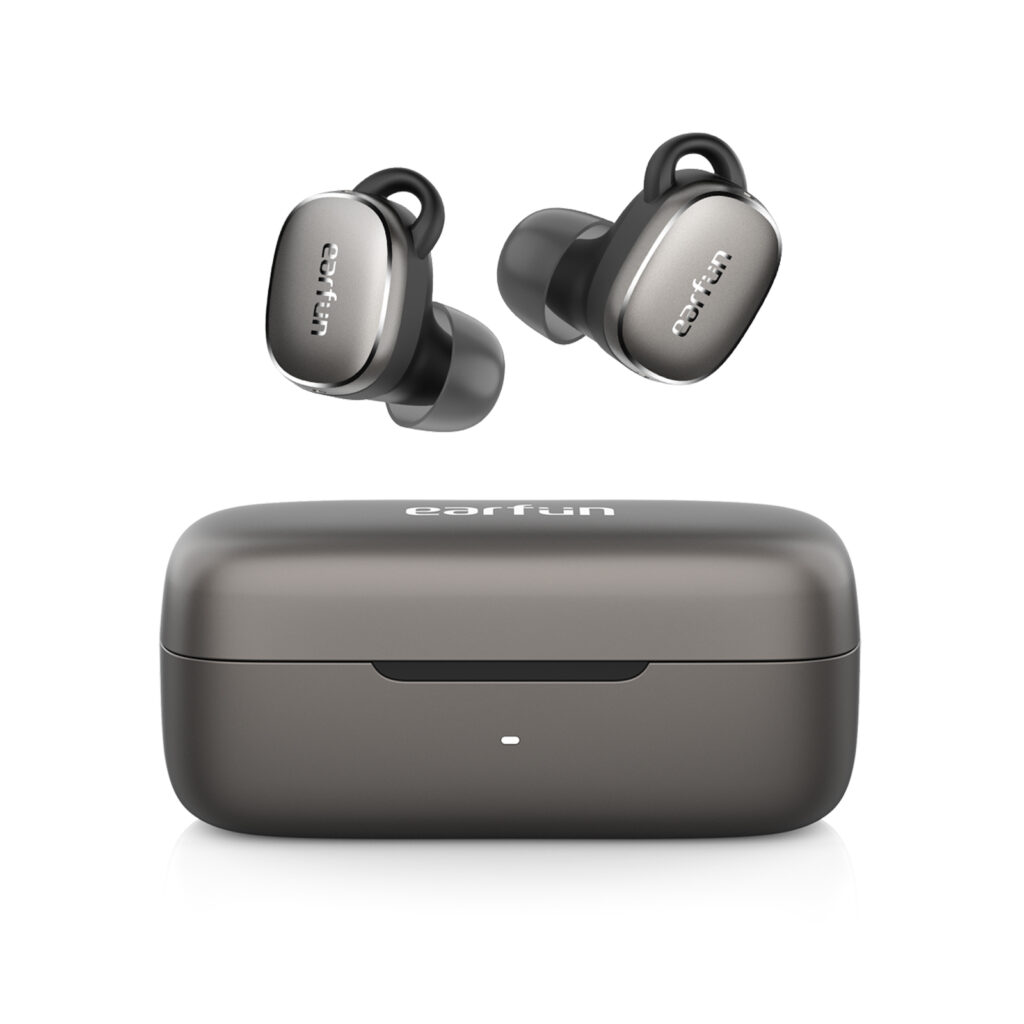
EarFun Free Pro 3 takes a compact approach to affordable ANC earbuds. Stabilising fins and several tip options help distinguish it from stem-shaped competitors, while EarFun Audio provides useful adjustment of sound and controls. The original test finds plenty to like for the price but identifies a bass-heavy default balance, limited endurance relative to the longest-lasting rivals and ordinary microphone performance. It is a practical candidate for a listener who values fit and adjustability more than an effortless all-day single charge.
Research-based review. This assessment draws on manufacturer documentation and the original published evaluations linked below. Audio Review has not performed a hands-on test of this model.
The compact shape is only part of the fit
A small housing and stabilising fin can make an earbud feel secure, but the result depends on matching both the tip and the fin to the ear. SoundGuys’ original tester obtained a useful seal with the supplied foam tips. That is a fitting option rather than a guarantee that the same tip will suit everyone.
Try each ear separately and avoid assuming both sides need an identical size. Check whether the fin stabilises the body without creating a pressure point after a longer session. Gently move the jaw and turn the head while listening for loss of bass. A seal that works only while sitting perfectly still may be unsuitable for the intended activity. Fit deserves attention before evaluating equalisation or noise cancellation, because an inconsistent mechanical seal can make those functions seem less predictable than they are.
A bass-heavy baseline that can be adjusted
The original SoundGuys review describes too much low-frequency emphasis in the default tuning and obtains a more suitable result through the app equaliser. It still regards the overall sound as credible for the price. That supports a recommendation for listeners willing to make a deliberate adjustment, rather than an assumption of neutral playback straight from the case.
Begin with familiar music in the noise mode you expect to use. Reduce a little bass if it obscures voices or the line of an instrument, then compare with the untouched setting. Avoid fixing an uncertain seal by applying extreme boosts. A useful preset should remain comfortable across several recordings, not make one demonstration track spectacular. For a listener who enjoys a full low end during commuting, the starting balance may already be closer to the desired result.
Useful ANC without premium expectations
SoundGuys finds worthwhile noise reduction for the price while keeping the result below the strongest premium alternatives. The seal still matters, especially for sounds the active system does not remove as effectively. EarFun’s maximum cancellation claim should not be treated as equal attenuation at every frequency.
Test the earbuds against the kinds of noise encountered every day. A reduction in steady rumble may be enough to make a journey more comfortable even when nearby speech remains audible. Keep volume at a comfortable level rather than using music to force the remaining noise out of attention. Ambient mode has a different purpose and should be checked separately. It can be useful for interruptions, but if clear communication is required, pausing and removing the earbuds may be the more reliable routine.
Codec support and two-device use
The documented advanced codec is aptX Adaptive, with the result dependent on a compatible source. A successful Bluetooth connection does not show that this mode is available or selected. Do not assume a phone supports it merely because it uses Android or has a recent Bluetooth version.
Two-device connectivity can be helpful for a phone and computer. Try the actual call software and playback handover before relying on it for a working day. Multipoint is a switching convenience, not a way of combining two independent music streams. If a low-latency mode is important, evaluate the complete application and source combination. A favourable advertised number for one part of the connection cannot establish the total delay seen and heard in every game or video workflow.
A sensible endurance plan for compact earbuds
EarFun lists different single-charge maxima with ANC enabled and disabled, plus a case-inclusive total. SoundGuys reports four hours and fifty-eight minutes in its battery benchmark. The test is useful evidence for planning, while its specific settings and the owner’s real use can differ.
Think in terms of uninterrupted time rather than the total available through several case recharges. A short commute with a charging break presents a different requirement from a long flight. Calls, codec choice and listening level may change the interval. USB-C and wireless case charging offer convenient ways to replenish the system between uses. Neither allows an exhausted earbud to keep playing while it is being worn. Leave a margin if the session length is important, and compare other models if frequent long travel is the main task.
Microphones, care and the current value case
The original microphone assessment is qualified, particularly with incidental noise and wind. An earbud that sounds good for music should not automatically become the first choice for critical outdoor calls. Test a real conversation through the intended application and ask the other person about intelligibility.
The earbud water rating does not make the charging case a place for wet storage. Dry the earbuds appropriately before charging and inspect the contacts if charging becomes inconsistent. For an older model, consider seller support, returns and the price gap to newer alternatives. A low price can be attractive when the compact fit is right and the limited endurance is acceptable. The strongest reason to choose Free Pro 3 is a successful combination of fit, sound adjustment and everyday practicality, not a belief that every advanced codec or microphone claim will improve every use.
Alternatives to consider
Soundcore P40i: P40i offers a different affordable form and everyday package. Compare tip comfort, endurance in similar modes and actual call results rather than assuming the higher maximum battery figure describes every session.
TOZO NC9 Pro: NC9 Pro is another budget feature comparison. Decide whether the Free Pro 3 compact shape and fins fit better, then compare sound and control convenience on the same phone.
EarFun Free Pro 3 key specifications
- Design
- Sealed true wireless in-ear with stabilising fins
- Driver
- 7 mm dynamic
- Bluetooth
- 5.3
- Advanced codec
- aptX Adaptive with compatible source
- Noise control
- Hybrid ANC and ambient mode
- Multipoint
- Two-device connection
- App
- EarFun Audio with EQ and control settings
- Water resistance
- IPX5 earbud rating
- Charging
- USB-C and wireless case charging
- Playback claim
- Up to 7.5 h ANC off / 6 h ANC on
- Case-inclusive claim
- Up to 33 h
Verdict
Free Pro 3 remains a useful affordable candidate for someone who prefers a compact shape with stabilising fins and is happy to use the app. The original test supports its price-relative appeal while giving clear reasons to adjust expectations for battery life and calls.
Establish a secure fit, try a moderate bass adjustment if needed and verify the actual source connection. It can be a satisfying short-session everyday pair at the right current price. A buyer who needs consistently long uninterrupted playback or dependable speech in difficult outdoor conditions should compare alternatives before deciding.
Documentation and original reviews
EarFun official Free Pro 3 features, codec and battery specifications · SoundGuys original Free Pro 3 fit, battery and sound evaluation
Editorial record
Sources and updates
Product specifications and factual claims were checked against Official EarFun Free Pro 3 product page ↗. Scores and buying advice follow our category-specific editorial methodology.
- Published
- November 17, 2026
- Last updated
- November 17, 2026