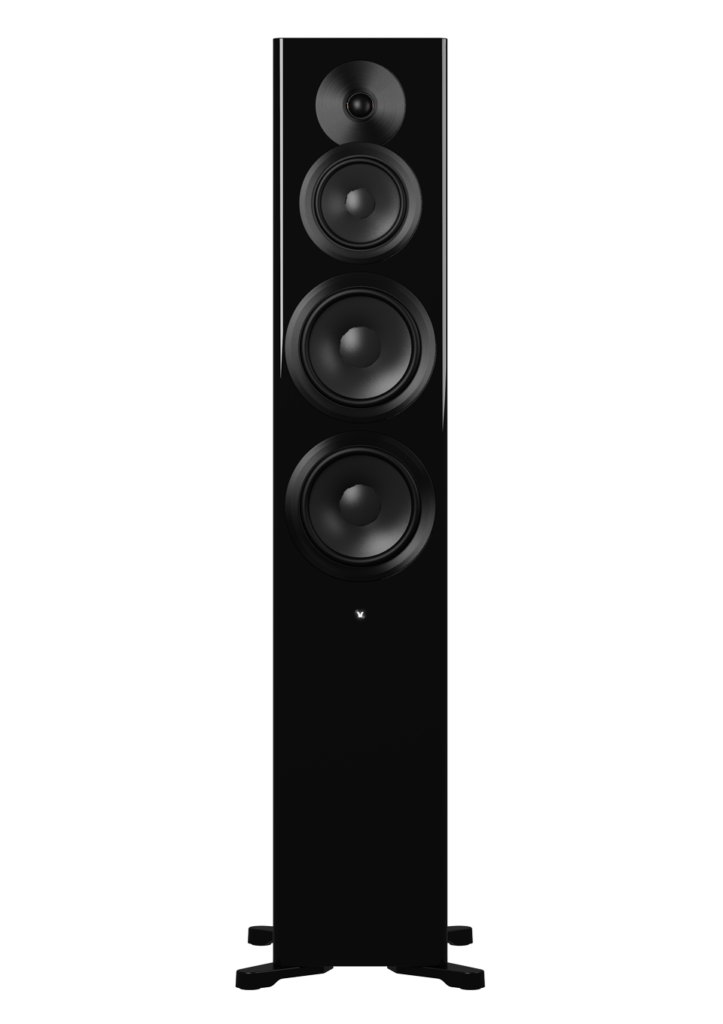
Dynaudio Focus 50 is a substantial three-way active stereo system that places streaming, digital processing and amplification inside two floorstanding speakers. It aims to provide the capability of a serious hi-fi installation with fewer separate components. A dedicated midrange and two bass drivers distinguish it from the smaller Focus models, while optional Dirac Live adds a measured room-integration route. Original listening evidence is strongly positive, but the size, expense and exact connection requirements make it a purchase to plan as a complete installed system.
Research-based review. This assessment draws on manufacturer documentation and the original published evaluations linked below. Audio Review has not performed a hands-on test of this model.
Three-way design and the amplifier count
The official design uses three amplifier channels per speaker. The tweeter and midrange have their own channels, while the two bass drivers share one amplifier and operate in parallel. It would be inaccurate to give each woofer a separate full amplifier rating simply because there are four physical drivers.
More importantly, the component ratings are not directly comparable with the continuous stereo output of an unrelated integrated amplifier. The Focus electronics and drivers form a coordinated active system. Judge whether that system provides clean, enjoyable playback at the required distance and level. A large summed wattage is neither a listening test nor a reason to assume unlimited deep bass at every output. The three-way layout is a meaningful design distinction, but the value comes from the result in a real room rather than arithmetic applied to the brochure.
A large presentation supported by original listening
Twittering Machines’ original evaluation is enthusiastic about bass scale, the handling of dense music and the physical presence of quieter voices and instruments. The reviewer uses the system over an extended period and also explores Dirac. That is strong published support for an audition, without becoming a claim that Audio Review has repeated the listening work.
Try contrasting material: an intimate voice, a complex arrangement and music with sustained low-frequency energy. Listen for whether the room supports that scale or makes the bass dominate. A premium system should remain convincing at ordinary levels as well as during an impressive demonstration. Match volume carefully against another candidate and allow enough time to judge involvement. A large sound is useful when it serves the music and the space, not simply when it makes the first track feel spectacular.
Room optimisation and the optional measured route
Dynaudio provides placement and tonal settings, while Dirac Live adds measurement-based correction through the appropriate licence and calibrated microphone setup. The two approaches should not be conflated. A ready-to-use placement preset does not measure the room, and Dirac readiness does not mean every required item is included in a speaker offer.
For a purchase at this level, a dealer-assisted home setup can be valuable. Establish the physical layout first, then assess correction at comparable level with familiar music. Keep a clear baseline and use a target appropriate to the room and preference rather than copying another reviewer’s result. If buying used with an activated licence, confirm the serial-linked transfer process described by Dynaudio. Room correction can be an important strength when it is actually available and configured, rather than an assumed benefit that never becomes part of the installation.
Streaming, updates and the everyday control routine
The primary speaker includes network and source functions, with Wi-Fi, Ethernet and compatible streaming routes. The official 2025 update adds Qobuz Connect and expands practical controls, so an early review’s feature list does not describe every current software detail.
Demonstrate the service used most often, queue changes, volume control and recovery from standby. Check whether the app and remote arrangement is comfortable for everyone who will use the system. A premium active pair should reduce everyday friction, not create a sequence that only one technically confident owner understands. Ethernet may be a practical network choice when the cable route is available, while Wi-Fi can make another placement easier. The useful standard is stable access to the actual library and accounts, not the largest possible number of supported logos.
Television, vinyl and service sockets
There is no built-in HDMI input. Dynaudio’s WiSA TV guidance requires suitable transmitter hardware, so a readiness label on a television is not sufficient by itself. The analogue input expects a line signal, and the USB connections are for service rather than general computer audio.
Confirm the exact TV arrangement and test ordinary input switching and synchronisation. For vinyl, use an appropriate phono stage unless the turntable already supplies line output. These extra parts affect the complete cost and the promise of fewer boxes. Do not remove a working previous system until every essential source has a verified route. The Focus 50 can be flexible without being a universal replacement for every function of an AV receiver or computer DAC. Choosing the correct architecture begins with the owner’s sources and habits, not with the assumption that an expensive active system must include every input.
Space, service and the complete purchase
Each speaker is a substantial object, and the final footprint includes the supporting feet. Plan delivery, safe handling, cable access and the listening layout. A larger cabinet should not be squeezed into an unsuitable corner merely because the electronics eliminate a separate equipment rack.
Ask about repair support for the active modules and verify both cabinets thoroughly with used stock. Include any Dirac setup, TV transmitter, phono stage and subwoofer plan in the comparison. Current firmware also affects subwoofer integration, so use the relevant instructions rather than an old fixed recipe. The system can be an elegant alternative to separates when the complete arrangement works. Its long-term value is less persuasive if the room cannot accommodate the scale, the essential source needs remain uncertain or the owner strongly prefers the freedom to replace amplification independently.
Alternatives to consider
KEF LS50 Wireless II: LS50 Wireless II is useful when deciding whether a smaller active system would already meet the room’s needs. Include stands and any subwoofer rather than comparing a standmount pair’s bare price with the complete floorstanding installation.
Naim Uniti Atom: Uniti Atom with suitable passive speakers represents a different system architecture. Compare total cost, placement, control and preferred sound; the attraction is flexibility of separate speaker choice rather than an automatic performance ranking.
Dynaudio Focus 50 key specifications
- System
- Active streaming floorstanding stereo pair
- Cabinet
- Sealed, three-way DSP crossover
- Tweeter
- 28 mm Cerotar soft dome
- Midrange
- 15 cm MSP
- Bass drivers
- Two 18 cm MSP per speaker
- Amplification per speaker
- 110 W tweeter, 280 W midrange, one 280 W channel shared by the bass pair
- Primary inputs
- RCA stereo line, optical and coaxial digital
- Network
- Wi-Fi and Ethernet
- Interspeaker audio
- WiSA up to 24-bit / 96 kHz or coaxial up to 24-bit / 192 kHz
- USB
- Service only
- Room correction
- Optional Dirac Live with licence and measurement setup
- Weight
- 33.5 kg per speaker
- Dimensions (W × H × D)
- 215 × 1140 × 305 mm per speaker
- Power supply
- 100–240 V AC, 50/60 Hz
Verdict
Focus 50 is an ambitious active stereo system with strong original listening support for scale, detail and musical engagement. Its dedicated midrange, integrated streaming and room-adjustment route make it a serious alternative to a collection of separate components.
Treat installation and source verification as part of the purchase. Include optional calibration costs, understand the television transmitter requirement and arrange safe handling for the heavy cabinets. For a buyer who prefers a coordinated active system and has the right room, it can be deeply appealing. A complete home comparison is more persuasive than any isolated driver or power specification.
Documentation and original reviews
Dynaudio official Focus 50 driver, amplifier and connection specifications · Dynaudio official Focus operation and connection manual · Dynaudio Focus Dirac licence clarification · Dynaudio Focus WiSA television transmitter clarification · Dynaudio 2025 Focus firmware and subwoofer-management update · Twittering Machines original Focus 50 listening and room-correction evaluation
Editorial record
Sources and updates
Product specifications and factual claims were checked against Official Dynaudio Focus 50 product page ↗. Scores and buying advice follow our category-specific editorial methodology.
- Published
- November 17, 2026
- Last updated
- November 17, 2026