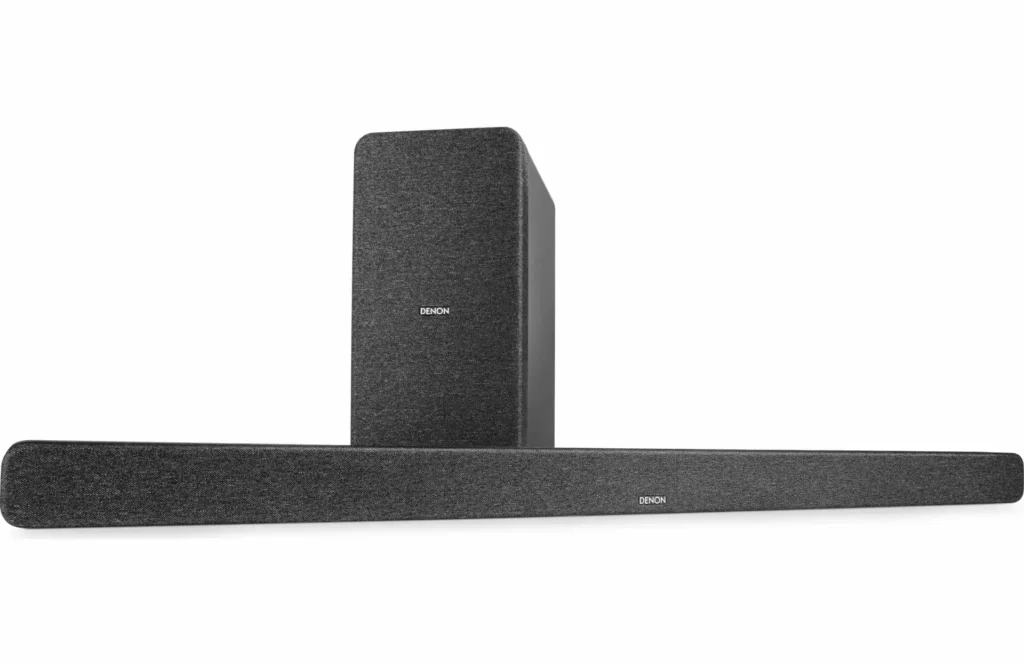
Denon DHT-S517 pairs a 3.1.2 soundbar with a supplied wireless subwoofer, adding physical up-firing drivers and a dedicated centre to a relatively straightforward system. A source HDMI input is a practical advantage over bars that rely entirely on the television’s return channel. It is not a HEOS network speaker or a full rear-surround package. This research-based review separates those useful facilities from the more qualified original listening evidence, particularly around bass control and the reach of height effects in a real room.
Research-based review. This assessment draws on manufacturer documentation and the original published evaluations linked below. Audio Review has not performed a hands-on test of this model.
Useful midrange and scale, with bass reservations
AVForums’ original test favours a broad, organised front stage and convincing vocal projection. It is less positive about the subwoofer’s control and integration, and finds the height impression modest. The reviewer also hears a harder presentation at higher levels. Those findings make normal-volume dialogue and bass transitions more useful audition material than a dramatic demonstration alone.
Start with a familiar scene that moves between speech, ambience and effects. Check whether the bass supports the main bar or attracts attention as a separate sound. Reducing its level may improve balance, but should not be assumed to change every aspect of bass character. Then compare quieter music and ordinary television. A two-piece system should remain enjoyable when it is not being asked to demonstrate maximum impact. The Denon has a credible simple-film role, but the evidence does not justify an unconditional recommendation based only on its physical height drivers. Hear the complete package against another current option and judge the aspects that matter most to the household.
Real height hardware still needs realistic expectations
The official European information sheet documents dedicated front channels and two upward-firing speakers. This is a physical height approach rather than a purely virtual one, but there are no rear speakers supplied. The location of each component remains important to the spatial result.
Keep the upward paths clear and avoid enclosing the bar beneath a shelf. Follow the placement instructions and assess appropriate material from the actual seats. A different ceiling, listening distance or open-plan room may produce a different result from a review environment. Physical up-firing hardware is a useful distinction, not a guarantee of precise overhead localisation everywhere. If sound clearly behind the listener is a priority, compare a documented complete surround installation before purchase. The DHT-S517 is a simpler front-and-bass arrangement. That may be the right compromise for a shared room, provided its limitations are understood. Do not assume that any Denon-branded wireless speaker can be added as a rear simply because the company also sells networked home-audio equipment.
The HDMI input helps, but formats still matter
Alongside the eARC/ARC television output, the bar has a source HDMI input, optical and analogue connections. Denon’s manual documents Dolby and PCM support rather than DTS decoding. That is important for a disc collection or external player, even when ordinary streaming television works without difficulty.
List the sources and decide which benefits from a direct connection to the bar. Check the television-return route separately for internal apps and equipment attached to the display. Confirm both the picture mode and expected audio format with the actual player settings. Avoid assuming that one working soundtrack establishes support for every disc or service. A supported source conversion setting may be useful, but it should meet the actual requirement rather than conceal an unexamined limitation. Optical is a practical route for older displays, with different format boundaries. Test synchronisation, standby recovery and normal remote volume control before finalising the installation. The input is a genuine convenience when it solves a source problem, but a clear signal plan remains more valuable than a socket count.
Simple control instead of a network platform
Bluetooth provides phone playback, with SBC documented in Denon’s technical specification. The DHT-S517 does not provide an independent Wi-Fi music or HEOS platform. Its supplied remote gives access to Movie, Music, Night and Pure modes, bass adjustment and three dialogue-enhancement levels.
Try the ordinary control routine from the sofa. Check which mode is preferred for television and whether music is more coherent with less processing. Night mode can make quieter listening more manageable, but should not be described as preventing sound from reaching other rooms. Compare the dialogue settings with normal speech instead of assuming the strongest setting is automatically clearest. If direct service playback or multiroom music is essential, select a system that documents those functions rather than expecting a firmware update to add an unspecified platform. For occasional phone music, Bluetooth may be enough. The simpler approach is an advantage only when its sources match the household’s expectations from the start.
The supplied subwoofer needs placement and power
Wireless in this package describes the bass signal connection, not an absence of mains power. The separate enclosure gives the system a different footprint from an all-in-one bar. Its integration with the main unit deserves attention before a final position is chosen.
Measure the available floor space and leave the documented clearance around the cabinet. Try sensible locations while listening from the normal seats, rather than hiding the unit automatically in the nearest corner. Use the same passage to compare changes and keep level adjustments moderate. A stronger rumble is not necessarily a more coherent result. Check quiet evening listening as well as a louder film, because the balance that seems exciting in a demonstration may become excessive over a complete programme. The bar’s roughly 1050 mm width and low profile also need checking against television feet and remote clearance. A successful installation accommodates both components sensibly and remains easy to operate after the initial novelty of additional bass has passed.
Compare complete current offers
The basic DHT-S517 package includes its external bass unit, while a competing bar price may not. Its connection flexibility and physical height drivers should be weighed against its lack of network music and the original concerns about refinement. An older launch price is not a permanent value statement.
Check current regional stock, warranty and included accessories, especially for discounted or second-hand examples. Compare the actual complete system with another properly installed option rather than a bar-only price beside a supplied-bass package. A listener wanting uncomplicated films and occasional Bluetooth music may accept its boundaries readily. Someone seeking a primary album system, an established multiroom platform or precise rear surround may benefit from a different starting point. Do not justify the purchase with an assumed future accessory unless the manufacturer documents the route. The strongest case is a room and source arrangement where the supplied two-piece system already meets the requirement and an audition confirms a comfortable balance at the levels used every day.
Alternatives to consider
Sonos Beam Gen 2: Compare vocal refinement, music and the network platform, accounting for the different source connections and any optional bass cost.
Samsung HW-Q800F: Assess a more extensively equipped supplied-bass package if network facilities and expansion matter, using the current final local offer.
Denon DHT-S517 key specifications
- Configuration
- 3.1.2 with supplied wireless-signal subwoofer
- Centre / height
- Dedicated centre and two physical up-firing speakers
- HDMI
- One source input; eARC/ARC television output
- Other inputs
- Optical; 3.5 mm analogue; Bluetooth
- Bluetooth
- Version 5.0; SBC
- Network music / HEOS
- Not provided
- Format focus
- Dolby Atmos, TrueHD, Digital Plus, Digital and PCM
- DTS
- Not supported
- Modes
- Movie; Music; Night; Pure
- Dialogue enhancement
- Three levels
- Bar width / height
- Approximately 1050 / 60 mm
- Separate rear speakers
- Not included
- Power
- Mains needed for both bar and subwoofer
- Soundbar dimensions (W × H × D)
- 1050 × 60 × 96 mm (EU information sheet)
- Subwoofer dimensions (W × H × D)
- 172 × 370 × 290 mm
Verdict
DHT-S517 offers useful source flexibility, a dedicated centre and physical height drivers in a simple supplied-bass package. Original evidence supports its front-stage organisation while qualifying low-frequency discipline and overhead reach. Confirm formats, positioning and normal-volume balance before buying. It is best judged as the exact complete system supplied, without assuming the network and expansion features of other Denon products.
Documentation and original reviews
Denon official European DHT-S517 information sheet · Denon official European DHT-S517 operating manual · Denon official DHT-S517 technical and Bluetooth specifications · AVForums original DHT-S517 listening review
Editorial record
Sources and updates
Product specifications and factual claims were checked against Official Denon DHT-S517 product page ↗. Scores and buying advice follow our category-specific editorial methodology.
- Published
- November 17, 2026
- Last updated
- November 17, 2026