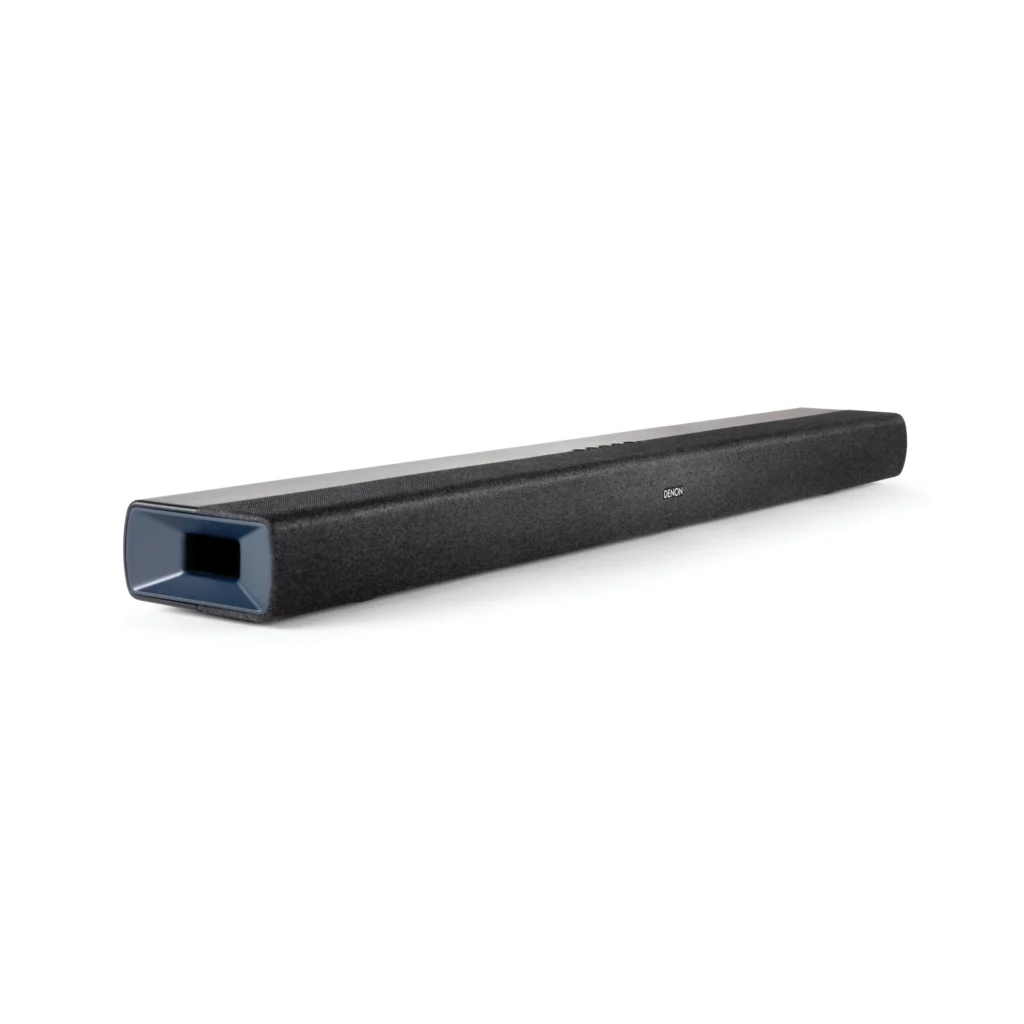
Denon DHT-S218 combines a 2.1 all-in-one speaker layout with useful source connections and Bluetooth LE Audio support. Built-in down-firing bass keeps the initial installation free of a separate cabinet, while a wired subwoofer output allows a documented optional route. Its Atmos approach is virtual and it has no independent Wi-Fi music platform. This research-based review considers the original evidence for clear everyday television sound, the limits of a compact front-only system and the practical value of its HDMI input alongside eARC.
Research-based review. This assessment draws on manufacturer documentation and the original published evaluations linked below. Audio Review has not performed a hands-on test of this model.
Everyday clarity is the strongest sound case
Lyd & Bilde’s original evaluation finds clear dialogue and substantial, well-integrated bass for the size. It qualifies the stereo spread and music resolution, and reports strain when demanding bass material is played at higher levels. The indicator lights also prove less intuitive than a full display. These findings support a practical moderate-level television role rather than an unrestricted cinema or hi-fi claim.
Begin with normal speech and a programme containing music beneath voices. Check the usual household volume, not only a louder demonstration. Then introduce a busy film passage and familiar music. Listen for comfortable balance, how easily words can be followed and whether low notes remain composed. A compact bar can make viewing more satisfying without reproducing the deepest effects or the separation of a larger stereo system. Those limits may be entirely acceptable in a smaller room. The useful question is whether it improves the real daily experience enough at the current price, rather than whether it can briefly sound more dramatic than the television alone.
Built-in bass and an optional wired route
Denon documents two down-firing bass drivers inside the bar and a separate output for an external active subwoofer. The base package does not include another bass enclosure. That gives a simple starting arrangement, with expansion available if it is appropriate to the room and budget.
Assess the bar alone before assuming extra bass is essential. A separate cabinet adds floor space, power and a cable route as well as potential low-frequency capability. If an existing active subwoofer is being considered, follow the official connection and adjustment guidance, and check integration from the normal seats. More output is not automatically better if it distracts from speech or seems disconnected from the front sound. The built-in arrangement can be a sensible compromise where another cabinet is inconvenient. The output is useful flexibility, not a reason to postpone an essential decision about what the system must do. Compare the final intended price with a complete two-piece alternative if expansion is already certain.
Virtual Atmos should be judged in the actual room
The physical layout remains a front-only 2.1 bar with down-firing bass, rather than a set of height and rear speakers. Atmos decoding and virtual processing do not change where its drivers are located. That distinction is important when comparing demonstrations and channel labels.
Keep the bar unobstructed and follow the positioning instructions. Use appropriate material from the main seats and decide whether the wider or more spatial presentation is a worthwhile addition. Do not expect a real speaker behind the sofa or identical overhead localisation to a separate-height installation. For a room where those physical speakers cannot be accommodated, the simpler front-only approach may be the correct practical choice. For a buyer whose main goal is precise immersive effects, a documented complete system deserves comparison before purchase. Avoid assuming that another Denon wireless speaker can become a rear channel, because this model is not a HEOS surround platform. Choose the feasible layout and required effect first, then judge the processing within that arrangement.
A direct HDMI input broadens the installation options
The official product information lists one HDMI source input and an eARC output, with 4K passthrough and VRR / ALLM facilities. That is useful flexibility, but the exact requested video mode still needs confirming rather than inferring unrestricted performance from a feature name. Optical and analogue inputs provide additional source choices.
Map the player, console and television-app routes before finalising the cables. A source may connect directly to the bar when the display cannot forward the desired soundtrack reliably. Another source may be better at the television if that preserves the required picture mode. Test audio and video separately, including synchronisation and return from standby. The European manual lists supported PCM and Dolby formats rather than DTS decoding, so a particular disc library deserves attention. Do not treat ordinary sound from one programme as proof that every source is configured correctly. A clear plan makes the direct input a practical advantage instead of another route whose settings are difficult to remember later.
LE Audio is useful only with an appropriate source
Denon’s European specification lists Bluetooth 5.3 with SBC and LC3, and the product information identifies LE Audio support. These are not promises that every existing phone sends LC3 automatically. Source hardware, software and connection settings remain relevant. There is no independent Wi-Fi or HEOS music platform.
Test the actual phone and intended application before treating a particular wireless route as a reason to buy. Check pairing, volume adjustment, playback recovery and returning to television audio. A Bluetooth version number alone does not establish codec operation or guarantee imperceptible delay for every video application. For occasional music and podcasts, the normal route may already be sufficient. A household expecting direct playback from network services or multiroom grouping should choose a documented platform that supplies those functions. Compare familiar music in an appropriate mode and listen for separation as well as bass weight. Practical convenience is best judged by a routine that every user can repeat, not by a wireless logo whose requirements have not been checked.
Controls and complete value deserve a realistic check
The DHT-S218 provides a remote, three-level Dialog Enhancer and several listening modes, including Pure and Night. These can help adapt ordinary use, but the small indicator system is a reason to test control feedback from the actual sofa position. Its compact one-piece design should simplify the room rather than create frequent uncertainty about active settings.
Check television clearance, rear cable space and mounting suitability against the manufacturer’s diagram. Confirm the exact regional product, warranty and included accessories. Compare current complete prices rather than treating a review’s older price as permanent. A buyer needing only straightforward television and occasional Bluetooth playback may find the source input and built-in bass an efficient combination. Someone immediately adding network music, substantial external bass and more source switching may be better served by another starting system. Those decisions should come before a discount. The Denon is strongest when its documented facilities already meet the requirement and the normal listening level stays within the comfortable role suggested by the original evaluation.
Alternatives to consider
Sonos Beam Gen 2: Compare musical refinement, app control and the network ecosystem, allowing for the different direct-source arrangement and total local price.
Sennheiser AMBEO Soundbar Mini: Another compact virtual-spatial approach to audition where network music and room presentation matter. Check the actual input arrangement and cost of desired extras.
Denon DHT-S218 key specifications
- Arrangement
- 2.1 all-in-one with dual down-firing bass drivers
- Atmos approach
- Virtual; no dedicated physical height speakers
- HDMI
- One source input; one eARC output
- Video
- 4K passthrough; official VRR / ALLM support, exact mode dependent
- Other audio inputs
- Optical; 3.5 mm analogue; Bluetooth
- Bluetooth
- Version 5.3; SBC and LC3
- LE Audio
- Compatible source and configuration required
- External bass
- Wired active-subwoofer output
- Network music / HEOS
- Not provided
- Sound adjustment
- Three-level Dialog Enhancer; Movie / Music / Night / Pure
- Weight
- Approximately 3.6 kg
- Supported digital audio
- PCM and documented Dolby formats; not DTS
- Dimensions (W × H × D)
- 890 × 67 × 120 mm
Verdict
DHT-S218 is a practical compact option with useful direct-source HDMI, built-in bass and source-dependent LE Audio support. Original evidence favours everyday clarity while qualifying loud playback and musical resolution. Confirm the required formats, control routine and real room performance. It makes the most sense as a straightforward front-only television upgrade, with optional bass treated as a separate considered decision.
Documentation and original reviews
Denon official DHT-S218 product features and source connectivity · Denon official European DHT-S218 technical and codec specification · Lyd and Bilde original DHT-S218 evaluation
Editorial record
Sources and updates
Product specifications and factual claims were checked against Official Denon DHT-S218 product page ↗. Scores and buying advice follow our category-specific editorial methodology.
- Published
- November 17, 2026
- Last updated
- November 17, 2026