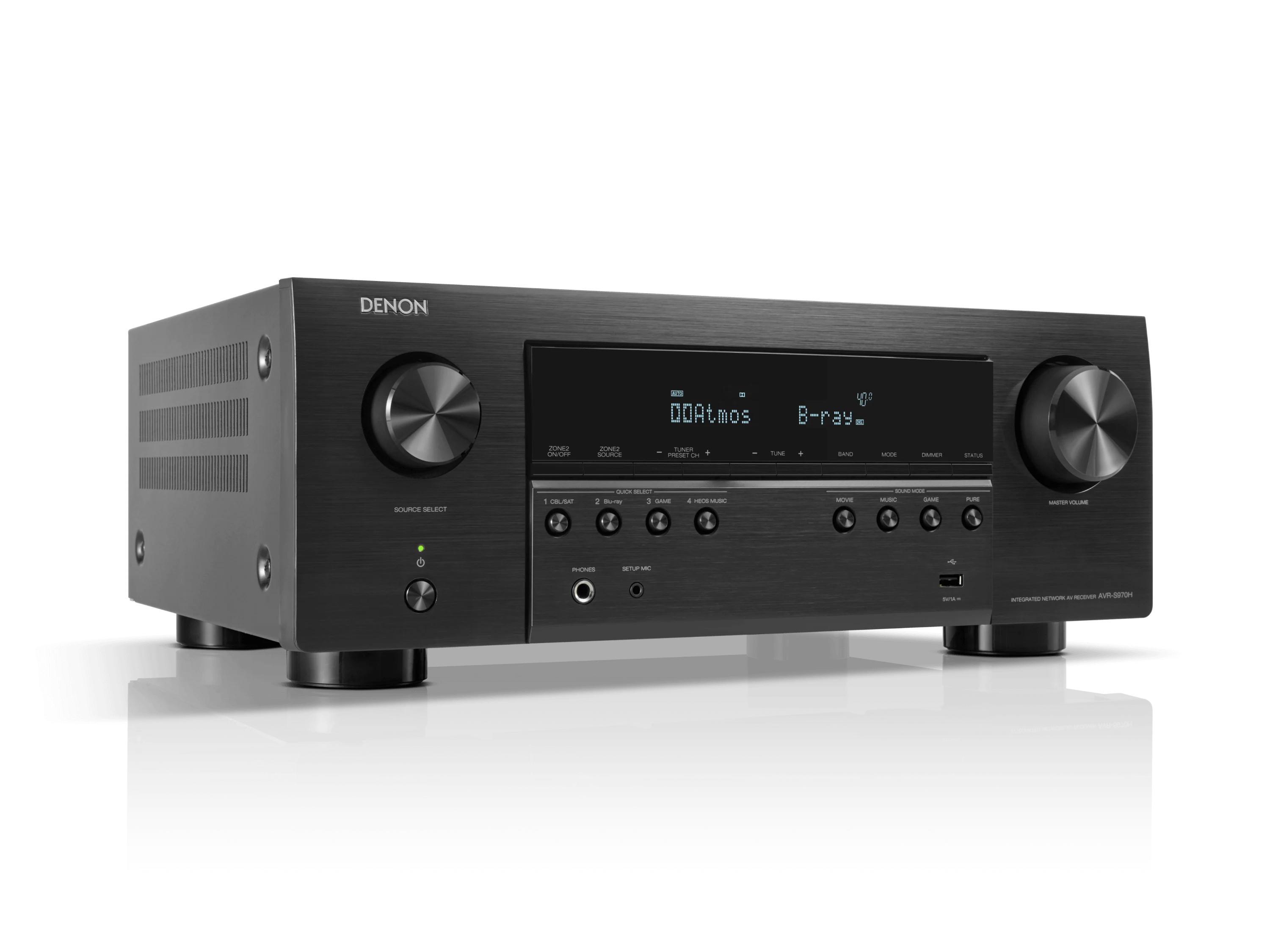
Denon AVR-S970H is an established seven-channel receiver that can still be a sensible purchase when the price and speaker plan match. It offers modern connection routes without becoming a larger expansion platform. The main decision is therefore architectural: will you actually remain within a 7.1 or 5.1.2 layout, or are you already planning more height speakers and external amplification? Answering that before buying is more useful than comparing headline power figures alone.
Research-based review. This assessment draws on manufacturer documentation and the original independent evaluations linked below. Audio Review has not performed a hands-on test of this model.
Seven amplifiers set the system boundary
The receiver has seven built-in amplifier channels. That supports a conventional seven-channel surround arrangement or a five-channel bed with two height channels, depending on assignment. The presence of two subwoofer sockets does not add more full-range amplifiers or turn the receiver into a larger Atmos platform.
Powered second-room use draws from the same amplifier resources. If you assign channels to another room, you cannot also count them as available for the full main-room layout. Write down the speakers you intend to install now and in the realistic future. If that plan already exceeds seven powered channels, buying the S970H and immediately trying to work around it is unlikely to be the best value, regardless of an attractive discount.
Sound and the original listening assessment
Home Media Entertainment’s original test is positive about the receiver’s film presentation in a modest Atmos system and treats it as a capable alternative to the more expensive neighbouring X-series model. That provides useful listening context, while the source’s room, loudspeakers and level remain part of its result.
Our recommendation is for a manageable cinema rather than an assumption that every loudspeaker can be driven to any level. Speaker sensitivity, impedance behaviour, room size and listening distance all matter. Use suitable bass management and leave the receiver adequate ventilation. Clear dialogue and controlled levels during the programmes you actually watch are more meaningful goals than trying to reproduce a shop demonstration’s maximum output in a different room.
Audyssey and the limits of the version supplied
The S970H uses Audyssey MultEQ, with Dynamic EQ and Dynamic Volume available. It should not be described as the XT or XT32 versions found elsewhere in the range. These labels identify different correction capabilities, so comparing receiver families by brand name alone can hide a material feature difference.
Good setup still starts with microphone positioning, sensible speaker placement and an appropriate room plan. Follow the guided process carefully and review the results rather than assuming every automatically selected value must be ideal. Dynamic EQ and Dynamic Volume also perform different jobs: one relates to perceived balance as level changes, while the other manages variations in loudness. Try them with familiar material and keep track of which is active before deciding that a change belongs to the receiver’s basic sound.
HDMI inputs, outputs and real gaming needs
Denon’s European guide lists six HDMI inputs and two monitor outputs, with compatible high-resolution video paths. The higher-bandwidth source inputs must be distinguished from the other sockets. Connect a demanding console or computer to the appropriate port and use the relevant supported settings rather than assuming every input has the same capability.
The two monitor outputs can send the same picture to two displays; they should not be treated as two independent video zones. A TV-and-projector arrangement can be useful, but the connected displays and chosen video mode still determine what the chain can carry. Test the actual resolution, refresh rate, HDR and audio requirements together. A specification containing 8K does not remove the need to check the source, cable and display as a complete path.
HEOS, eARC and everyday operation
HEOS and supported network playback make the receiver useful beyond film sound. Check the services and control routine you actually use, including whether playback comes from an app, a network source or another device. An integrated streaming facility can simplify the system when it matches your habits, but should not be assumed to reproduce every service interface in exactly the same form.
For TV applications, eARC can return supported audio to the receiver. Source and television settings still matter, especially when switching between built-in apps and external equipment. The receiver’s remote and menu approach are conventional rather than a reason to expect a new-generation interface. Try the everyday input and volume routine if several people will use the system, because usability can matter as much as a less frequently used format label.
Value, expansion and buying established hardware
The S970H’s value depends on the current offer against suitable seven-channel rivals. Compare warranty, region, included setup microphone and the condition of any used unit. A low price is less attractive if essential accessories are missing or the receiver’s connection arrangement already conflicts with the intended system.
It is not a full main-channel pre-out platform for adding a large external amplifier system later. If expansion is central, choose a receiver designed for that purpose from the start. Conversely, avoid paying for many extra channels if the room and speaker plan will never use them. The S970H is most convincing as a complete, sensibly sized cinema hub, with enough HDMI and music flexibility to cover daily use without making promises beyond its seven-channel design.
Alternatives to consider
Denon AVR-X1800H: The X1800H is worth comparing for its room-correction version, current price and HDMI arrangement. Neither is a route to an eleven-channel system, so choose between the actual features instead of assuming the X-series name removes every layout limit.
Yamaha RX-V6A: The RX-V6A provides a different control, calibration and music ecosystem within the seven-channel class. Check the exact unit’s HDMI capabilities and the room setup you need, particularly when buying older stock or used equipment.
Denon AVR-S970H key specifications
- Amplified channels
- Seven
- Speaker layouts
- 7.1 or 5.1.2, subject to assignment
- Subwoofer outputs
- Two
- HDMI inputs
- Six, including three higher-bandwidth 8K-labelled inputs
- HDMI monitor outputs
- Two; same picture can be sent to both
- Video facilities
- Compatible 8K/60 and 4K/120 paths
- TV audio
- eARC
- Immersive audio
- Dolby Atmos and DTS:X
- Room setup
- Audyssey MultEQ, Dynamic EQ and Dynamic Volume
- Network music
- HEOS, supported services and AirPlay 2
- Second room
- Powered Zone 2 shares the seven-channel amplifier resources
- Main-channel pre-outs
- Not a full external-amplifier expansion platform
- Rated power
- 90 W/ch, 8 ohms, 20 Hz–20 kHz, 0.08% THD, two channels driven
- Dimensions (W × H × D)
- 17.1 × 6.6 × 13.4 in with antennas horizontal; height 9.3 in with antennas upright
- Weight
- 21.0 lb (approximately 9.5 kg)
Verdict
AVR-S970H remains a reasonable value-focused receiver for a 5.1.2 or 7.1 installation, particularly when its input selection, dual monitor outputs and HEOS facilities suit the system. The original listening assessment supports treating it as capable established hardware rather than dismissing it because newer models exist.
The limits should guide the purchase: seven shared amplifier channels, basic MultEQ and no broad main-channel pre-out expansion. Compare the X1800H and RX-V6A using the actual connection and calibration requirements, then judge the current local offer. Choose the S970H when the speaker plan is clear and stays within its architecture, not as a temporary shortcut towards a much larger system.
Primary documentation and independent reviews
Denon official AVR-S970H product information · Denon official European AVR-S970H feature and connection guide · Home Media Entertainment original AVR-S970H review
Editorial record
Sources and updates
Product specifications and factual claims were checked against Official Denon AVR-S970H product page ↗. Scores and buying advice follow our category-specific editorial methodology.
- Published
- November 17, 2026
- Last updated
- November 17, 2026