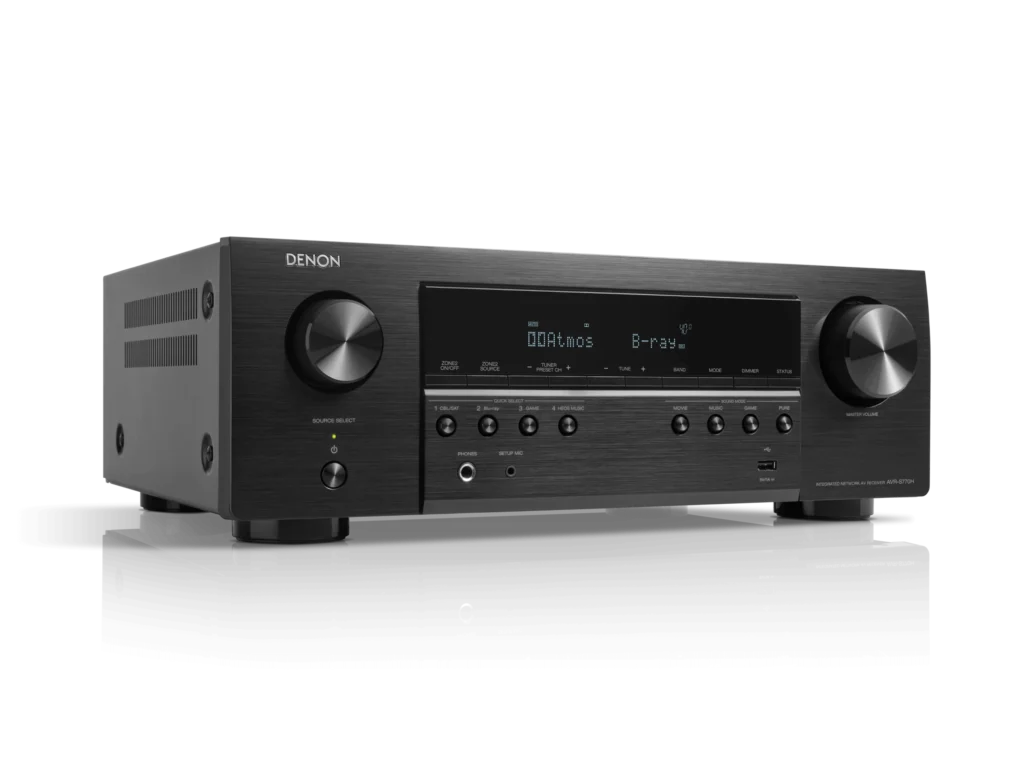
Denon AVR-S770H is a seven-channel network receiver that can bring Dolby Atmos and DTS:X into a relatively modest separate-speaker system. Its natural immersive layout uses five conventional speaker positions and two height channels, with subwoofer connections alongside. The appeal is a useful combination of HDMI connectivity, guided setup and network music. The boundaries are equally important: it is not an eleven-channel platform, and powering another room uses channels that cannot simultaneously serve every main-room role.
Research-based review. This assessment draws on manufacturer documentation and the original independent evaluations linked below. Audio Review has not performed a hands-on test of this model.
Choose between surround-back, height and second-zone roles
The official amp-assignment table makes the trade-off clear. Seven amplifiers can serve a seven-channel bed-layer arrangement, a five-channel arrangement with a height pair, or a main five-channel system plus powered stereo in another room. They are alternative allocations of the same resources.
Draw the intended speaker plan before running cables. If both rear surrounds and four height positions are expected eventually, start with a receiver designed for that larger layout. An affordable seven-channel model can be an excellent endpoint for a suitable room, but it is less economical if the owner already knows the next step exceeds its processing or amplification. Count what must work at the same time rather than adding every advertised configuration together.
Original listening evidence and realistic expectations
Home Media Entertainment’s original evaluation is positive about film dialogue, surround movement and ordinary music playback. It also reports successful high-frame-rate console checks in its test system. Those findings support the S770H as a capable shortlist option, without guaranteeing the same result with every television, speaker or room.
Listen to the complete setup where possible, including quieter dialogue as well as a dramatic scene. A receiver does not supply the bass output of the subwoofer or determine the placement of a height speaker. A convincing demonstration should make those system roles clear. Avoid comparing receivers with different speaker levels or different processing enabled and attributing the whole change to the amplifier itself.
HDMI: identify the three higher-bandwidth inputs
Six inputs make room for several sources, while three support the higher-bandwidth video modes listed in the table. Use the appropriate sockets for a console or computer requiring those modes. The single output is a limitation if a television and projector both need a direct receiver connection.
Test the actual source at the desired frame rate, HDR and variable-refresh settings. The receiver, cable and screen all participate in the chain. A stable menu image does not prove the system can maintain the intended game or film signal. Keep a note of which inputs and settings work so that a later source change does not turn troubleshooting into a series of unrelated adjustments across several devices.
A practical first height-speaker system
Two height channels can add a useful vertical dimension when placed appropriately, but they do not provide the same directional possibilities as four separate height positions. Choose the configuration from the room and seating rather than expecting virtualisation or extra labels to create missing physical positions.
If using upward-firing speakers, consider the ceiling and actual listening area before purchase. If mounting speakers overhead or high on a wall, follow a suitable installation plan and the receiver’s supported assignment. The system should remain intelligible for everyday programmes, not only immersive demos. A well-balanced centre and sensible subwoofer integration can matter more to daily enjoyment than using a height mode before the basic speaker arrangement is right.
Audyssey setup and checking the result
The receiver uses the basic MultEQ tier. Follow the microphone procedure carefully and check the speaker configuration when it finishes. Calibration is useful, but it should follow good placement and correct wiring rather than being expected to compensate for every physical compromise.
Check that each channel plays from the intended location, dialogue is centred and the subwoofer works at a sensible level. Keep the original result available before making changes. If a correction setting sounds less natural, compare with familiar material and investigate methodically. Randomly increasing several levels at once can create a more exciting first impression while making it harder to identify the actual cause of an imbalance.
Network music and television convenience
HEOS, AirPlay 2 and Bluetooth provide several ways to play music. Verify current service support and choose a normal route that is easy for the household to repeat. An MM phono input can also serve an appropriate turntable setup; a deck with an active built-in stage instead needs a suitable line-level path.
For television use, ARC/eARC and control settings can simplify everyday operation when the connected devices behave as intended. Check the actual audio format received from a television app or directly connected source rather than relying only on the programme badge. A clear input name and a reliable startup sequence can be more valuable in daily use than a feature that is available but never configured comfortably.
Value and the system beyond the receiver
Compare X1800H pricing before settling on the S770H, because a small difference may make another calibration or connection package preferable. Also include the speakers, subwoofer, stands, installation and cables in the total budget. A receiver chosen too cheaply for a known expansion plan can require replacement, while an unnecessarily large model can take money from the speakers that are needed now.
For used or imported examples, check the regional power version, calibration microphone, remote and HDMI operation. Test several inputs rather than merely confirming that it switches on. The best S770H purchase is a complete seven-channel plan at a competitive current price, with no expectation of features or simultaneous speaker roles that belong to a larger platform.
Alternatives to consider
Denon AVR-X1800H: X1800H is a particularly important comparison if current prices are close. Check the calibration tier, required inputs and support rather than assuming the S-series label always produces the best total value.
Yamaha RX-V6A: RX-V6A offers another seven-channel approach. Confirm the exact unit history and high-frame-rate HDMI requirements, then compare setup and sound with the same speaker layout rather than choosing from amplifier wattage headlines.
Denon AVR-S770H key specifications
- Role
- Network AV receiver
- Amplified channels
- Seven
- Immersive layout
- Up to 5.2.2
- Alternative layout
- Seven bed-layer channels without height pair
- Formats
- Dolby Atmos and DTS:X
- HDMI
- Six inputs, one output
- High-bandwidth HDMI
- Three inputs, up to 4K/120 Hz or 8K/60 Hz
- Room correction
- Audyssey MultEQ
- TV return
- ARC/eARC
- Music
- HEOS, AirPlay 2, Wi-Fi and Bluetooth
- Powered Zone 2
- Uses assignable channels; main room limited accordingly
- Phono
- MM input
- Rated power
- 75 W/ch, 8 ohms, 20 Hz–20 kHz, 0.08% THD, two channels driven
- Dimensions (W × H × D)
- 434 × 151 × 339 mm with antennas horizontal; height 215 mm with antennas upright
- Weight
- 8.6 kg
Verdict
S770H is a coherent affordable route to a practical 5.2.2 system, supported by a positive original evaluation and a useful HDMI set. Its channel-assignment limits are straightforward when planned in advance.
Compare X1800H offers, verify the actual video chain and make sure seven amplifier channels match the long-term room plan. Choose a larger platform for more height channels or simultaneous main-room and zone ambitions beyond its allocation. The S770H earns its value by covering a clear system need without unnecessary complexity.
Primary documentation and independent reviews
Denon official AVR-S770H product information · Denon AVR-S770H European manual and amp assignment · Home Media Entertainment original AVR-S770H evaluation
Editorial record
Sources and updates
Product specifications and factual claims were checked against Official Denon AVR-S770H product page ↗. Scores and buying advice follow our category-specific editorial methodology.
- Published
- November 17, 2026
- Last updated
- November 17, 2026